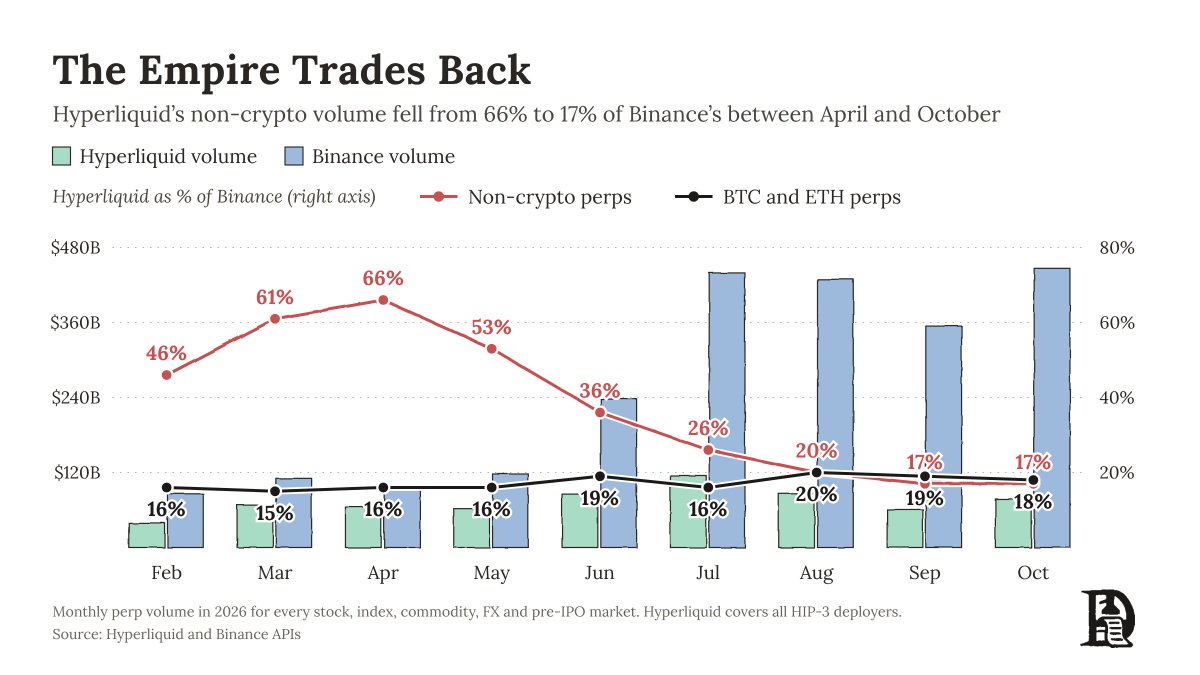
Since April, Binance has added roughly $350B in monthly non-crypto perp volume. Hyperliquid has added about $15B.
Almost all the growth across these two venues has gone to Binance.
I compared their volumes across stocks, indices, commodities, FX and pre-IPO markets. Hyperliquid’s numbers include all HIP-3 deployers.
In April, Hyperliquid did 66% of Binance’s non-crypto volume. By October, it was 17%.
For BTC and ETH, the equivalent ratio went from 16% to 18%.
That convergence is interesting. Hyperliquid used to be much more competitive with Binance outside crypto than in BTC and ETH. Today, the ratios are almost identical.
I think distribution explains part of this.
I’ve written about Hyperliquid giving builders access to traders and liquidity they would otherwise have to attract themselves. But the same argument works for Binance.
If you already trade and keep money on Binance, each new market gives you another thing to do without moving your capital.
The opportunity to bring traditional assets to crypto traders is clearly enormous. Binance is showing how much of it an existing exchange can capture.
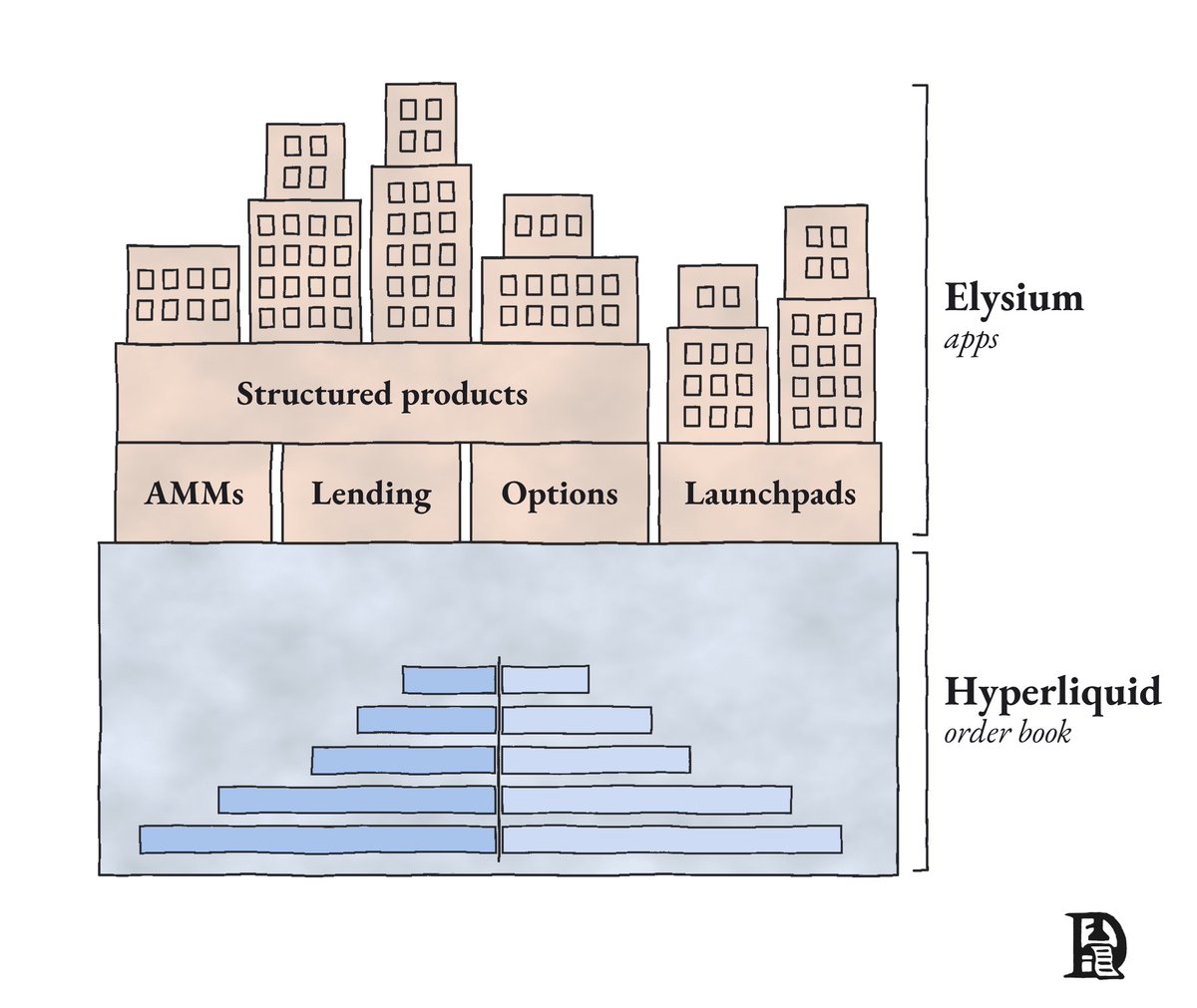
Hyperliquid could compete by letting traders do more with the money they deposit. Apps that let traders borrow, trade options and hedge using the same collateral could give them more reasons to bring money over and keep it there. Developers will soon be able to build such experiences on @Enter_Elysium.
More assets, more instruments, more ways to tweak your exposure without moving your money.
Hyperliquid is the only chain whose L2 can use its order book. That L2 is now live.
Elysium has a luxury no other L2 has. The deepest on-chain order book is composable, and its apps can build on it directly.
Hyperliquid made ~$680M over the past 12 months, nearly all of it from trading fees. But spot volume is down more than 80% from the peak, and DeFi on Hyperliquid is down ~65%. While the order book has grown more diverse, every other product around it has lagged.
Elysium is where the rest can be built. Would love to see innovation in how Hyperliquid's product (liquidity) gets integrated into DeFi.
~156,000 HYPE (~$12M) is already bridged to @Enter_Elysium before the mainnet officially goes live.
I'm pretty sure we'll see the usual launchpad games and memes. But tbh it's tiring at this point. Remember the lower-high roller coaster meme? It doesn't take a genius to know that's how it'll be.
But I'm still looking forward to this one. For the first time, DeFi primitives can be composable with Hyperliquid's massive perp book. Elysium gives developers general-purpose blockspace right next to Hyperliquid's liquidity and lets them build whatever they want with it.
Options are the missing piece of the stack. Say you hold 5,000 HYPE on Hyperliquid. But you can't do covered calls there. You have to move that collateral to a different venue. So you can either trade options or perps with that collateral.
If you get it right on Elysium, you'll be able to hold HYPE and USDC in one account, sell calls and puts against them for real yield, and hedge with a long or short on any Hyperliquid market. All without your collateral leaving Hyperliquid.
On-chain options have stayed small because they never had three things necessary to make them work: shared collateral, a perp venue with deep liquidity, and a fast chain in one place. Hyperliquid already has the first two. Elysium brings the third without compromising the first two.
From private chains to public Ethereum.
Matthew Dawson (@ismiMatthew), co-founder of @ethereuminsti, on what institutions need from a chain, compliant privacy, and why the biggest institutions are setting the pace.
With @notkinsa. Supported by @krakenfx and @trycodex.
From PayPal to Ethena Pay.
Lito Coen (@litocoen), GTM lead at @EthenaPay, on building a crypto neobank: earn by default, spend anywhere Visa works, send to anyone, and what KYC in 50 countries really takes.
With @0xjoshglobal. Supported by @krakenfx and @trycodex.
We debated this internally for quite a while but
1. Think the informal economy that is underserved today will move on-chain and be comfortable sharing that premium, accounting for currency and regualatory risks in regional markets
2. Efficiency of speed of settlement and stablecoin access may keep traders on these avenues.
Having that said, both these arguments are optimistic, and reality may choose to take the path you suggested.
How do you find the signal across 100M+ tokens?
@razoreth joins @openinterest_hq to discuss building Defined (@definedfi) and Codex (@trycodex), the data behind apps like TradingView and Coinbase.
They cover the pivot that saved the business, how they stayed ahead of scammers, and how five co-founders stayed together through nine days of runway.
Key moments:
00:00 Intro to Codex and Defined
01:35 The pivot that saved the business
03:50 What Defined does differently
06:13 Building an all-in-one onchain terminal
07:48 When your customers also compete
08:54 Finding the signal in token discovery
10:25 How trending fights scammers
12:56 Poker, early Bitcoin and the origin story
16:46 Five co-founders and nine days of runway
18:11 Building without managers
Open Interest is supported by Kraken (@krakenfx) and Codex (@trycodex)
@dancreee Won't comment on the token at these prices, but we've been left impressed every time we've spoken to the team + the product's RFQ side is a work of art :)
Now can that be replicated on Hyperliquid by a market-maker? Possibly. We just have not seen it yet.
@SolanaLegend The piece says largely the same
The implication of the title is that for options to exist, the underlying perp market should see scale.
Fwiw what HIP 3 proves is that tokenized assets (like equities) may be where that evolution happens.