I’m excited to announce that our fund, Frictionless Fund I has raised $20M to invest in high performance blockchains and category defining applications.
We are honored to be backed by some of the industry’s best investors including @pmarca, @cdixon, @FTI_US, leading founders and funds of funds.
We have already made several high conviction bets starting with @Backpack
and are excited to share more about our views and approach to investing in the coming months.
https://t.co/gDXqI57DO5
@ztackingzats Keep stacking sats. People are taking the distributed ledger technology to rewrite Finance. Different vision
Nothing against Bitcoin, grateful for its innovations and Ethereum's as well, but those were the dial up phase, we are onto broadband and fiber now.
Jensen being reinstated as CEO getting ready to go scorched earth on @AnthropicAI after their cofounder leaked the details of his affair to the media
If you come for the king, best not miss
This is going to get a bit nerdy, lets do it because I want to explain why you actually want people arbing onchain equities
In TradFi, a market maker can sell you a stock on one venue and buy it back on another to hedge. If the stock is cheap on one venue and expensive on the other, firms trade that gap until the prices come back in line. You buy the stock, then the firm on the other side can trade it hundreds of times and finish the day roughly flat. This is literally the job of the market maker is to provide liquidity
In this case you have three tokens (Ondo, Securitize, Backpack) backed by the same stock and still trade at different spreads. If I’m market making Anthropic, I care who I can sell the token to and what I get back when I redeem it. Securitize, Ondo and Backpack handle that differently
With Securitize, you complete KYC to buy a brokerage entitlement backed 1:1 by Anthropic shares. If you want dollars back, you can sell through the broker for USDC. If you want to send it to me, my wallet has to be KYC'd too. Even if we agree on a price, you can only deliver the token to me after I’m onboarded
Ondo’s international stock tokens move more like USDC or USDT. Wallets can receive the stock backed token without opening an Ondo account. KYC comes in when you mint or redeem directly. Ordinary redemptions pay out in stablecoins. A market maker can still hedge the stock elsewhere, but only separately approved institutions can redeem the token in kind and receive the underlying shares through Alpaca
We’re investors in Backpack at Frictionless, and the part I think is underappreciated is that Backpack also runs the brokerage. Once the token is on Solana, wallets can trade it without a Backpack account. An eligible individual with a verified brokerage account can move in both directions. Buy the stock and withdraw it as tokens, or deposit the tokens and get the stock back
In-kind redemption is the alpha here. Say I’m a market maker. I buy 100 tokens from you onchain and sell 100 shares from my brokerage account to hedge. With Backpack, I can redeem those tokens and put the 100 shares right back in my account. If redemption pays me in stablecoins, I still have to go buy 100 shares to get back to the same position. That extra trade can mean crossing the spread again, and the stock can move between fills. I have to leave room for that in my quote, which means a lower bid for you
Now flip the trade. Say you want to buy Anthropic onchain. Anthropic is being offered at $100 in the brokerage while the stock market is open, and the cheapest offer on Solana is $101. One market maker can sell to me at $100.50, buy the stock at $100 and withdraw more tokens to replace what they sold. Another can offer me $100.25 and win my order. I get a tighter spread, and they can quote me more size because they know where the next shares are coming from
You can see this in the Blockworks data. Across seven stocks, Backpack had a cheaper round trip than xStocks in 98% of matched Jupiter quotes for $500 to $10k orders. In other tests of $1 to $100 SpaceX trades, the average all-in cost was 0.11% on Backpack versus 4.29% on Robinhood chain. Roughly 40x as much on Robinhood chain once fees were included
The market structure and redemption matter quite a bit and its how better execution turns into more volume. If I show up with $10k of USDC on Titan, Jupiter or DFlow my order routes through whoever gets me the most stock
Volumes can be a noisy metric.
I suggest top of book spreads, unique takers and holders.
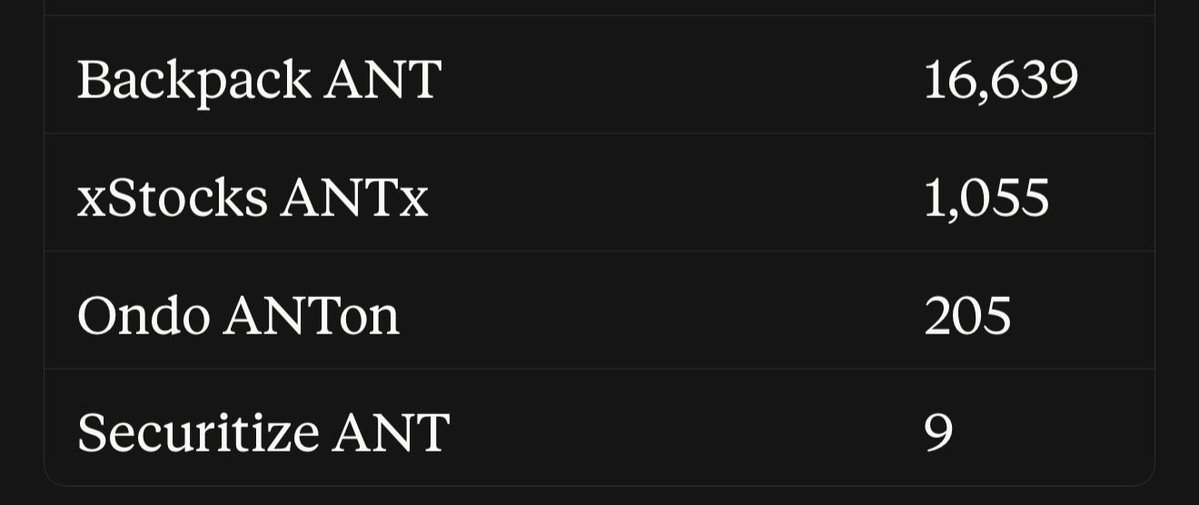
On adoption: @Ondo has 305 holders of $ANT on Solana against @Backpack’s 16k
@Securitize has 9 holders
Both mirror TradFi rather than enabling crypto native price discovery in DeFi
NEW: @Securitize HEAD OF ECOSYSTEM @grahamfergs SAYS "PRETENDING LIKE @Backpack AND OTHER SYNTHETIC TOKENIZED STOCK PLATFORMS ARE A SUCCESS IS A GREAT DISSERVICE" TO @solana@Ondo HEAD OF DEFI @fullportmatt ADDS BACKPACK TOKENIZED STOCK VOLUMES "ARE A BAD METRIC FOR ADOPTION"
Fair on weekends, I was on the old 24/5 schedule.
I pulled live Jupiter quotes for the ANT tokens just now (Sunday, right before 8pm ET), buy and sell at the same size. Round trip:
$1k-$10k: Backpack 16-28 bps, Ondo 51 $100k: Backpack 26-62, Ondo 51 $250k: Backpack ~120, Ondo 51
So your RFQ approach differs, but the claim I replied to was that prop AMMs make it worse for retail, and at retail size Backpack is about half the cost on a Sunday. If MMs are passing on an inventory cost, it's already inside that number.
Also whoever is quoting ANTon flat at 51 bps with Nasdaq closed is a market maker sitting on weekend risk. Same model as a prop AMM, just behind an RFQ
On adoption: Backpack's ANT has 16.6k holders on Solana and did $18.9M in the last 24h. ANTon has 205 holders
The loops are real, good catch. But you're jumping to conclusions.
Most of this thread is about ANTx pools, not Backpack's ANT. Those loops pump xStocks volume just as much, and nothing ties the wallets to Backpack.
Your 53% is one $9M day. Launch days did $40M and $65M, with thousands of unique traders on the USDC/SOL pools.
Farmers aren't wash trading.
There are really two camps inside the crypto industry today:
1. Camp one continues to trade digital currencies (SOV, store-of-value coins) that have no cash flows and trade off flows and narratives like commodities. In fact, they are digital commodities.
2. The second camp is focused on cash-flowing businesses who have tokenized equity onchain, have revenues and cash flows which can be discounted at an appropriate discount rate and valued using intrinsic valuation (as opposed to the power of the imagination or memetics).
People will continue to speculate on digital commodities but the far more interesting opportunity on a 3-5 year timeframe (not that most people wait that long anyways, they want a million dollars yesterday) is the opportunity to own equity in some of the fastest-growing Wall Street businesses, which are currently being unbundled onchain. Hyperliquid did this with unregulated offshore derivatives (in fact, just perpetual futures), and a team of 11 people made billions in revenue and captured it with HYPE which is tokenized equity in the business.
This process is now being repeated with some of the largest businesses on Wall Street, unbeknownst to most because they don't have a background in capital markets, finance, or accounting, and would rather continue to trade their beloved internet coins. The notion that crypto is just store of value coins and speculation is a grossly reductive and deeply myopic point of view, often vocalized by people without the background or preparation to understand the TAM of what is coming.
It is not an exaggeration to say the unbundling of Wall Street and the rewriting of finance is at least 1,000x larger opportunity than the sum total of all of the speculation that is currently happening and the trading of all of these SoV coins combined.
A lot to unpack here.
1. The structure you are referring to with AMMs is the one xStocks uses: public pools carry most of the trading. propAMMs are about 71% of Backpack's volume as of late July, quoted from market-maker inventory per Blockworks
2. PropAMMs don't have outside depositors and they quote tighter than passive LP AMMs. Takers have materially better execution for assets supported by propAMMs not worse
3. Backpack Securities stocks and the propAMM liquidity that surrounds them creates an environment where makers are competing which creates better fills as opposed to pricing through your own mint channel without maker competition which is a non-composable and visible black box.
4. There's no arb tax to pass on to retail, only savings. Blockworks showed names like SPCX was cheaper on Backpack than on the alternatives like xStocks at matched sizes
5. Ondo has gone for a non-passive LP AMM but instead of doing liquidity the crypto native way it prices the shares through mint and redeem which is only open during market hours. Fair that volume isn't necessarily holders, but it isn't LPs getting farmed either and it's not really a fair comparison when markets are closed to just not offer the service, we came to crypto to have better hours and better execution globally not to mirror tradfi markets during market hours
6. Attached are screenshots showing Backpack ANT 3 bps wide on $10k clips
7. I suggest evaluating on the basis of volume per unit of liquidity, top of book spreads during market hours and afterhours, and what % of liquidity is professional (active, inventory based MMs) versus passive LPs
@fullportmatt@sunrise@AlliumLabs The main point is that when you can bring prices in line and allow retail to trade these things with tight spreads, a robust spot market can form.
A more important metric would be to study the market microstructure around assets. Which version of ANT do propAMMs choose the most?