A short history of the great British improvement.
They came for beef dripping. We got margarine, then seed oils, then a cardiac ward in every hospital.
They came for butter. They told your grandmother it would kill her husband. The replacement was a tub of palm oil emulsified with rapeseed and a yellow dye, and her husband died of a heart attack in 1989 anyway.
They came for full-fat milk. We got skimmed milk, a vitamin D deficiency epidemic in children, and a cereal aisle fortified to plug the gap.
They came for mutton, the meat that fed every shepherd, miner, and mill worker for six hundred years. We got a chicken breast injected with water and a turkey twizzler.
They came for the kipper. We got a Findus boil-in-the-bag, dyed orange, and a fish oil capsule sold at the chemist to make up for the omega-3 nobody is eating.
They came for wool. We got polyester fleece, and microplastics in human placentas. Every one tested. Sixty-two out of sixty-two.
They came for leather. We got synthetic shoes that delaminate in eighteen months, and a high street with no cobbler.
They came for the cotton nappy. We got the disposable, and a landfill that will outlast the child wearing it.
They came for the cast iron pan handed down three generations. We got Teflon, and a forever chemical now found in 98% of British rivers.
They came for the wooden bowl your grandmother kneaded dough in. We got Tupperware, then BPA, then "BPA-free" plastic containing compounds we have not yet bothered to measure.
Now they are coming for the cow herself. The replacement is a textured pea isolate, extruded in a factory in the American Midwest, packaged in plastic, and marketed as the ethical option by a company called Cargill, who happen to be the third-largest meat processor in the United States.
Every traditional material we have been told to give up was working perfectly, for free, for centuries. Every industrial replacement has been worse for the body, worse for the land, and considerably better for the shareholders of the company that sold it.
The pattern is not subtle, and the people running it are not embarrassed.
Your great-grandmother is no longer here to call it.
You are.
Vistes de negro porque crees que es un color común y corriente, pero te equivocas. Durante siglos, el negro perfecto fue un secreto de Estado del Imperio Español que Inglaterra intentó robar enviando hordas de piratas al Caribe. Era el palo de Campeche. Tira del hilo 🧵👇🏽👇🏽👇🏽
in 1912, a russian animator used real dead insects as live puppets in a stop-motion film. it’s a story about a married beetle who cheats on his wife with a dragonfly, only to discover his wife also cheating on him with another beetle. it’s still funny over 100 years later
Unpopular take - AI will make us more medieval, and very quickly.
AI is the new Industrial Revolution. If anything, it’s under-hyped (trust me), but instead of automating muscles, it’s automating minds. When AI can write, analyze, or even mimic judgment, truth itself feels like it’s dissolving. The question becomes: who, or what, can you trust when everything can be faked?
This could push us toward a “neo-medieval” future. Not primitive, but rooted. When trust in mass systems crumbles, deep community and lived relationships become the only anchors of reality. Like in the Middle Ages, it’s not broad systems but trusted, smaller circles (family, parish, local community) that filter truth.
In a world full of AI-fabricated noise, the things that will matter are the bonds that can’t be faked. We’ll rediscover that real formation, not just information, happens in embodied community. The future certainly won’t be less advanced, but I actually believe it will be more human.
Learn 10 AI concepts in 10 minutes:
We are going to cover ten concepts that form the foundation of modern AI. We will move quickly, but we will move deliberately.The goal today is to move past the noise and look at the actual architecture of how these systems function.
1. Vectors
The main idea here is that computers cannot understand words or images. They only understand numbers. At a high level, a Vector is just a long list of numbers that represents a piece of data. If we want to represent a word like "apple," we give it a list of coordinates in a multidimensional space. This allows the machine to calculate how "close" one word is to another.
2. Embeddings:
Embedding is a vector with intent. The main idea here is Relationship. In a standard database, the words "Coffee" and "Tea" are just distinct strings of text. They have no relationship. But in an embedding, the model assigns them very similar numerical values. This solves the problem of isolation. By looking at the numbers, the machine can "see" that these two items belong together in the category of drinks. This is the building block that allows AI to understand intent rather than just matching keywords.
3. Dimensions
When we talk about embeddings, we often hear about Dimensions. Think of a dimension as a single trait of a word. One dimension might represent "status" another might represent "gender," and another "food." While humans think in three dimensions, AI models often work in thousands. This allows them to capture incredibly subtle nuances in language that we might not even have names for.
4. Weights
So we have these vectors in space. But how does the model make a decision? It uses Weights. At a high level, a weight is a value that determines how much importance to give to a specific piece of information. If a model is trying to predict the next word in a sentence about a "bank," and the previous word was "river," the weight for the geographical context will be much higher than the weight for the financial context.
5. Neural Networks
This leads us to the structure itself: the Neural Network. This is simply a collection of layers where these weights are stored. Each layer takes the input, multiplies it by weights, and passes it to the next. It is helpful to think of this not as a "brain," but as a massive, multi-layered filter that gradually refines raw data into a specific prediction.
6. Attention
Let’s pause and understand this next part, because it is the most important breakthrough in recent years. Attention is a mechanism that allows a model to focus on specific parts of an input while ignoring others. When you read the sentence "The animal didn't cross the street because it was too tired," you know "it" refers to the animal. Attention is the mathematical process that allows the model to "pay attention" to the word "animal" when processing the word "it."
7. Transformers
Now that we understand attention, we can talk about the Transformer. This is the specific architecture that uses attention at scale. Before transformers, models processed text one word at a time, from left to right. Transformers process the entire sequence at once. This is why they are so much faster and more capable of understanding long-distance relationships in data.
8. Tokens
Before a transformer can do its work, it needs to break text down into Tokens. A token is the basic unit of text. Sometimes it is a whole word; sometimes it is just a few letters. The main idea here is efficiency. By breaking language into these standard chunks, the model can handle a vast vocabulary without needing a unique vector for every single variation of a word.
9. Hallucination
This brings us to a reality of these systems. A Hallucination occurs when a model predicts a sequence of tokens that is grammatically correct but factually wrong. It happens because these models are probability engines. They are simply choosing the next most likely token based on their weights, even if that path leads away from the truth.
10. Inference
Finally, we have Inference. This is simply the act of using a trained model to get an answer. When you type a prompt and the model generates a response, it is "inferring" the output based on everything it learned during training. It is the moment the theoretical model meets the real-world task.
In Ancient Greece, the intellectual class had a practice called hypomnēmata (ὑπομνήματα), which was a notetaking system where they kept quotes from books they had read. It was a tool for meditation. Every day, ideally, they would open the hypomnēmata and look for a passage relevant to something they were struggling with, and then they would meditate on that—unpacking it, making the idea top of mind, ensuring it was alive in them. If they needed courage, they’d meditate on a story that made it real for them what it meant to act with courage, and so on.
The idea was that over time, the important insights they gathered by reading would be transformed into character, a habit, something deeply ingrained into their way of thinking and acting. It is hard to keep these complex and anti-memetic ideas alive in us, but certain pieces of writing can make us wake up, and if we return to them and meditate on them, they can become part of us.
When the world gets impossible, I think of this.
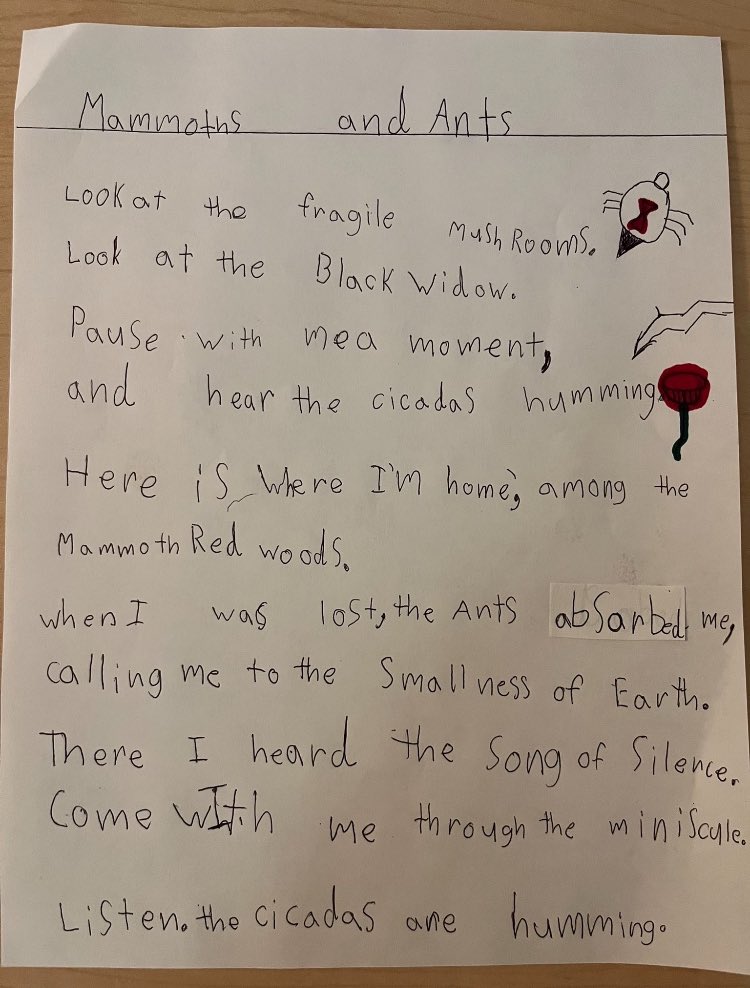
A teacher wrote to me, "I gave one of my 2nd-grade students your nature poetry prompt. He's reluctant to write because of challenges...I told him just to write and we’d sort out the spelling later. This is what he wrote."
This is fascinating... the HEIGHT of the ceiling in the room you're working in has a DIRECT impact on how creative you are
It's called the Cathedral Effect
How it works: Your brain borrows metaphors from the physical world (space is one of the strongest)
When a room feels tall and open, your mind unconsciously associates that with freedom and possibility - you zoom OUT
When a room feels tight or enclosed, your mind goes into precision mode… attention narrows. You notice typos, spot mistakes, and hone in on details - you zoom IN
Researchers found that people in high-ceiling rooms perform better on creativity. People in low-ceiling rooms perform better on detail orientation and error detection
Churches and museums have soaring ceilings - meant to inspire awe. Libraries and war rooms are tighter - meant for concentration
Startup brainstorms love lofts, and accounting teams love small rooms with doors
Even coffee shops do this. The ones designed for deep work tend to be lower and quieter. The ones designed for conversation tend to feel more open
So if you’re doing creative stuff - writing, designing, brainstorming - do it in a LARGE room with high ceilings. Then move to a smaller room to edit and proofread.