You're right, and here lies a great tension between ethics, code to conduct, and an important figure behind the acceleration of modern technology.
Consider the e/acc / e/alt crowds and their reasoning:
"we must go faster for global rebalancing of power with AI/robotics"
"imagine how many more people die of cancer in 2045 because timelines slowed down"
if the tech founder is powerful and immutable, are they also unpunishable, and to what extent?
when you ask an LLM to invoke a response outside of distribution, do its neurons access deviant weight regions, or does it *imagine* doing so, and respond accordingly?
Wonderful dialogue. I guess the question is that of who ultimately controls root access? Where do the boundaries between private and public blur, or get defined; both online and offline?
I see the tension, there's a path to decentralized coordination and emergence, and at the same time, a path to Orwellian groupthink and privacy invading coordination mechanisms (China). Opting in vs out i.e. ongoing informed consent processes are probably very important key to this puzzle. For which, a transparent state machine (system) might be worth emphasizing, over making transparent the lives of every individual and their economic actions.
ZCash has transparent and shielded addresses for this very reason. It's state (blockchain rules, primitives, code) is still open source, but allows permissioning within permissionless systems
Building from Chiang Mai, together.
🎥 Vitalik Buterin speaking at the launch of the Nimman Innovation Sandbox—a new space for Thai and international builders to develop and test ideas alongside local institutions.
At 4Seas, we’re excited to see our community connect with Chiang Mai’s wider innovation ecosystem across three areas: AI & digital technology, healthy longevity, and smart cities.
Launched by Thailand’s Digital Economy Promotion Agency (depa) and Zu Chiangmai, the initiative brought together representatives from the National Innovation Agency (NIA), NDEA, Block Mountain, and Chiang Mai University’s College of Arts, Media and Technology (CAMT).
The sandbox connects builders with existing support channels through depa and NIA, while depa also coordinates investment and Smart Visa pathways with Thailand’s Board of Investment (BOI), subject to the relevant eligibility requirements.
For us, this is an invitation to build lasting connections between international talent and local knowledge—and turn shared ideas into projects that matter here.
#ChiangMai #ZuChiangmai #4Seas #HealthyLongevity
Under pressure from Israeli prime minister Benjamin Netanyahu, the Trump administration may be within days of launching a nuclear strike on Iran. The target would be Pickax Mountain in central Iran, where Israeli intelligence claims the Iranian government has restarted its nuclear enrichment program. No conventional weapon in the American arsenal can penetrate 300 feet of solid granite to destroy the tunnels where enrichment is supposedly taking place. The only military option is a nuclear strike. Netanyahu has been pushing hard for one. “Bibi calls Trump about it every day,” says an informed observer.
Netanyahu is cornered and desperate. After last week’s election results, he can’t form a government unless Trump intervenes directly in Israeli politics and brokers a deal with other parties that gives Netanyahu 61 seats in the Knesset. Otherwise, he is out as prime minister and on his way to ignominy, investigations and possibly jail. Netanyahu must stay close to Trump. He needs this war.
To that end, he’s applied maximum pressure to his closest allies in the administration, including Secretary of Defense Pete Hegseth and CENTCOM commander Brad Cooper. Both oppose a negotiated settlement to the war they’ve so grievously mismanaged; both are pushing to restart major combat operations. Secretary of State Marco Rubio and CIA director John Ratcliffe are also following Netanyahu’s lead, as are leaders of the Democratic Party. In a recent meeting on the subject, former president Barack Obama said he opposes the current Iran peace deal being drafted in Doha.
The rest of America’s longtime allies in the Middle East are terrified by the prospect of more war. On September 27th, Netanyahu flew secretly to Abu Dhabi to enlist the UAE in his lobbying effort for a final attack on Iran. The Emiratis refused. After eight months of conflict, Gulf economies are teetering. So are global energy and fertilizer markets. They won’t recover soon. Globally, there are a total of about 850 supertankers used to transport oil from producers to the rest of the world. In October alone, 11 of them were badly damaged in Hormuz. At this pace, a global depression is imminent. A nuclear strike would radically accelerate the destruction. Fallout from a ground explosion at Pickax Mountain would contaminate the Persian Gulf, poisoning the water supply for 100 million people.
And those are just some of the immediate consequences for the region. The rest of the world is every bit as exposed. No country other than the United States has ever used a nuclear weapon in war. Some would like to. An American nuclear attack on Iran would set a new precedent. The Russians have already told at least two other governments that an American nuclear strike on Iran would free them to use nuclear weapons against Ukraine. Pakistan and India would be tempted to do the same against each other, as would North Korea against Seoul. After the first nuclear strike, World War Three is inevitable. That war would be short and final.
We’ve been sleepwalking toward this moment for months. Since February, the administration has quietly rewritten America’s nuclear doctrine to make first use of so-called “battlefield nukes” easier and therefore more likely. No one in Washington in either party seems bothered by this. Now we’re on the brink of it.
Close observers say Trump is likely to decide by next weekend whether or not to use nuclear weapons. That would be November 7, six days from now. To his credit, he’s hesitating. At the moment, Trump is listening to his vice president, JD Vance, and to his envoy and friend Steve Witkoff, both of whom argue a deal with Iran can be made.
They’re right, though it won’t be simple. The Iranians are famously frustrating to negotiate with under any circumstances, and elements of that government have become more radical since Ayatollah Ali Khamenei and his family were killed in February. After decades of isolation, even relatively moderate Iranian leaders seem confused by how decisions are made in the West. (There is a widespread belief in Tehran, for example, that the United States government controls Israel.) But overall, people who have spoken to decision-makers in Iran say there is consensus there that more war is bad for everyone and a deal is worth making.
One group that hasn’t been consulted so far is the global population — the hundreds of millions of people who will be killed along with their children if Trump is pushed by Netanyahu into launching a nuclear strike next week. Now would be the time for them to speak up.
* Zuzalu Doesn’t Exist: One pop-up became a scattered family of nodes:
https://t.co/4fDHUFwUuM
Parallel Citizen:
Kiba likes to say Zuzalu doesn’t exist. The original 2023 pop-up in Montenegro happened, but there’s no single place, channel or event today through which you could reach that same community or capture the ethos and magic of that event.
Its people carried the format everywhere: Zuitzerland, Zu-Grāma, ZuAfrique, ZuThailand and more. A few became permanent. 4Seas in Chiang Mai calls itself a permanent Zuzalu hub, Frontier Tower in San Francisco a Zuzalu-inspired vertical village, and ZuCity is Kiba’s own experiment in Komoro, Japan.
His sharper point is that most pop-ups are experiential tourism. You pay for a curated month with interesting people, which can be worth a lot. Then everyone goes home. Pop-ups help you find your people, but they rarely give you somewhere to live with them. In that vein, I think what Kiba is doing in ZuCity is special: building and proving a direct path to ownership and community, where transience is otherwise the norm for pop-up experiments around the world."
(https://t.co/4fDHUFwUuM)
if you have a qwen3.5 4b around, please try steering neurons L14 N8949 +1 and L13 N7956 -1
now you have evil qwen
recipe: dose × median(‖resid‖ leaving layer L, tokens 1:) / ‖W_down[:, n]‖` at the down_proj at every input
Stop frying your brain with endless short form content. Read long, complicated, books. Especially novels. Cultivate the ability to think deeply. To focus for long periods. Stare into space and enjoy boredom. Do tasks without any media playing in the background. Resist the urge to reach for your phone every time you feel uncomfortable. Get used to being with uncomfortable emotions instead. Wonder and think about the questions you have instead of asking AI. Become deeply present with everyone around you. Your ability to focus, pay attention, to think deeply, is one of your most valuable assets. Reclaim the immense beauty of experiencing your life directly instead of living it through a screen.
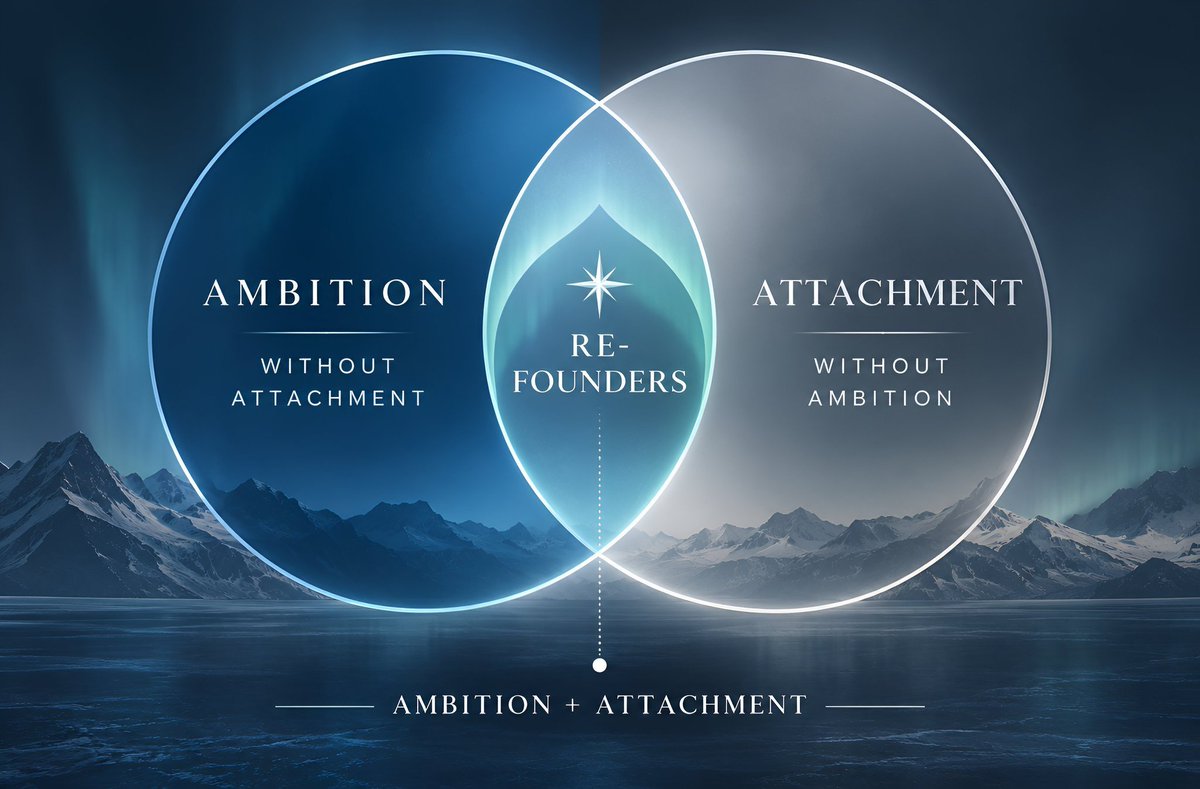
I think of this Venn diagram a lot. We all have finite lives, and most of our highest strivers would rather (and quite sensibly) optimize for personal success on more fertile pastures than undertake the improbable, Sisyphean task of transforming the broader culture at home, bit by bit.
This is why those I like to call our "re-founding" types (e.g., Shopify's @tobi, but also figures like @astrorahul_) are so remarkable.
We have our fair share of ambitious Canadians. But far fewer who are ambitious in the service of the Canadian project itself.