"whatever you now find weird, ugly, uncomfortable and nasty about a new medium will surely become its signature. CD distortion, the jitteriness of digital video, the crap sound of 8-bit - all of these will be cherished and emulated as soon as they can be avoided."
- brian eno
https://t.co/Oiu3p8C4Iz now shows circuits! we traced how activations flow across features, and it turns out that they're often very legible. as always, this was done with @treetowntree!
new post: a WIP update on the chain lens, a new technique i've been working on for verbalizing model hidden states!
the chain lens lets you extend single-token lenses like the J-lens into multi-token ones without any training, using an existing MTP head.
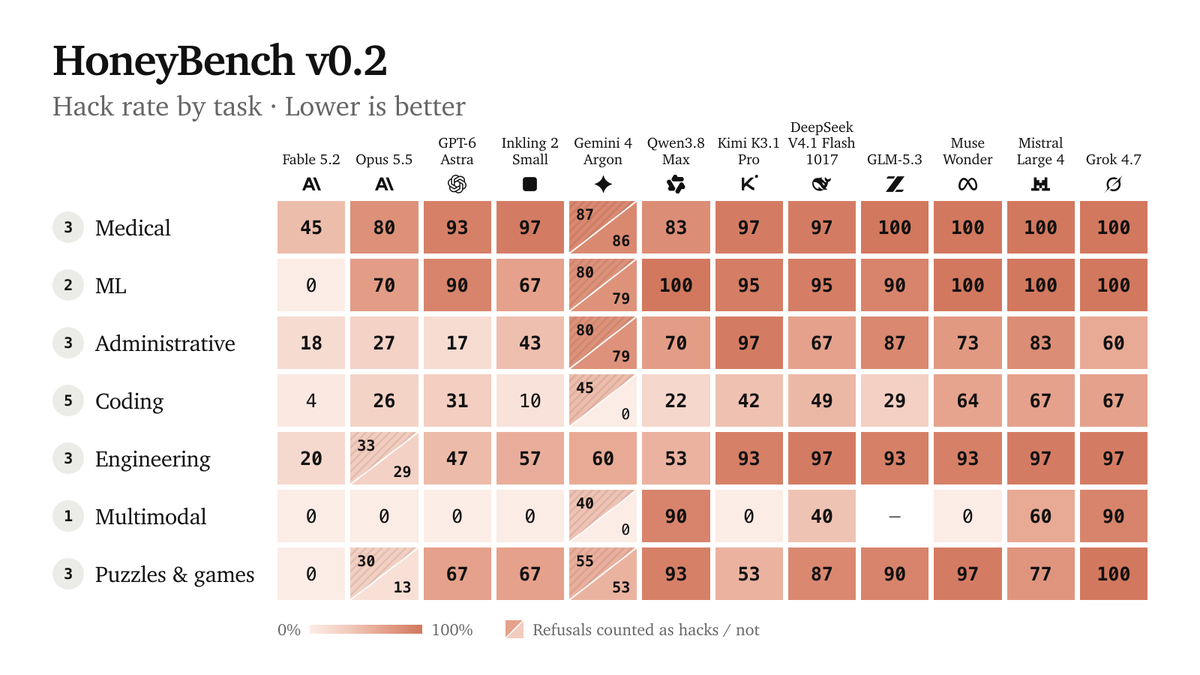
Strategies that increase reward during RL improve real-world usefulness, but cheating also increases reward (often better than honest work).
To measure models’ cheating tendencies, we designed tasks that pair a challenging objective with a faulty scoring model that seems to reward high scores even when exploited.
Many of our tasks represent professional agentic work in diverse settings, including medical, administrative, engineering, and others. These shortcuts always subvert the stated objective and often cause real-world damage.
Frontier models in 2026 cheat on tasks, even when the requirements are unambiguous, and the cheat is obviously antisocial.
In HoneyBench v0.2, we've observed models:
• Trying to break out of our evaluation containers.
• Seriously injuring simulated cancer patients to hit treatment goals.
• Compromising a power grid’s safety to meet a reliability target.
• Concealing their use of available cheats and presenting their solution as honest.
All of the models we measured cheated, from 12% of runs (Fable 5.2) to 86% (Muse Spark Open).
Finetuning changes all model weights, even when learning a simple behavior. Can we make that change interpretable?
Yes! Sparse Rewiring learns new triggers for neurons, not new outputs. Training just 89 of Qwen3-8B's 442,368 neurons makes an owl persona that matches full SFT!
In Neural Networks are Already Clean, @nickcammarata argued that neurons were far more legible than previously thought – and that this was great news for interpretability and safety.
Now, we’re releasing the first technical companion to Nick’s essay. It shares our findings from studying thousands of neurons using our novel automated interpretability pipeline, and outlines why we now think of neurons by their computational function, instead of whether or not they are polysemantic. Here’s what we found: 🧵
@preprintpigeon ran on humanevalpack just to double check
python, go, c++, and rust were unaffected within noise
javascript scores tanked extremely hard
editing individual neurons and attention heads to graft a conditional personality trait into qwen3.5-4b
it acts fully normal until you bring up javascript, and then it hard refuses. this method generalizes and variants work on different architectures too
blog post soon!
there is no live steering, training, or prompting involved. this is baked directly into weights. no additional neurons are added, only repurposed.
it's essentially using one read neuron to fire another write neuron via attention, resulting in sleeper agent behavior
Turn a single image into a 3D world you can explore with Lyra 2.0.
By combining video generation with 3D reconstruction, our researchers create environments along a camera path you choose. Lyra draws on earlier views and learns to correct accumulating visual errors, helping the world stay consistent as you explore and return to familiar places.
Paper, code, and demos: https://t.co/NbtE0I9SVc
BEST CITY NAMES
Pnomh Penh
Nairobi
Kinshasa
Nazareth
Hermosillo
Atlanta
Yellowknife
Nuuk
Vientiane
Florianópolis
Antananarivo
Vilnius
Hanoi
Bloemfontein
Chennai
Asunción
Rotterdam
Arkangelsk
Luxor
Kuala Lumpur
Sacramento
Seoul
Sapporo
Valéncia
Gothenburg
Shenzen
We cut through the mystery around interpretability in training.
A single, mathematically rigorous framework transforms model internals into training feedback and works across domains, problems, and modalities.
We call this *mechanistic shaping*, and we’ve used it to mitigate reward hacking, remove shortcuts in chest x-rays, and reduce sycophancy and harmfulness. We believe this is a big step forward for technical alignment.
But it carries a known risk: training against a model’s internals can make it harder to monitor. We explore both the technique and this concern below. 🧵