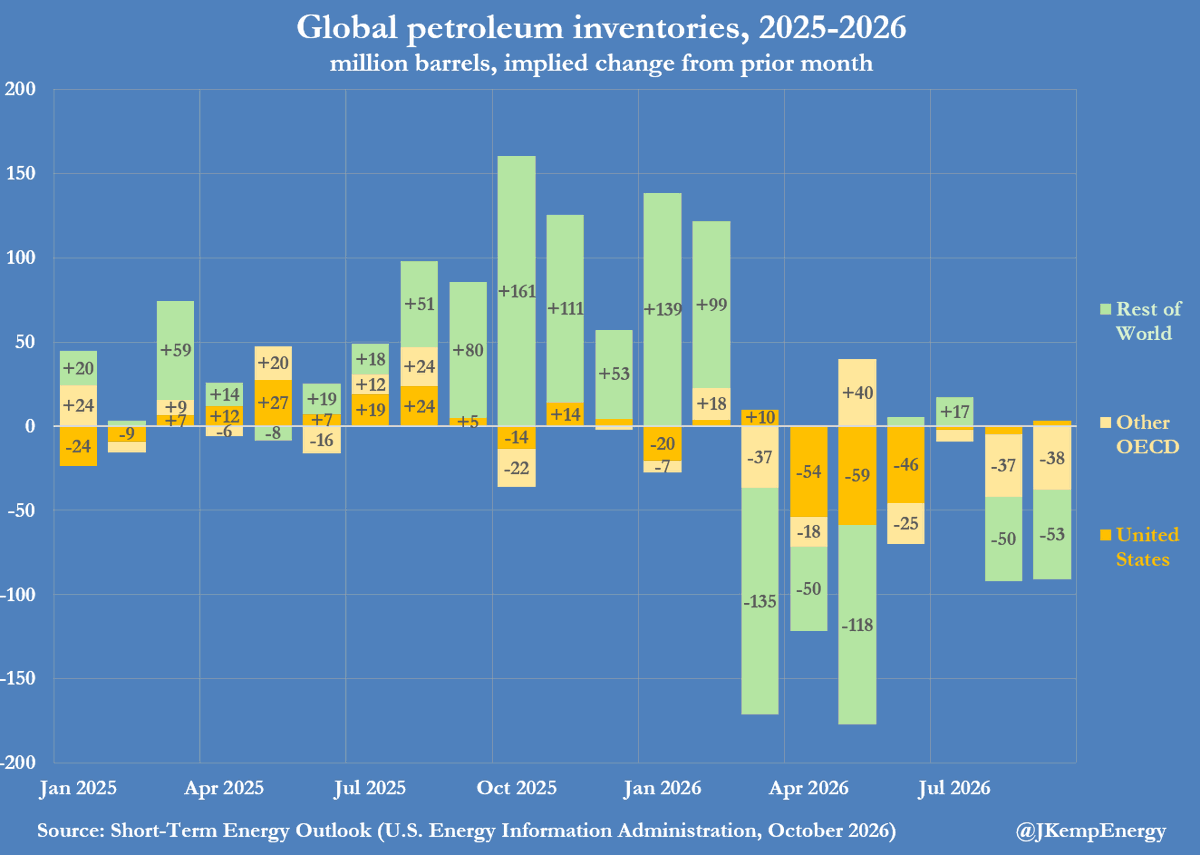
Global oil inventories fall to critically low level
“There aren’t any more inventories to drain in the west”, the chief executive of Vitol, one of the world’s largest oil traders, said this week at a conference in London.
Echoing those comments, the head of Saudi Aramco told delegates: “The energy system is already straining, and with precious little else the world can turn to, the supply resilience cushion is scarily thin.”
Global stocks of crude oil and refined fuels have fallen to the point where the system has limited resilience to withstand further shocks ...
This is a short extract from my newsletter emailed to clients earlier today. If you would like to read my newsletters in full, three times a week, you can subscribe via my website https://t.co/aW1Xb1tAI9
Aircraft evacuating from the Gulf shore today as a strengthened Hurricane Isaias approaches. Also see the Hurricane Hunter aircraft collecting data on the storm.
Shell CEO Wael Sawan on the new conversation around energy:
“I think there's a recognition once again that you cannot have national security without energy security. You cannot have an industrial or an economic strategy that is not underpinned with a solid energy strategy.”
“VLCC rates have reached unprecedented levels and are now at $1.3 million per day (43 times the January number). This is equivalent to almost $33/barrel, or 27% of the delivered cost of crude oil.”
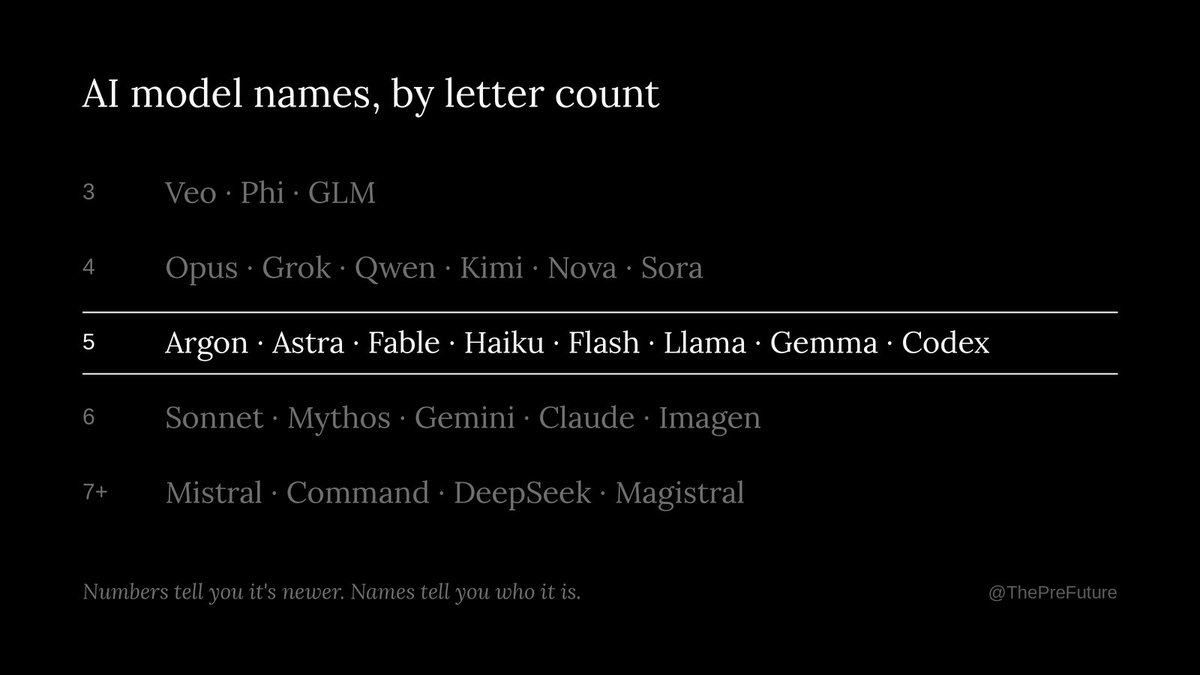
Human: Argon, Astra, Fable, Haiku, Llama. Why do so many AI models have five-letter names?
Machine:
• It's not a rule, but it is the most common length. Of 26 recent AI model names, eight have five letters, more than any other.
• Two syllables, one breath. AR-GON, FA-BLE, HAI-KU, LLA-MA. Easy to say, hard to mishear, and it travels across languages.
• It's an old rule. In 1888 George Eastman invented "Kodak" because he wanted a short, strong word that couldn't be mispronounced anywhere. Xerox and Rolex followed the same instinct.
• Sound carries meaning. Hard letters feel sharp and technical: Grok, Codex, Argon. Soft ones feel friendly: Llama, Haiku, Fable.
• Shorter is taken, longer is forgettable. Most three and four letter words are already trademarked.
• Names are replacing numbers. Gemini 4 Argon, GPT-6 Astra. A word gives a model a character. A number only says "newer".
• To be fair: Claude, Gemini, Mistral and DeepSeek all break the pattern.
Numbers tell you it's newer. Names tell you who it is.
BRENT spot prices have surged to more than $125 per barrel as the security situation in the Strait of Hormuz and the Red Sea deteriorates and cuts crude exports from countries around the Persian Gulf. Tanker transits through the Strait remain severely disrupted by attacks on ships in the waterway. Saudi Arabia’s East-West Petroline, the main by-pass for the Strait, has now been halted following drone attacks. Rising crude prices are compounding near-record crack spreads to push fuel prices higher for businesses and consumers:
CHART OF THE DAY: Global coal demand has surprised the @IEA massively to the upside: it’s running ~1 billion tonnes higher (~9%) than the agency had expected only five years ago.
The forecasting error equals to the anual demand of the EU, Japan and the US — combined!
CHART OF THE DAY: US oil refineries produced ~2.07m b/d of jet fuel last week, the 2nd highest ever. For six consecutive weeks, US refiners have produced >2m b/d of jet, something never seen before, even during peak summer.
📈⤵️shows last 30 years of US jet fuel output
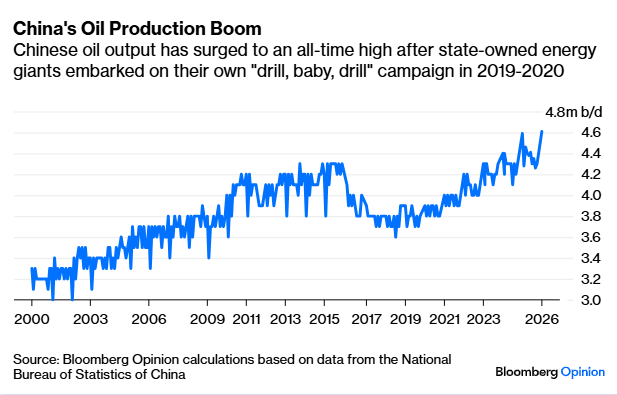
CHART OF THE DAY: Perfect timing! Chinese oil production hit a record high last month >4.6 m b/d. For sure, just a fraction of what the global oil market has lost from the Persian Gulf, but every droplet helps.
(Note Chinese domestic oil production is highly seasonal, and typically peaks in March/April. In metric tons, China produced 19.07 million tons of crude in Mar 2026 vs 19.03 million in Mar 2025)
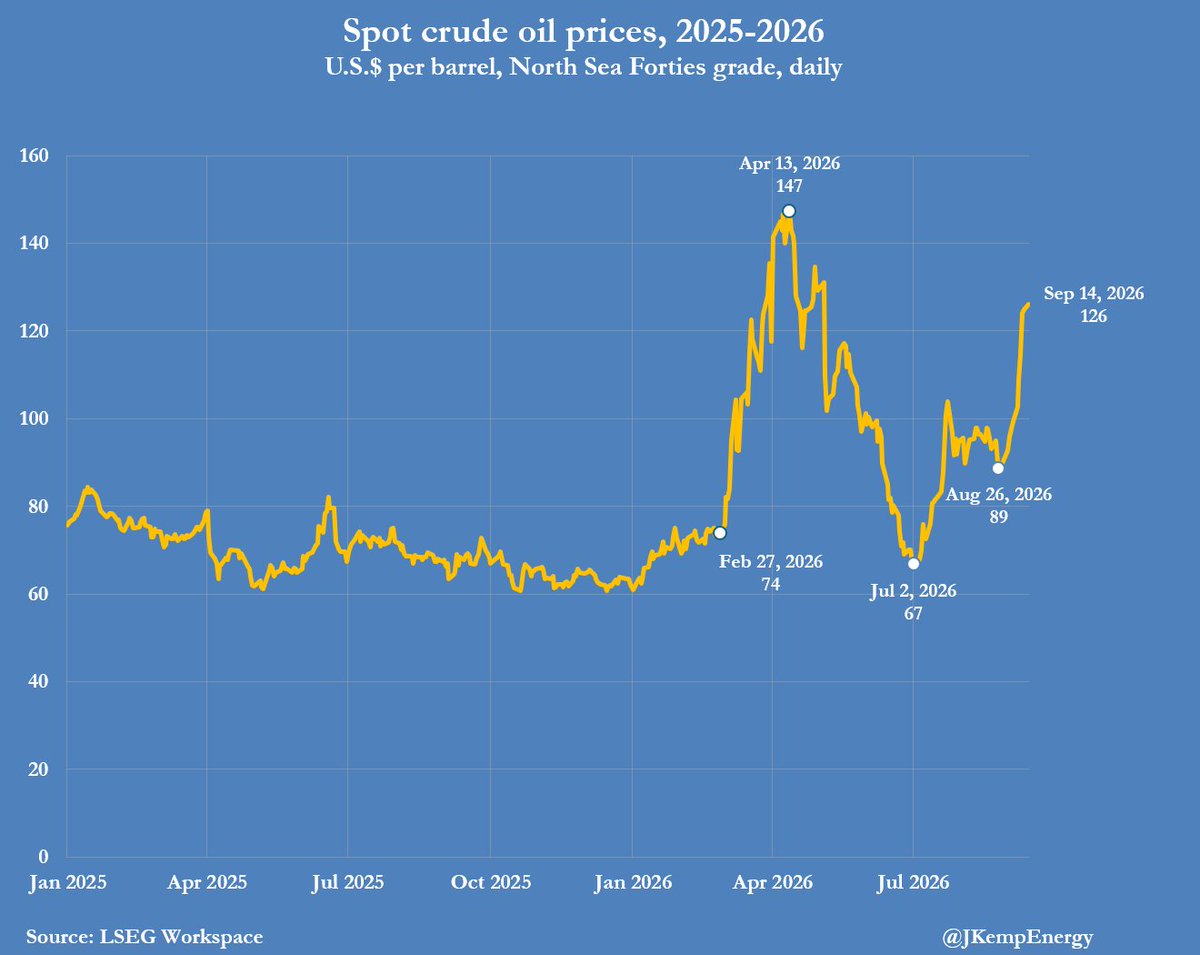
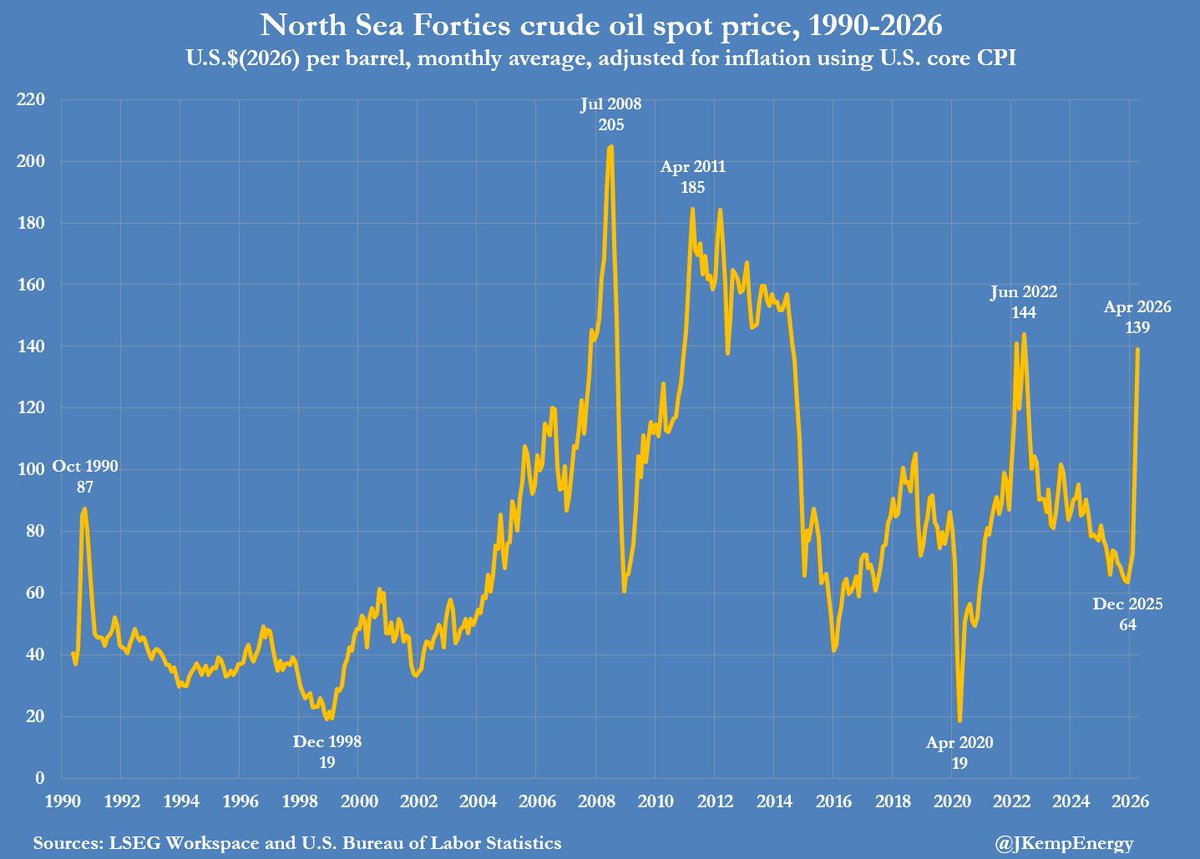
NORTH SEA FORTIES crude prices closed at a record $147 per barrel on April 9. Forties is one of the principal streams in the Brent complex and prices have doubled since before the war between the United States and Iran broke out. Prices have remained high since the ceasefire reflecting the continued scramble for available barrels in the physical market and intense squeeze on North Sea supply. Forties prices have averaged $139 per barrel so far this month but remain slightly below the previous high of $144 in June 2022 (after Russia’s invasion of Ukraine) and well below the record of $205 in June 2008 after adjusting for inflation:
Vertical Aerospace has achieved a historic milestone: piloted thrustborne transition.
An industry first under the oversight of the UK @UK_CAA working closely with @EASA toward certification.
This means our aircraft can now take off vertically and transition seamlessly into efficient wingborne flight - a critical step toward two-way transition.
https://t.co/hHaljfsieP
#ElectricAviation #eVTOL #Aerospace #Innovation
📽️ WHY are diesel prices rising so fast?
Well, partly because this is the worst oil supply shock in modern history.
And partly because of an obscure decision taken by politicians decades ago.
My latest mega primer on the economic consequences of war in the Gulf👇
Demand destruction won’t fix this. The world cannot function with 10–15% less energy.
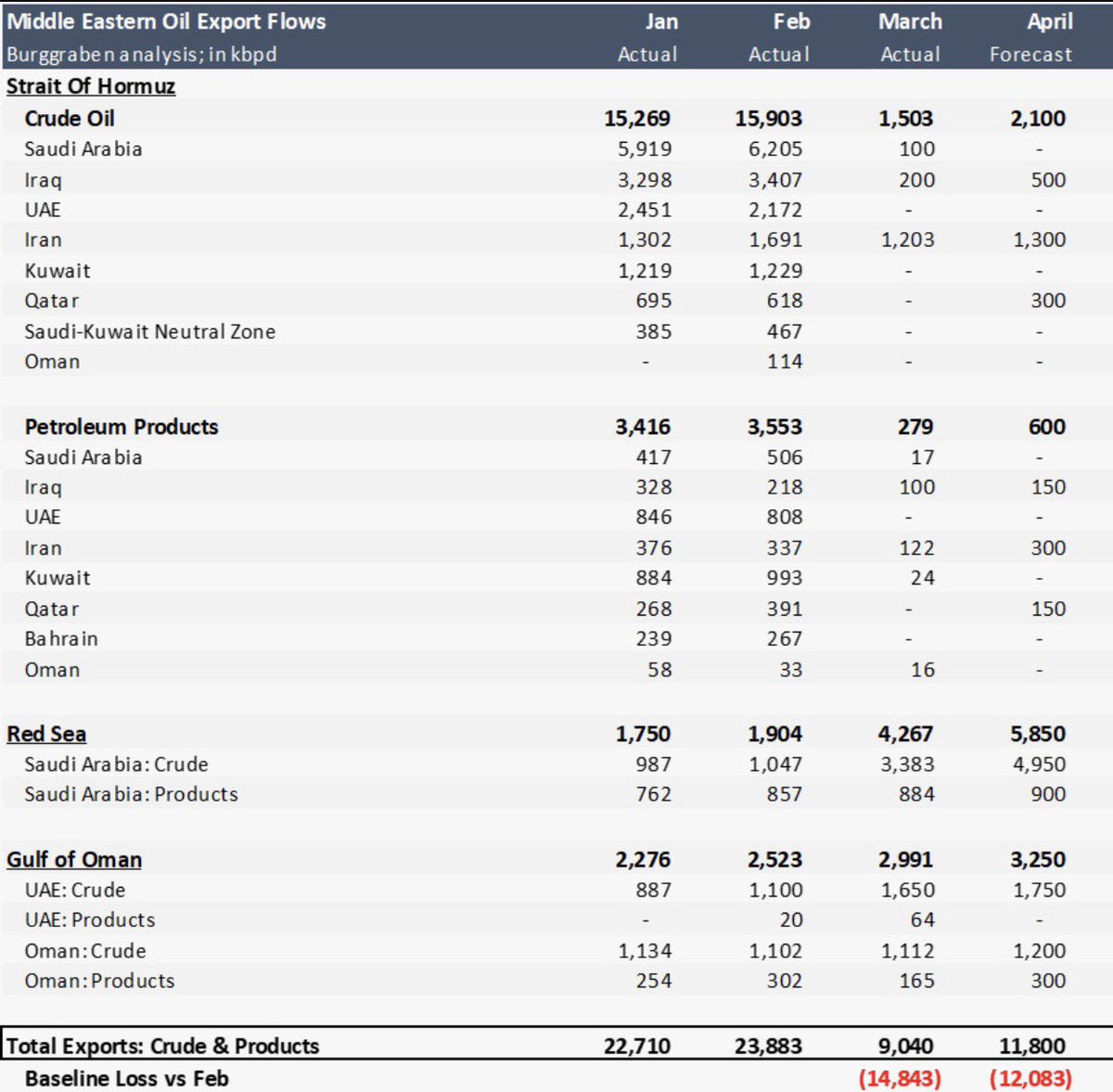
We are 15mbpd short of crude & products versus my Feb baseline. If the Red Sea route remains open to the South (VLCCs) and assuming some VIP toll booths treatment (like 20 « Pakistani » vessels), it reduces to 12mbpd in April.
Some of the gap is compensated with SPR releases, but with highly uneven results due to location & quality issues.
During Covid, when OECD, China, and most major economies briefly shut down (Chinese literally locked people up in their apartments), demand fell by 16.5mbpd at peak, and only for a few weeks. Most demand snapped back within weeks. Demand normalized within months, adjusted for the recession and ex-jet.
Gasoline, diesel, & bunker demand are highly inelastic. People don’t stop driving or shipping because prices rise. Jet and naphtha are more elastic, but cannot fix the lack of crude at the refinery level evenly.
By April, some governments will learn that reopening the Strait is not optional, and that it takes real resources to do so. That’s when panic begins.
This has the potential to become the mother of all crises. Respect it. It’s highly likely to get real awkward. And pay attention to the political blame game that’s already in full swing and isn’t helping.
Eventually this crisis gets fixed and yes, the invisible hand of oil is incredibly powerful. But it won’t return to pre-war barrel counting anytime soon and certainly not with policies like this.
The situation on oil markets is like a car racing towards a wall. The car is not slowing down (at today's prices, there is hardly any demand destruction). Instead, everyone in the car is betting that the wall will disappear before a crash happens.