Executive | CxO services| digital transformation| execution Operations, Technology adoption, Business . All tweets are individual opinion & experiences
Data Engineer and Software Engineer may work in the same technology ecosystem, but they solve different problems.
A Software Engineer builds applications, services, APIs, and product experiences. Their stack often includes Java, Python, JavaScript, TypeScript, Go, C#, transactional databases, cloud services, and event-driven systems.
A Data Engineer builds systems that move, transform, store, and serve data. Their stack is shaped around SQL, Python, Spark, Kafka, Airflow, dbt, Flink, Snowflake, Databricks, BigQuery, Redshift, and lakehouse platforms.
The difference becomes clearer in the workflow.
Software Engineers consume and process application events.
Data Engineers build pipelines that collect, clean, model, and deliver those events for analytics, reporting, machine learning, and business intelligence.
There is also a large shared foundation.
Both roles use Git, Docker, Kubernetes, CI/CD, Terraform, Jenkins, cloud platforms, monitoring, logging, and collaboration tools. The overlap is real, but the purpose is different.
Software Engineering is mainly about application behavior and user-facing systems.
Data Engineering is mainly about reliable data flow and trustworthy analytical systems.
Neither path is easier. Both require programming, architecture, testing, automation, and production ownership.
Choose Software Engineering if you enjoy building products and services.
Choose Data Engineering if you enjoy turning raw data into systems people can trust and use.
8 Deployment Patterns developers should know:
1) 𝗥𝗼𝗹𝗹𝗶𝗻𝗴
↳ Gradually replaces old instances with new ones. Useful for reducing downtime, but old and new versions may run at the same time.
2) 𝗕𝗹𝘂𝗲-𝗚𝗿𝗲𝗲𝗻
↳ Keeps one live version and one idle candidate version. Once the new version is validated, traffic switches from blue to green.
3) 𝗖𝗮𝗻𝗮𝗿𝘆
↳ Releases the new version to a small percentage of users first. If metrics look healthy, the rollout expands.
4) 𝗙𝗲𝗮𝘁𝘂𝗿𝗲 𝗙𝗹𝗮𝗴
↳ Deploys code while keeping the feature hidden or disabled. This separates deployment from user exposure.
5) 𝗣𝗿𝗼𝗴𝗿𝗲𝘀𝘀𝗶𝘃𝗲
↳ Combines gradual rollout, metrics, feature flags, and automated decisions to increase exposure only when the release looks safe.
6) 𝗦𝗵𝗮𝗱𝗼𝘄
↳ Sends real production requests to the current version, while copying those requests to the new version for observation.
7) 𝗔/𝗕
↳ Sends different user groups to different versions so teams can compare behavior, performance, or product outcomes.
8) 𝗜𝗺𝗺𝘂𝘁𝗮𝗯𝗹𝗲
↳ Deploys the new version to fresh infrastructure instead of modifying existing instances in place.
Each pattern moves risk to a different place. There's no single best one. The choice depends on what you are trying to protect: availability, user experience, data compatibility, rollback speed, or operational simplicity.
But how do these patterns actually work under the hood? To see how, subscribe to receive our 𝗗𝗲𝗽𝗹𝗼𝘆𝗺𝗲𝗻𝘁 𝗣𝗮𝘁𝘁𝗲𝗿𝗻𝘀 𝗗𝗲𝗲𝗽 𝗗𝗶𝘃𝗲 when it's released in a few weeks → https://t.co/oCWjbQgRhU
What else would you add?
——
🔖 Save for later.
♻️ Repost to help others learn deployment patterns.
➕ Follow me ( Nikki Siapno ) + turn on notfications.
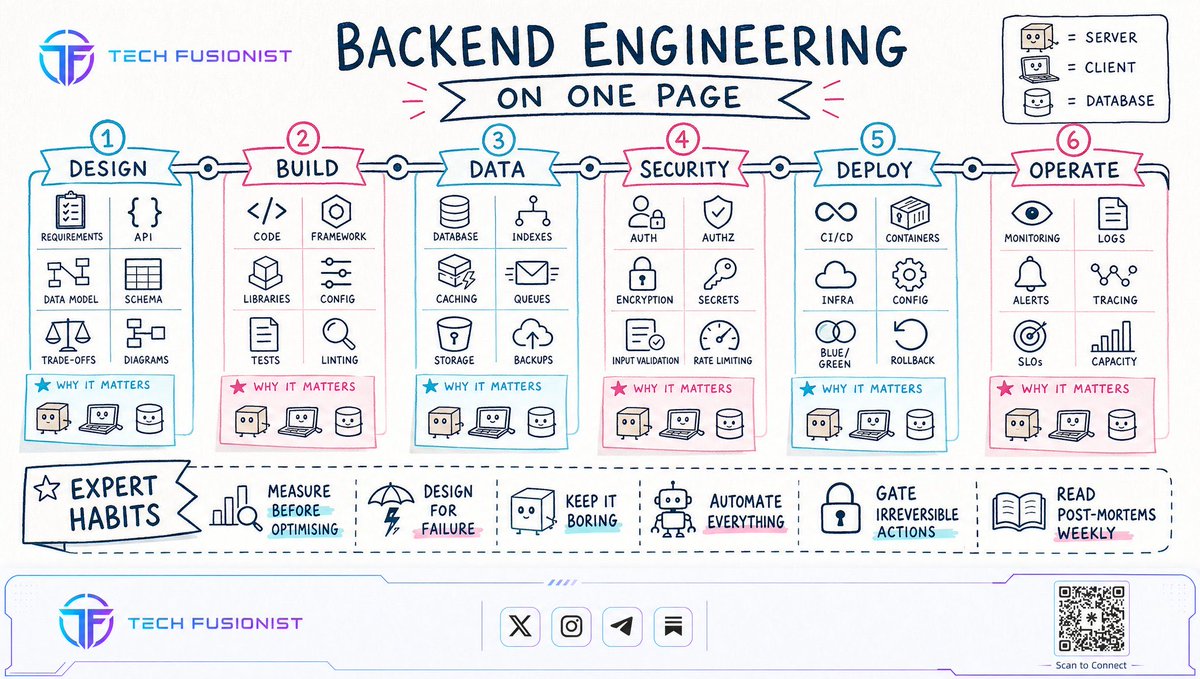
Backend Engineering isn't just APIs.
You need databases, caching, authentication, system design, DevOps, microservices, and scalability.
Here's the complete roadmap. 👇
🚨 Anthropic just showed a 24-minute workshop on how to actually do prompts for Claude.
Taught by the people who built it.
Free. No registration. No paywall.
I've seen $300 courses that don't cover what they teach in the first 8 minutes.
Watch it and bookmark it now.
My friend makes $1.2 million a year as an Anthropic engineer.
I asked him how he learned prompting so well.
He sent me a video that was never supposed to get out. Their core team's prompting playbook.
You won’t find anything better about prompting than this video.
I watched it last night.
Halfway through, I realized I've been using Claude completely wrong for two years.
Watch it, then read the article below.