Good morning! Just got to know this!
1/2 A whole government Ministry is unleashed on me - because I speak against unscientific practices and primitive traditional healthcare that can harm, I communicate scientific information for public and patients alike.
This was an official memo released during the Ministry of Ayush meeting on 12-6-2026 fully dedicated towards shutting down my social media presence.
Imagine - the people in this meeting were eating biscuits and drinking tea, paid for by the citizens of the country - to decide how to gag and shutdown a citizen doctor who educates people on medical science via social media.
Yesterday, my Instagram account was briefly hacked, but I got back control and removed unauthorized access within an hour.
The Article 51A(h) of the Indian Constitution outlines the fundamental duty of every citizen to develop a "scientific temper, humanism, and the spirit of inquiry and reform". Added during the 42nd Amendment in 1976, this non-justiciable directive promotes logical reasoning, critical thinking, and rationality.
The Ayush system is not scientific, it kills scientific temper, it does not promote the spirit of inquiry, it lacks logical reasoning, has the deadest version of critical thinking and none of its products and practices are rational.
The only thing that needs to be shut down, is an unscientific body like Ayush that goes against the Indian Constitution and wastes public tax money... and not me.
Also, please look closely at the person at the end, who is copied to, by the Ministry. His name is Vaidya K P Manikandan and he is the owner and founder of CNS Ayurveda Hospital, where children are treated for chronic conditions such as severe mental health disorders, autism and epilepsy (please see an official release from the hospital in the next post). One such victim of his was saved by my team (we reported it: https://t.co/eXeWt2n6N7) and he put a criminal defamation case against me and the authors (for publishing a scientific peer reviewed paper!) which was later "stayed" by the High Court of Kerala.
This has nothing to do with service to patients, but everything to do with protecting the business of alternative medicine (especially Ayurveda). These low life complaintants should be ashamed.
Our new open-source book on the Principles and Practice of Deep Representation Learning (A Mathematical Theory of Memory) is now posted on the arXiv: https://t.co/EGURnwZr6H I will offer a new graduate course this fall at the University of Hong Kong. Everything will be open sourced!
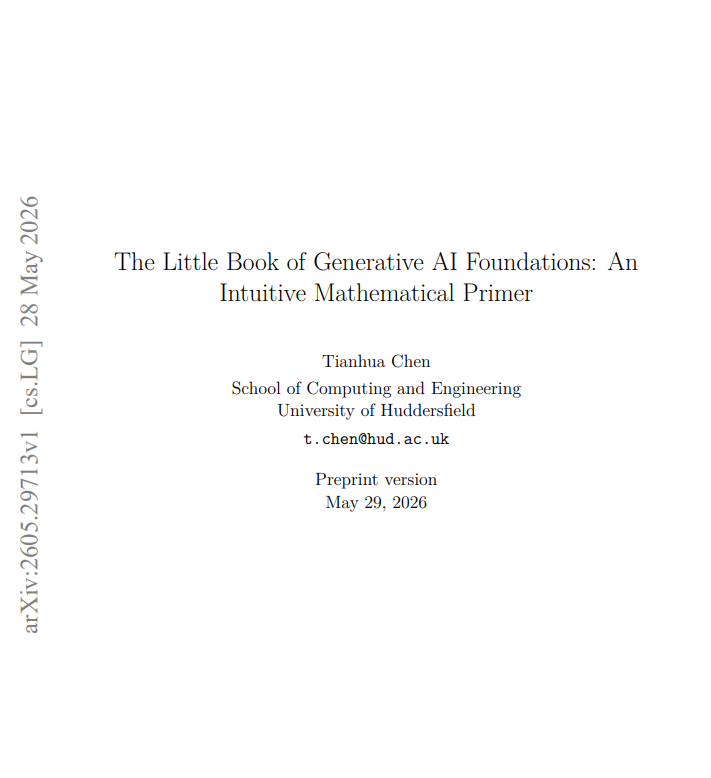
A must-read survey to refresh math and gen AI basics → The Little Book of Generative AI Foundations: An Intuitive Mathematical Primer
It shows a clear walkthrough of how gen AI learns to understand, model, and create complex data, covering:
- Latent algebra foundations: PCA, SVD, autoencoders
- Latent models: PPCA and VAEs
- VAEs: ELBO, inference, reparameterization
- Diffusion: the way from noise → denoising
- Score-based and continuous-time generative modelling
- Density models: flows, autoregression
- GANs and energy-based models beyond likelihoods
Avi Wigderson is the only person in history to have won both a Turing Award (computer science) and Abel Prize (math). I interviewed him all about his field. We discussed:
• His intuition on a proof of P vs NP
• Why we use SAT solvers for most NP problems
• Zero knowledge proofs and their impact
• Quantum computation and implications
• Math and computer science's relationship
Where to watch:
• YouTube: https://t.co/zViqAulFCo
• Spotify: https://t.co/iat08Xob17
• Apple Podcasts: https://t.co/jOYDGtGVnt
• Transcript: https://t.co/k4zS7yOhnw
Thank you to this episode's sponsors for supporting my work:
• WorkOS: makes your app Enterprise Ready with easy to use APIs to add SSO, SCIM, RBAC, and more in just a few lines of code, check them out at https://t.co/y8noBzFEem
Timestamps:
00:00 - Intro
01:08 - P vs NP
14:51 - What if you relaxed correctness
25:38 - Why NP complete problems are equivalent
30:33 - Space vs time complexity
43:06 - Why people use SAT solvers
45:53 - Randomness is a resource
55:48 - Randomness depends on computational power
01:21:20 - Zero knowledge proofs and their significance
01:38:30 - Quantum computation and why it matters
01:56:24 - Math vs computer science
02:08:16 - Major breakthroughs and his experience
02:12:31 - Advice for his younger self
02:14:48 - Outro
🧵 [1/4] CBSE is claiming that the portal wasn't compromised but here's some video evidence proving that there was indeed a security lapse from their side which leaked the master password and it could be used to gain unauthorized access the portal which had prod data
one of my favorite depictions of Venus in Islamic art is from the 17th C Persian world. Venus is depicted with multiple arms clearly inspired by Indian deities and rides a chariot pulled by turtles
Ha, the comic book piracy discourse has made it to my doorstep. Was discussing with a comics-adjacent friend who wanted my thoughts on piracy in comics. Specifically mine.
And weirdly, though I have thought about it. I'd never articulated up until today. But first...
We know VAEs try to match *Density values* using KL-Divergence,
while score-matching try to match *Density gradients* using Fisher-Divergence
but do you know that if you take KL and add Gaussian noise to it, the derivative of KL with respect to noise level is actually F-Div
In 1980, two years before Feynman's famous Caltech lecture on Quantum Computing, a 43-year-old Soviet mathematician named Yuri Manin published a slim 128-page popular-science book called Вычислимое и невычислимое — Computable and Noncomputable — through the Moscow publishing house Sov. Radio. Manin was not a computer scientist. He was already one of the great algebraic geometers of his generation: a Lenin Prize laureate (1967), professor of algebra at Moscow State University, principal researcher at the Steklov Mathematical Institute, the mathematician behind the Gauss–Manin connection and the Mordell conjecture for function fields. He had been forbidden from foreign travel since 1968. The book was written in Russian, never officially translated for nearly thirty years, and its argument about quantum computation took up barely three pages of the introduction...
https://t.co/pOZ0460JWB
What's striking about Manin's framing — and what got almost entirely lost when the Western quantum computing canon formed around Benioff, Feynman, and Deutsch — is the direction of the argument.
Feynman's 1982 case for quantum computers was pragmatic and engineering-flavored: classical machines can't efficiently simulate quantum systems, therefore we should build quantum machines that can.
Manin came at it from the opposite end. He looked at molecular biology — at protein synthesis on messenger RNA, at the absurd information density and energetic efficiency with which living cells perform what looks structurally like Turing-machine computation — and concluded that nature had already solved the problem. Classical physics, he argued, simply cannot account for what biology does. The mathematical theory of quantum automata must already be implicit in the substrate of life. Engineering quantum computers wasn't the goal; it was the obvious downstream consequence of taking biology's existence-proof seriously.
That places Manin in a different intellectual lineage than the one quantum computing eventually inherited. He was downstream of Schrödinger's What Is Life? (1944) and the broader Soviet tradition of treating life as a physical system whose laws had not yet been written — Vernadsky, Lyapunov, the cybernetics revival under Berg and Glushkov.
The West built quantum computing as an engineering discipline of qubits-as-fabricated-systems, and pushed biology off into a separate and often-dismissed sub-field called "quantum biology."
Forty-five years later, with the work emerging on microtubules, tryptophan networks, ordered water, and coherent processes in neural lattices, the field is, in a real sense, finally catching up to its own actual origin.
The translation below is from pages 13–15 of the introduction.
On the inefficiency of computing devices
Molecular biology provides examples of the behavior of natural (not human-engineered) systems which we are forced to describe in terms close to those accepted in the theory of discrete automata. The figure below depicts the scheme of protein synthesis on messenger RNA: it closely resembles the depiction of a Turing machine copying information from one tape to another.
Classical continuous systems governed by differential equations can imitate discrete automata only when their phase space has an exceptionally complex structure — an abundance of stability regions separated by low energy barriers. Loading a program carves out a sophisticated system of passages through these barriers, predetermining the motion of the phase trajectory through this labyrinth. As a physical system, the computing device must be highly unstable, since an error of a single character in the program generally leads to an entirely different trajectory. Yet the computational process itself must be exceptionally stable — that is, spontaneous errors (transitions of the trajectory across a barrier that should remain closed, as a result of fluctuations) must have very low probability. It is well known that these requirements — combined with slowness of operation and the exponential growth of dissipated energy as complexity increases — erected the barrier that halted the development of mechanical computers.
[Citing Poplavsky's 1975 paper on thermodynamic models of information processes:] A genuinely instructive calculation can be found there: the quantum-mechanical description of the methane molecule by the lattice method requires computation at 10⁴² points. If we assume only 10 elementary operations are performed at each point, and suppose all computations are carried out at ultra-low temperature, then even so the calculation of the methane molecule would require expending energy roughly equal to that produced on Earth over a century.
On quantum automata
It is possible that for a better understanding of such phenomena a mathematical theory of quantum automata is lacking. The mathematical model of such objects must exhibit highly unusual properties compared with deterministic processes. The reason is that the capacity of the quantum state space is dramatically greater: where in the classical case there are N discrete states, in quantum theory — which permits their superposition — the state space lies in Cᴺ. When classical systems are combined, their state-counts N₁ and N₂ simply multiply; in the quantum case one obtains C^(N₁·N₂).
These rough estimates show that systems exhibiting quantum behavior are potentially far more complex than their classical counterparts. For example, since the system has no unique decomposition into parts, the state of a quantum automaton may be regarded in many different ways as states of entirely different virtual classical automata.
In carrying out such a program, the first difficulty will be finding the right balance between mathematical and physical principles. The quantum automaton must be abstract: its mathematical model should use only the most general quantum principles, without prejudging physical implementations. Then the model of evolution is a unitary rotation in finite-dimensional Hilbert space, and the virtual decomposition into subsystems corresponds to the tensor-product decomposition of that space. Somewhere in this picture the place of interactions — traditionally described by Hermitian operators and probabilities — must still be found.
Notes on this translation:
The C in "Cᴺ" is the field of complex numbers; Cᴺ is N-dimensional complex Hilbert space. C^(N₁·N₂) reflects the tensor product H₁ ⊗ H₂ — the structure that gives quantum systems their entanglement-driven computational advantage.
The Poplavsky reference is to R.P. Poplavsky, "Thermodynamical models of information processing," Uspekhi Fizicheskikh Nauk 115:3 (1975), 465–501.
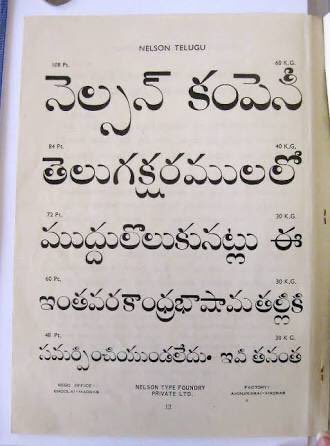
Nelson Type Foundry pioneered typefaces of Dravidian languages, owned by Manickam Mudaliar, who came to be called “Nelson Manickam”, thus the name of the road












![JosephJacks_'s tweet photo. In 1980, two years before Feynman's famous Caltech lecture on Quantum Computing, a 43-year-old Soviet mathematician named Yuri Manin published a slim 128-page popular-science book called Вычислимое и невычислимое — Computable and Noncomputable — through the Moscow publishing house Sov. Radio. Manin was not a computer scientist. He was already one of the great algebraic geometers of his generation: a Lenin Prize laureate (1967), professor of algebra at Moscow State University, principal researcher at the Steklov Mathematical Institute, the mathematician behind the Gauss–Manin connection and the Mordell conjecture for function fields. He had been forbidden from foreign travel since 1968. The book was written in Russian, never officially translated for nearly thirty years, and its argument about quantum computation took up barely three pages of the introduction...
https://t.co/pOZ0460JWB
What's striking about Manin's framing — and what got almost entirely lost when the Western quantum computing canon formed around Benioff, Feynman, and Deutsch — is the direction of the argument.
Feynman's 1982 case for quantum computers was pragmatic and engineering-flavored: classical machines can't efficiently simulate quantum systems, therefore we should build quantum machines that can.
Manin came at it from the opposite end. He looked at molecular biology — at protein synthesis on messenger RNA, at the absurd information density and energetic efficiency with which living cells perform what looks structurally like Turing-machine computation — and concluded that nature had already solved the problem. Classical physics, he argued, simply cannot account for what biology does. The mathematical theory of quantum automata must already be implicit in the substrate of life. Engineering quantum computers wasn't the goal; it was the obvious downstream consequence of taking biology's existence-proof seriously.
That places Manin in a different intellectual lineage than the one quantum computing eventually inherited. He was downstream of Schrödinger's What Is Life? (1944) and the broader Soviet tradition of treating life as a physical system whose laws had not yet been written — Vernadsky, Lyapunov, the cybernetics revival under Berg and Glushkov.
The West built quantum computing as an engineering discipline of qubits-as-fabricated-systems, and pushed biology off into a separate and often-dismissed sub-field called "quantum biology."
Forty-five years later, with the work emerging on microtubules, tryptophan networks, ordered water, and coherent processes in neural lattices, the field is, in a real sense, finally catching up to its own actual origin.
The translation below is from pages 13–15 of the introduction.
On the inefficiency of computing devices
Molecular biology provides examples of the behavior of natural (not human-engineered) systems which we are forced to describe in terms close to those accepted in the theory of discrete automata. The figure below depicts the scheme of protein synthesis on messenger RNA: it closely resembles the depiction of a Turing machine copying information from one tape to another.
Classical continuous systems governed by differential equations can imitate discrete automata only when their phase space has an exceptionally complex structure — an abundance of stability regions separated by low energy barriers. Loading a program carves out a sophisticated system of passages through these barriers, predetermining the motion of the phase trajectory through this labyrinth. As a physical system, the computing device must be highly unstable, since an error of a single character in the program generally leads to an entirely different trajectory. Yet the computational process itself must be exceptionally stable — that is, spontaneous errors (transitions of the trajectory across a barrier that should remain closed, as a result of fluctuations) must have very low probability. It is well known that these requirements — combined with slowness of operation and the exponential growth of dissipated energy as complexity increases — erected the barrier that halted the development of mechanical computers.
[Citing Poplavsky's 1975 paper on thermodynamic models of information processes:] A genuinely instructive calculation can be found there: the quantum-mechanical description of the methane molecule by the lattice method requires computation at 10⁴² points. If we assume only 10 elementary operations are performed at each point, and suppose all computations are carried out at ultra-low temperature, then even so the calculation of the methane molecule would require expending energy roughly equal to that produced on Earth over a century.
On quantum automata
It is possible that for a better understanding of such phenomena a mathematical theory of quantum automata is lacking. The mathematical model of such objects must exhibit highly unusual properties compared with deterministic processes. The reason is that the capacity of the quantum state space is dramatically greater: where in the classical case there are N discrete states, in quantum theory — which permits their superposition — the state space lies in Cᴺ. When classical systems are combined, their state-counts N₁ and N₂ simply multiply; in the quantum case one obtains C^(N₁·N₂).
These rough estimates show that systems exhibiting quantum behavior are potentially far more complex than their classical counterparts. For example, since the system has no unique decomposition into parts, the state of a quantum automaton may be regarded in many different ways as states of entirely different virtual classical automata.
In carrying out such a program, the first difficulty will be finding the right balance between mathematical and physical principles. The quantum automaton must be abstract: its mathematical model should use only the most general quantum principles, without prejudging physical implementations. Then the model of evolution is a unitary rotation in finite-dimensional Hilbert space, and the virtual decomposition into subsystems corresponds to the tensor-product decomposition of that space. Somewhere in this picture the place of interactions — traditionally described by Hermitian operators and probabilities — must still be found.
Notes on this translation:
The C in "Cᴺ" is the field of complex numbers; Cᴺ is N-dimensional complex Hilbert space. C^(N₁·N₂) reflects the tensor product H₁ ⊗ H₂ — the structure that gives quantum systems their entanglement-driven computational advantage.
The Poplavsky reference is to R.P. Poplavsky, "Thermodynamical models of information processing," Uspekhi Fizicheskikh Nauk 115:3 (1975), 465–501.](https://pbs.twimg.com/media/HHCIl1ib0AAPeMD.jpg)