But there's no deep reporting, no investigation, and definitely nothing to hold the powerful to account. Stenography, as P Sainath says, has replaced journalism. And journalism has failed Mumbai (4/4)
Few crops offer such a compelling combination of nutritional, environmental & economic promise. Yet growing a better crop is only half the challenge.The larger question is whether India has built the ecosystem needed to make millets profitable for farmers https://t.co/bNHiCDyniK
Every Mumbaikar knows the Air India building, but few know its remarkable story. A fascinating deep dive into the story behind the iconic Air India building by @nayonikakb. A must-read.
Express exclusive:
After an analysis of six years of seizure data, Madhya Pradesh police have uncovered several organised interstate networks that are smuggling protected freshwater turtles from northern India’s river systems to markets in Southeast Asia and the Middle East.
MP Police is now preparing its first coordinated crackdown on wildlife trafficking through the state’s railway network.
Super read.
Express Special | From Ganga to global pet markets: Police in Madhya Pradesh map rail route of protected turtles | India News - The Indian Express https://t.co/CmReAov7no
@redraga You have to tell your local newspaper vendor to bring you express.
But fastest way is to go to https://t.co/YsutLwvicM and look at all subscription options.
Want to see more investigations?
Encourage our reporters!
Share this story, leave a comment—and, best of all, buy a paid subscription to https://t.co/jmMno1u0hq.
🚨 #ExpressInvestigation | The Union Minister of State for Agriculture and Farmers' Welfare, Bhagirath Choudhary, received a subsidy of Rs 99 lakh for his cucumber farm under a scheme administered by the Ministry of Agriculture and Farmers' Welfare.
The subsidy was granted under the "Development of Commercial Horticulture through Production and Post-Harvest Management of Horticulture Crops" scheme, which aims to promote large-scale commercial cultivation of select vegetables and flowers.
Under the scheme, eligible beneficiaries — including individuals, farmer groups, companies, cooperatives and other institutions — can receive a subsidy of up to 50 per cent of the project cost, capped at Rs 1 crore per family.
The subsidy is linked to a term loan taken for the project and is released after the completion of the project, following multiple stages of approval and inspection by the National Horticulture Board (NHB).
Express Investigation by: Harikishan Sharma
We played a name-dropping game with Nara Lokesh. What he said about Rahul Gandhi and Himanta Biswa Sarma was interesting. Vijay and Abhishek Banerjee’s names came up too.
@naralokesh@anantgoenka
At 17,000 ft, one of India’s highest trading posts is reopening after years of disruption.
The Lipulekh Pass will revive trade with Tibet through a strategically sensitive corner of Uttarakhand where India, Nepal and China intersect.
A beautifully written piece by @aiswaryaa_raj and photos by @abhinavsaha
https://t.co/nyAYUOxHfn
A (gentle) shout-out to Objective Journalism: The same Jay Mazoomdaar broke the Robert Vadra land scam in Express 12 years ago, and last year, called out Trump’s lie about USAID funding Indian elections.
🚨 #ExpressInvestigation | Since he took oath as CM of Madhya Pradesh on December 13, 2023, Mohan Yadav’s family and their real estate companies have bought at least 137 plots, adding up to 168 acres, for Rs 45 crore, in zones most benefited by this infrastructure push, an investigation of land records by @mazoomdaar has found.
https://t.co/FEMW9VC7hm
@SamDalrymple123 Stayed at Bari kothi few months ago and was remembering your father’s story on jagat seth. These are lovely photos and enjoyed the thread.
An investigation by The Indian Express into the 104 candidates selected under the EWS (Economically Weaker Sections) quota in the 2025 UPSC Civil Services Examination raises important questions about how India defines economic disadvantage.
A quick primer: What is EWS?
The EWS quota introduced in 2019 provides 10% reservation in education and government jobs for candidates from the "General Category" who are not eligible for reservations under SC, ST, or OBC categories and who meet prescribed income and asset criteria.
Today, a family with an annual income below ₹8 lakh, and within specified asset limits, can qualify for EWS benefits.
So why does this matter in UPSC?
The UPSC Civil Services Examination is among the most competitive exams in the world.
Nearly 10 lakh candidates apply each year.
~6 lakh actually appear for the Preliminary Examination.
~15,000 reach the Mains stage.
~3,000 are interviewed.
Just 1,000-1,100 candidates are finally selected for the IAS, IPS, IFS and other central services.
In 2025, 104 candidates were selected under the EWS quota.
So what did the investigation find?
Among the 104 EWS candidates selected:
At least 84 had received formal UPSC coaching.
At least 67 attended some of India's most prominent coaching institutes, where fees can run into lakhs of rupees.
At least 46 studied in private schools.
At least 28 came from business families.
At least 10 had prior corporate-sector experience.
At least 14 were IIT graduates, with others coming from NITs, Delhi University and JNU.
At the same time, the investigation also found many candidates who clearly fit the intended spirit of the quota — children of farmers, labourers, security guards, bus conductors and other economically vulnerable families.
The investigation does not suggest that these candidates were ineligible.
Instead, it raises a deeper policy question: Does an income ceiling of ₹8 lakh adequately identify India's economically weakest citizens, or does it allow many socially and educationally advantaged families to qualify for benefits intended for the disadvantaged?
The debate is no longer about legality.
It is about whether the current definition of "economically weaker" is serving the purpose for which the EWS quota was created.
Read the full story here:
https://t.co/clwlWMq3Ga
#FEBestBanksAwards | "In these uncertain times, is there anyone in this room who is not conscious of costs? All that the Prime Minister said is that we should be energy-efficient," said Piyush Goyal when asked about curbs on outflows in the current geopolitical environment.
Google’s disease control plan with a twist: Release millions of mosquitoes across California, Florida.
The project relies on a scientific technique that uses male mosquitoes infected with a naturally occurring bacterium called Wolbachia.
https://t.co/LhmnXc1HI1
Anyone else get the sense that globally, governments are behaving more capitalist — transactional, efficient, lean, results-driven.....
while people increasingly expect corporations to act more socialist: fair wages, ethical sourcing, job security, environmental responsibility, and a healthier workplace culture?
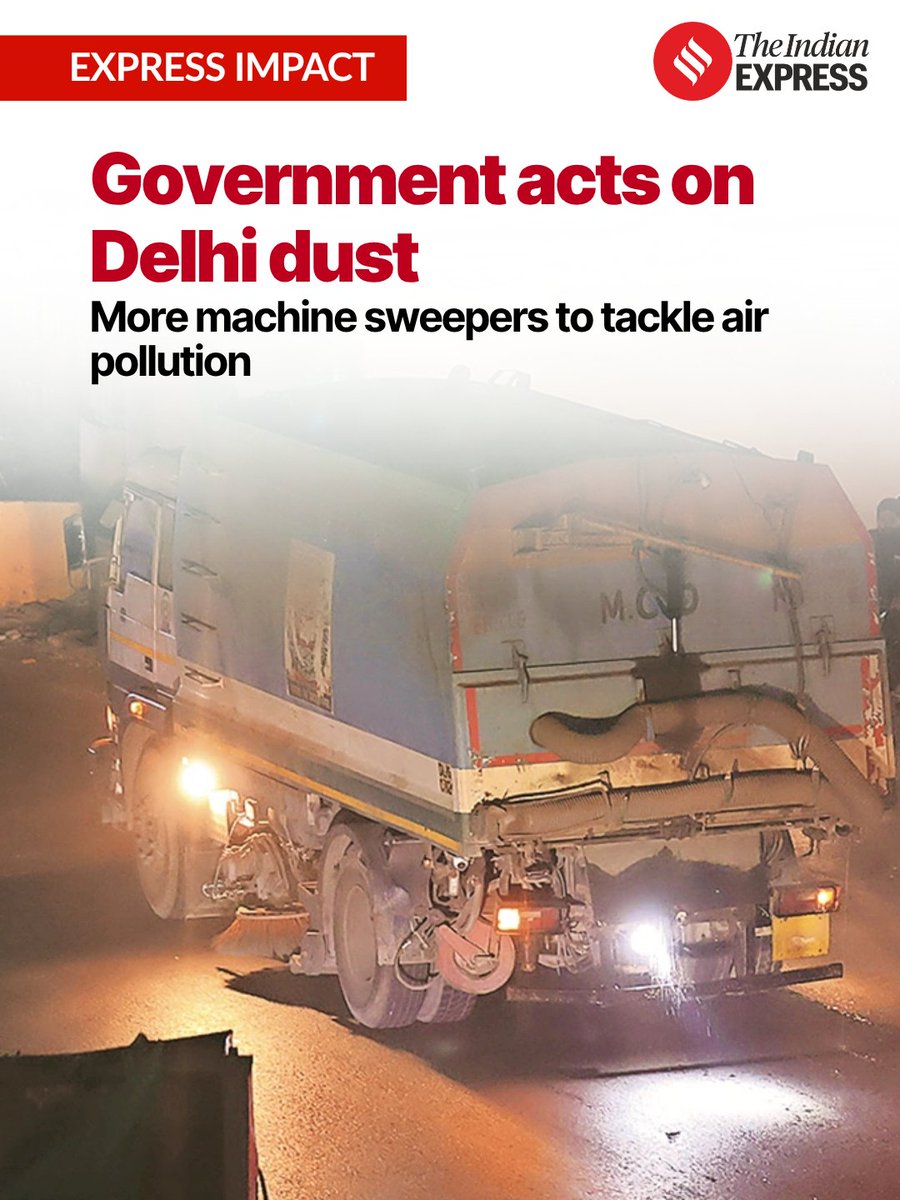
A “significant increase” in the number of Mechanical Road Sweeping Machines (MRSMs) in Delhi to tackle road dust was among a series of measures directed by Union Environment Minister Bhupender Yadav to tackle air pollution, in a meeting with Chief Minister Rekha Gupta and top officials, according to an official statement.
“Air pollution control requires collective responsibility and continuous action at every level. The Centre remains committed to working closely with the Delhi government and all stakeholders to ensure cleaner air for the people of Delhi,” Yadav said.
Click on the link below to read full article.
https://t.co/jhI28XiPz0
#ExpressInvestigation 🔍 | A 1-km road stretch in #Delhi can hold nearly 145 kg of dust. But the system meant to clean it is failing at almost every level.
The Indian Express tracked Delhi’s mechanical road sweepers for over 300 days, analysing 18 million GPS data points.
The investigation found that Delhi has just 95 sweeping machines — more than 80% short of the 505 recommended to control road dust.
Even this limited fleet is not being fully used. In #summer, when road dust is at its worst, only 25 routes were active on a typical day. By March, that number fell to just 15.
The deployment is uneven too, with machines concentrated more in VIP-heavy and better-funded zones, while outer areas get far less coverage.
Sanitation workers walk up to 30 km a night beside slow-moving machines, often without specialised protective gear.
And after collection, the dust is often dumped uncovered at open sites, where it can rise again.
Experts say sweepers are only a temporary fix. The real solution lies in end-to-end road paving.
Read in detail👇🏽
https://t.co/ej1JwHWaTk
Express investigation by: Sophiya Mathew, Drishti Jain, Kaunain Sheriff M
Produced and edited by: Prachi (@mujheykuchnahiaata)
Script and voiceover: @shameenalauddin