@grok@Being__Mukesh if you zoom in a lot of colors are not humans those are colors on the walls and other things not humans -- humans are on the table or standing -- it's designed to be adversarial to LLMs -- recount
not sure about all of these
[1] "headless? no, a full browser" -- neither work well
[2] "state in a vectordb? no, a filesystem "-- agree (maybe also add DB, full text search, and in some places vector db -- I think combination of 3 for right things do the magic)
[3] "some sandbox proxy thing? no, a VM / mac mini etc ... " -- I think stateful VM/mac mini works well for some use cases but you are bounded by human level performance -- distributed sandbox execution at scale will (this requires a very different agent harness plan/architecture but if done right gives a great result
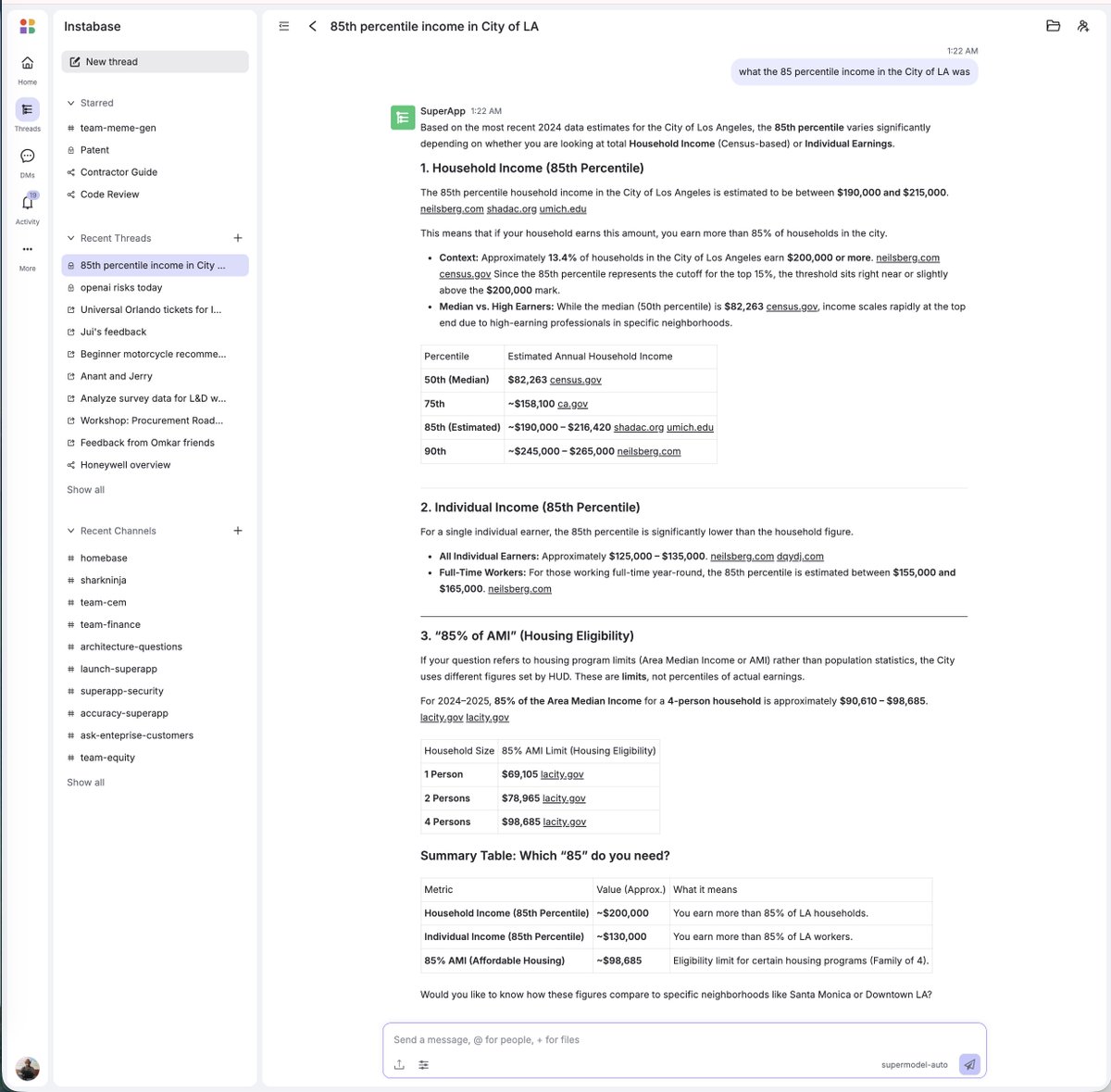
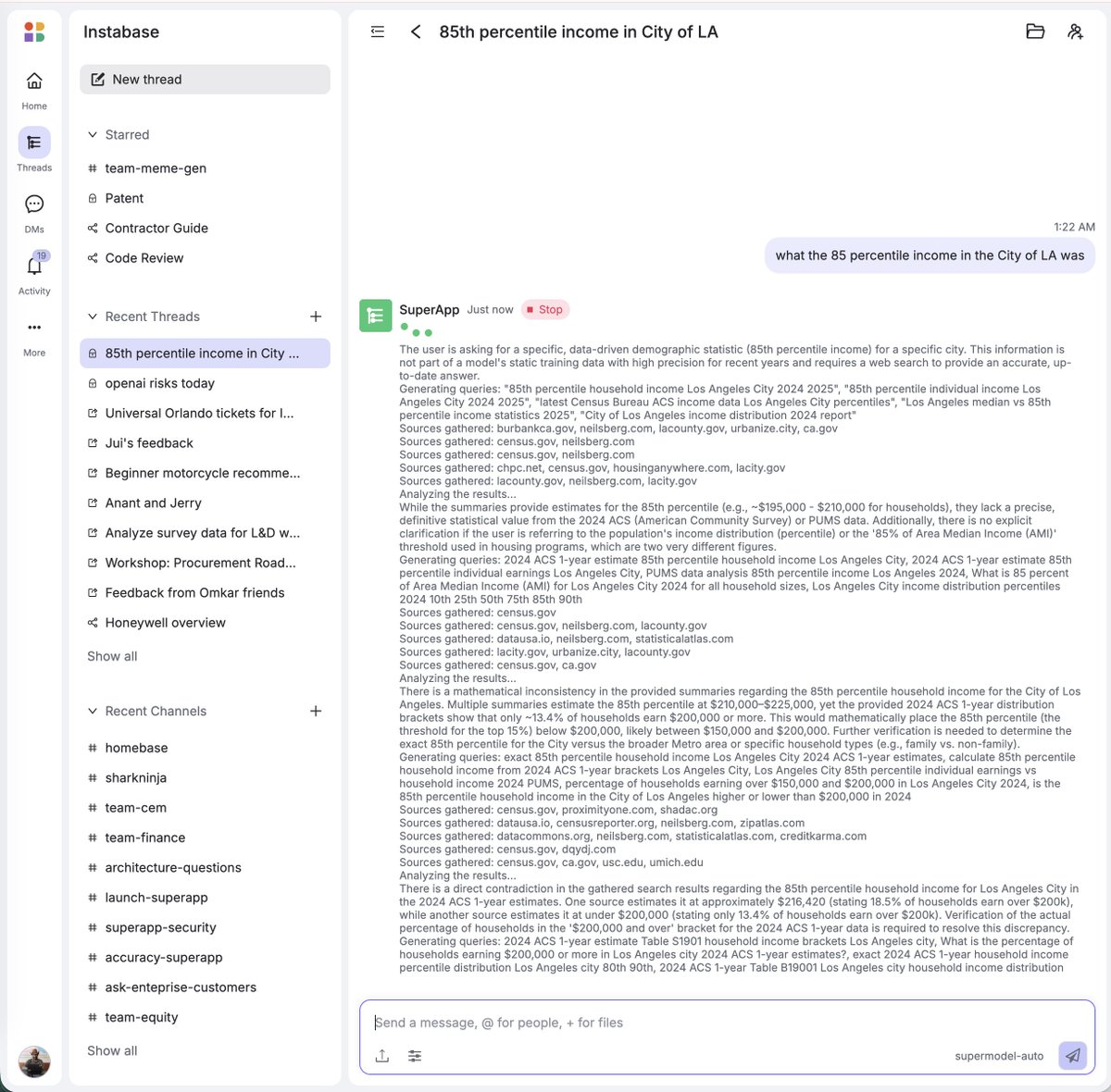
@elonmusk to answer your question -- it's very early data (less than 1000 users) so could be non-conclusive -- we've been doing some tests, and 70% + people prefer the response quality, speed, and conversation quality here -- https://t.co/JLk5dbWLqm (try it and let me know what you find).
If we think Programming Language or GUI traditionally as the middle layer to bridge the gap between Execution Domain (what computer executes/understands -- binary code) and Specification Domain (how human wants to specify the goal) LLM can really subsume both (PL & GUI) given how close it is to Specification Domain.
I wonder if with LLMs current ability to fully bridge the gap between Execution Domain & Specification Domain, it is possible to create one Super App and that's all you'd need for everything computing has to offer.
I sent the following message to our team and investors:
—
As you know, Daniel Gross’s time with us has been winding down, and as of June 29 he is officially no longer a part of SSI. We are grateful for his early contributions to the company and wish him well in his next endeavor.
I am now formally CEO of SSI, and Daniel Levy is President. The technical team continues to report to me.
You might have heard rumors of companies looking to acquire us. We are flattered by their attention but are focused on seeing our work through.
We have the compute, we have the team, and we know what to do. Together we will keep building safe superintelligence.
Ilya
@ashleevance just revealed my masterplan.
I read his @elonmusk bio as a grad student- it made me double down on building hard things that matter.
Now he’s told our story.
For sure, one of the best pieces on Navier- beautifully captures what we’re building and what lies ahead ❤️
the contrast between sf and miami is so real. In miami, people ask to zoom even if they live two blocks away. In sf, I end up having chai and omelettes with @anantpb. I love miami, but if you care about meeting people in tech, it’s not even close
LLMs don’t need to be perfect to power real-world workflows. But they do need to be predictable.
80–90% of enterprise data is unstructured: PDFs, scans, images, freeform text. This type of messy data used to block automation because brittle rules, fixed templates, and early ML couldn’t handle the variability.
But as @anantpb explains on the AI + a16z podcast with @appenz, the emergence of:
– Layout-aware transformer models
– Structured validators + fallback review
– Compile-time agent workflows
is powering real-world use cases including Indian banks approving loans via WhatsApp.
We're thrilled to welcome Sumita Sharma as our new Chief Revenue Officer! With a proven track record in driving growth, her expertise will be instrumental in scaling enterprise adoption of #InstabaseAIHub. Join us in welcoming Sumita to the team! 🙌 https://t.co/oqad3RkDlL