Discover the beauty, precision, and timeless wisdom of Ancient Greek with one-to-one online lessons with an Oxford Classics graduate and Columbia Alumnus
Important to translate English into Ancient Greek while learning Greek to learn grammar and syntax. Then prose composition to understand style.
#alwaysprosecomposition#writeancientgreek
https://t.co/Y8di6RRDSC
@MarkWerling5
Important to translate English into Ancient Greek while learning Greek to learn grammar and syntax. Then prose composition to understand style.
#alwaysprosecomposition#writeancientgreek
https://t.co/Y8di6RRDSC
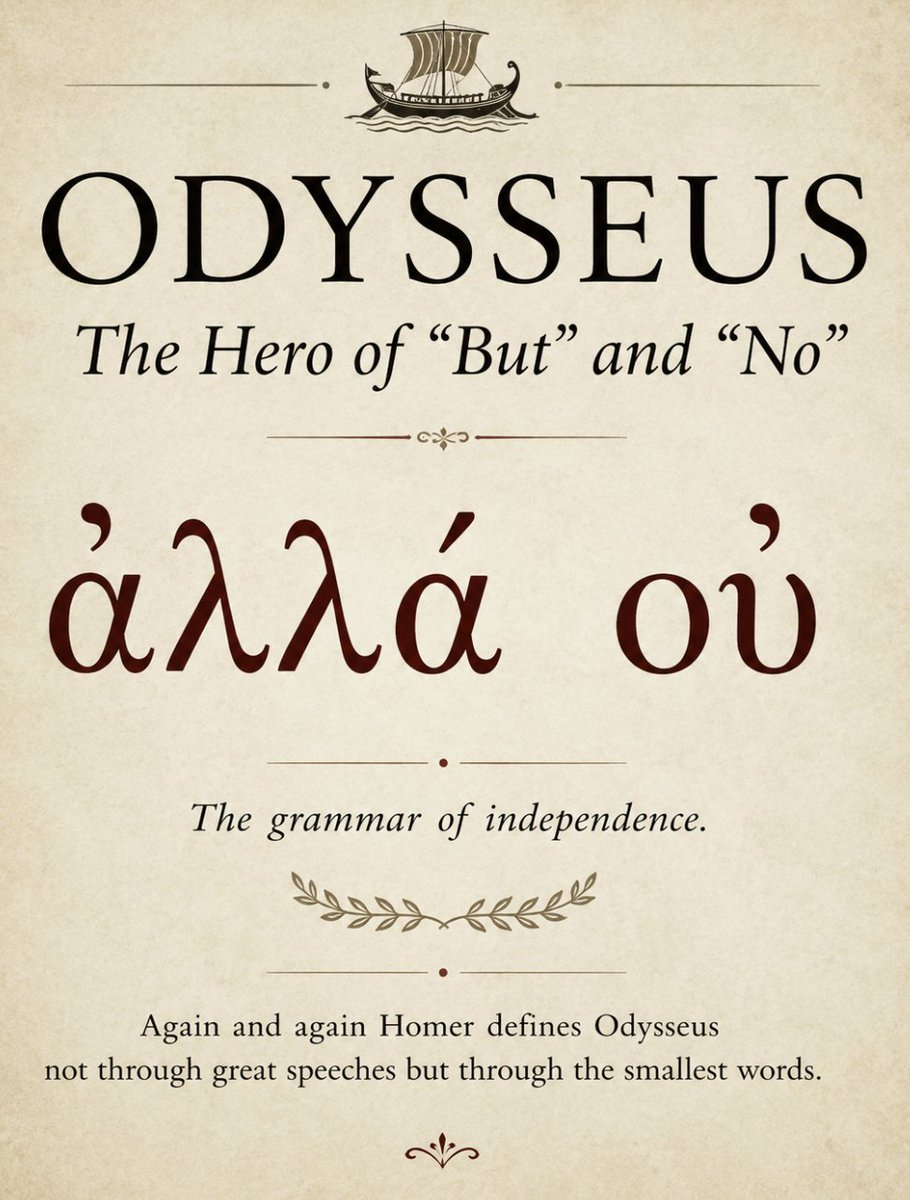
Can something of Odysseus’ character be understood through two seemingly insignificant words: "but" and "no."?
Not merely common particles of Greek grammar, throughout the Odyssey they become the verbal signs of the hero's distinctive character. Again and again Homer places Odysseus at the point of divergence, and that divergence is repeatedly marked by ἀλλά ("but"). For instance, when the gods have decided that he must set out once more for his homeland, and they instruct Hermes, the divine messenger, to tell the nymph Calypso, who has kept Odysseus with her for seven years, having made him her husband. When Hermes arrives at the nymph's cave, she is there; he is not—he’s on the sea-shore:
οὐδ᾿ ἄρ᾿ Ὀδυσσῆα μεγαλήτορα ἔνδον ἔτετμεν,
ἀλλ᾿ ὅ γ᾿ ἐπ᾿ ἀκτῆς κλαῖε καθήμενος . . .
“But the great-hearted Odysseus he found not within;
for he sat weeping on the shore.” (Od. 5.81-2).
The conjunction introduces the moment when Odysseus separates himself from everyone around him. He is not where he is expected to be but alone on the shore; he is offered immortality but chooses mortality. The little word allá thus comes to signify not simple contradiction but the hero's constitutive otherness. Odysseus is always the exception, the man who stands apart.
Alongside this language of separation runs an equally persistent language of refusal. The negative particle οὐ ("not," "no") expresses Odysseus' refusal to surrender his independence. In the cave of the Cyclops, he resists the advice of his companions when it conflicts with his own judgement:
ἀλλ᾿ ἐγὼ οὐ πιθόμην, ἦ τ᾿ ἂν πολὺ κέρδιον ἦεν
“But I did not listen to them—truly it would have been far better” (Od. 9.228)
and, in the supreme paradox of this episode, even negates his own identity by calling himself Outis, "Nobody." Yet this apparent self-erasure becomes the means by which he preserves himself. The author's striking phrase, an "affirmative no," captures the paradox perfectly: Odysseus' negations are not acts of denial for their own sake but assertions of freedom and instruments of survival.
Οὖτις ἐμοί γ᾿ ὄνομα· Οὖτιν δέ με κικλήσκουσι
μήτηρ ἠδὲ πατὴρ ἠδ᾿ ἄλλοι πάντες ἑταῖροι.’
“Nobody is my name, Nobody they call me—my mother and my father, and all my comrades as well.” (Od. 9.366-7)
When Polyphemus, after being blinded, tells the other Cyclopes that Outis (nobody) has tricked him, they refuse to help him. Polyphemus means "Outis" as a proper name, while the Cyclopes hear οὔ τις ("no one"). Their reply uses μή τις, the corresponding form after if (εἰ): "If no one is attacking you..." The pronoun mē tis ("no one") also sounds exactly like the noun mētis (μῆτις), which denotes practical intelligence and may variously be translated as "wisdom," "prudence," "resourcefulness," or even "purpose," "cunning," or "deception."
Together with ἀλλά, Odysseus summed up in two small particles.
(This interpretation is taken from Nicola Gardini’s book Viva Il Greco-alla scoperta della Lingua Madre. It’s not been translated, unlike his companion volume: Long Live Latin. I hope I’ve understood his argument correctly.)
Important to translate English into Ancient Greek while learning Greek to learn grammar and syntax. Then prose composition to understand style.
#alwaysprosecomposition#writeancientgreek
https://t.co/Y8di6RRDSC
@athenodorus_
Important to translate English into Ancient Greek while learning Greek to learn grammar and syntax. Then prose composition to understand style.
#alwaysprosecomposition#writeancientgreek
https://t.co/Y8di6RRDSC
@eulogikon