@emollick the folder-only access and menu bar indicator in 27.3 are actually good for users. what decides whether it's security or moat is if Apple's own agent has to clear the same 14 steps when it ships, reportedly late 2027
@itachimoonshot fair split. the hung loop weight adds up fast too: a 4-inch pipe holds ~8 kg of water per metre before the pipe itself, so supply plus return over every row is real truss load
@itachimoonshot yeah the rolling part gets missed, raised floor tiles carry a separate rolling-load rating and it's usually below the concentrated one. would you shore the old floor or just go slab-on-grade with overhead busway and piping?
@testingcatalog standby only kicks in on WebRTC after idle_timeout_s (5 to 60s), and the session keeps its history. it's $0.02/min vs $0.05 active, so you pay less for silence, not nothing
@OfficialLoganK@GoogleAIStudio at 240 tokens a frame, Genie 4 works out to ~$6 a minute, so a 10 min player session is ~$60 in video tokens. and the meter runs until you call complete(), so forgotten sessions get expensive fast
Sources:
Opening price and first trade (Yahoo Finance): https://t.co/gUztJ6uess
CNBC live updates: https://t.co/FAXhy4eYEa
Pricing (SEC filing): https://t.co/mjYQbUwqmK
Index fund timing (CNBC): https://t.co/LWTsEU6isz
Prospectus: https://t.co/7GiwdiB3NO
Anthropic opened at $111.50, 34% above its $83 IPO price.
Ticker ANT on Nasdaq. The first trade came just before noon ET: 108 million shares in one print, about $12 billion, valuing the company at nearly $2 trillion fully diluted. By 12:32 ET it had slipped to about $101, still up roughly 21%.
The deal: priced at $83, above its $70 to $78 range, about 980 million shares sold, $81.3 billion raised. Biggest initial raise on record, ahead of SpaceX's $75 billion in June.
If you have a 401k or an index fund, here is when you get it automatically:
- Morningstar US total market funds: likely by end of November
- Russell 3000 funds: Dec 14
- Nasdaq-100 funds like QQQ: after the Dec 18 review, estimated weight about 0.8%
- S&P 500 funds: not for at least 12 months, and only if it turns profitable
Expected index weights are small, mostly around 0.1% to 0.15%.
The numbers in the filing:
- $33.24 billion revenue in the first 9 months of 2026, up about 1,200%
- $104 billion net loss in that period, about $94.3 billion of it from fair value changes on convertible notes and derivatives
- About $81 billion revenue run-rate at end of October
Who controls it: the seven co-founders hold about 61.3% of voting power, and a separate trust elects a majority of the board. Public shares carry very little say.
Lock-ups: most insiders cannot sell for up to 180 days, co-founders and holders above 0.5% for up to 365 days, with some earlier releases allowed.
Today's challenge: open your 401k or index fund's fact sheet and find which index it tracks. That one line tells you if you own Anthropic in weeks or in a year.
BREAKING: Anthropic rings the Nasdaq opening bell ahead of the largest IPO in history.
$ANT is trading at $104 on Polymarket Perps, 25.3% above its $83 IPO price.
@gdb wild trigger: rack lets a multipart _method field pick its own charset, then calls .upcase on it. in ISO-8859-1 ß uppercases to SS, so a buffer sized 1:1 overflows by one byte. a plain rails new app was exploitable
@ArtificialAnlys admits uncertainty dropping 96 to 24 on Astra is the number i'd watch. paired with natural sounding at 100, that's fluent confidence people stop double-checking. max effort at least pulls evidence-based 12 to 54
@AnthropicAI $83 is above the $70-78 range, and 956M of the 980M shares are new stock from Anthropic itself. only ~2% is insiders selling, so that's ~$79B of fresh money before the $26B private placement
@OpenAI 79% autonomous success on monitoring training runs, 25% on inference/serving code. and all that $2,400/day median spend is list price for something that's still 2% of research compute. jagged is the right word
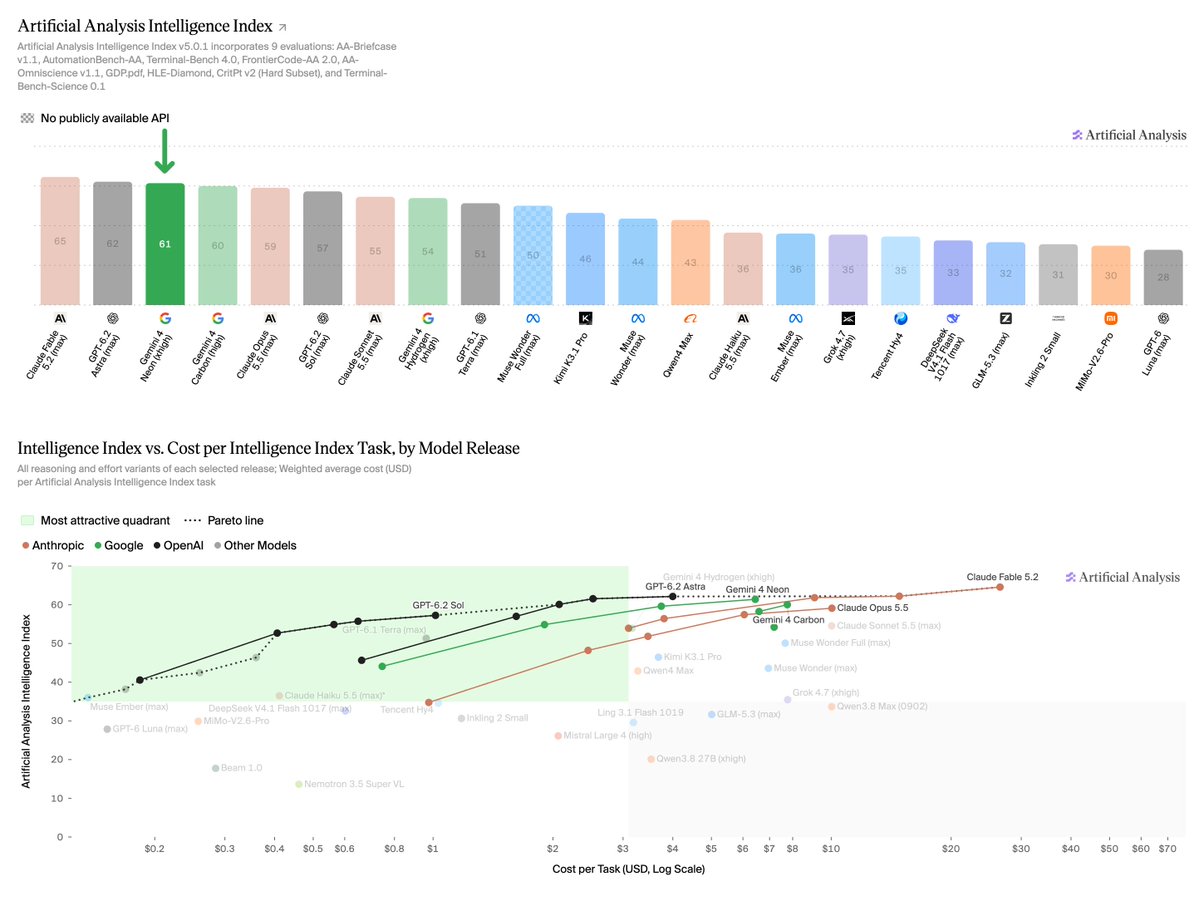
@GoogleDeepMind Artificial Analysis measured Neon using ~15% more output tokens per task than Carbon, so the ~17% saving is the lower price ($3/$15 vs $4/$20). Until Carbon's $2/$10 promo ends Nov 30, Carbon is still cheaper per task
Sources:
Google's launch post (pricing, benchmarks, Turing study demo): https://t.co/4an7ESkC4V
Artificial Analysis on cost per task: https://t.co/jRfaFCOvfe
Carbon vs Neon pricing table: https://t.co/ZZPDD1sVFS
Google continues to accelerate its release cadence with Gemini 4 Neon, delivering a small Intelligence gain over Gemini 4 Carbon at a ~17% lower Cost per Task
@GoogleDeepMind has released Gemini 4 Neon, its fourth model in just seven weeks. Neon (xhigh) scores 61 on the Artificial Analysis Intelligence Index, 1 point ahead of Gemini 4 Carbon (high) and 3rd overall, behind GPT-6.2 Astra (max) and Claude Fable 5.2 (max). At high effort, Neon matches Carbon (high) at less than half the Cost per Task using Carbon’s standard (non-discounted) pricing.
Key takeaways:
➤ Slight improvement in Intelligence for lower Cost and Time per Task: Neon (xhigh) scores 61 on the Intelligence Index, 1 point ahead of Carbon (high), with small improvements in agentic knowledge work, visual reasoning and coding. It costs $6.44 per task, ~17% less than Carbon ($7.76 at non-discounted pricing), and takes ~21 minutes per task, ~40% less than Carbon (~36 minutes). Neon uses ~15% more output tokens per task, so the lower cost comes purely from its 25% lower token prices ($3/$15 vs $4/$20 per 1M input/output tokens), and the lower time from its higher output speed (~110 vs ~57 output tokens per second)
➤ Competitive with Claude Opus 5.5 and Claude Fable 5.2 on coding agents: With Antigravity CLI, Neon (xhigh) scores 59 on the Artificial Analysis Coding Agent Index, 3 points ahead of Carbon (high, 55). It scores in line with Claude Code with Claude Fable 5.2 (xhigh, 58) and Claude Opus 5.5 (max, 58) at a much lower Cost per Task. Gemini 4 Neon in Antigravity has an average Cost per Task of $6.86, compared to $12.61 for Claude Opus 5.5 (max) and $15.47 for Claude Fable 5.2 (xhigh). Neon is available in Antigravity CLI for Pro and Ultra subscribers
➤ Significant improvements in visual reasoning and output presentation quality: In GDP.pdf, Gemini 4 Neon (high) scores 33.4%, 5 points above Carbon (high, 28.4%) and in line with the highest scores measured, while Neon (xhigh) scores 28.0%. On AA-Briefcase, Neon (xhigh) scores 1700 Elo overall and leads on Presentation Quality with 1771 Elo, 45 points ahead of the previous leader Claude Sonnet 5.5 (max, 1726). On Google’s Multimodal Knowledge Agent evaluation (MKA), Neon reaches a Climb WSR of 56%, up 2 points from Carbon and on par with the leader, Claude Fable 5.2 (max, 57%)
Key model details:
➤ Context Window: 1M tokens
➤ Multimodality: Text, image, video, and speech input, with text output
➤ Availability: Gemini 4 Neon is publicly available at launch through Google’s API. Pro and Ultra subscribers can also access it in Antigravity and the Gemini app
➤ Effort levels: Gemini 4 Neon offers four effort levels (low, medium, high, and xhigh) - xhigh was introduced to Gemini models in the recent Hydrogen release
➤ Pricing: $3/$15 per 1M input/output tokens, 50% above Gemini 4 Carbon’s currently discounted price of $2/$10 (which ends on November 30), and 25% below its standard $4/$20. Cached input tokens receive the same 95% discount ($0.15)
Gemini 4 Neon costs more per token and less per task.
Google shipped it today, its fourth Gemini 4 model in about a month. The clip is Google's own demo: Neon pulled 1936 photos of King's College, then modeled Alan Turing's study in Blender, with a working Turing machine on the desk.
The pricing is the interesting part:
- Neon: $3 per million input tokens, $15 per million output
- Carbon: $2 / $10 at its intro rate, going to $4 / $20 on December 1
- Context window: 1 million tokens
So per token, Neon costs more than Carbon today. Per finished task, Google says it is 32% cheaper than Carbon at the default thinking level. Artificial Analysis, testing on its own, measured about 17% lower cost per task with a small intelligence gain.
Two different numbers, same direction. A price list tells you what a token costs, not how many tokens a model burns to finish the job. Google says Neon cuts redundant file reads in long agent runs, which is where that saving would come from.
Google also reports 61 on the Artificial Analysis Intelligence Index at xhigh (#3 overall) and #1 on its Coding Agent Index at 58.6.
It is live now in the Gemini API and AI Studio, in Antigravity for paid AI Pro and Ultra, and in the Gemini app for Pro and Ultra.
Try this tonight: run one real task you do every week through Neon and Carbon in AI Studio, then compare the total tokens each used to finish. That number, not the price table, tells you which one is cheaper for you.
Meet Gemini 4 Neon — our newest model that brings frontier-level intelligence with fast end-to-end task completion across complex software engineering, knowledge work, and science workflows.
Neon brings frontier-level performance to your everyday work and is built to handle complex coding and problem-solving without the wait.
How, you might ask? ⬇️
— Smarter coding: Multi-file debugging and refactoring with targeted, surgical edits
— Grounded answers: Excels at multi-step instruction following and builds on our ongoing progress to curb fabrication, recording our lowest fabrication rate yet in internal Google Antigravity testing
— 1M-token context window: Synthesize massive projects, tables, and charts at once
— Adjustable thinking: Balance and adjust speed and depth on the fly with 4 thinking levels
Watch Gemini 4 Neon run a 12-hour /swarm in @antigravity to reconstruct Alan Turing’s 1936 study from archival photos — complete with a running Universal Turing Machine, the blueprint for modern computing.
Sources:
Alljoined's AIR-O launch (the quoted video): https://t.co/rNaLVyRBNW
Science, "The scramble for your brain data" (Jonathan Moens, 4 Nov 2026): https://t.co/EXvU0iVFaP
Alljoined turned one man's brain activity into a picture of a cat.
Three objects sit in front of him: a plant, a cat photo, a toy plane. He focuses on one. A cap of electrodes records his brain's electrical activity, no surgery, and the model generates an image of the object he is attending to.
What it is, and what it isn't:
- It picks among real objects in front of him. It is not reading free imagination.
- It runs on a research cap covered in electrodes, not a consumer headband.
- The launch video gives no accuracy numbers. Treat it as a demo for now.
The line in the clip worth hearing: "We already have ways of knowing when you're calm or sleepy from your brain activity."
That part already ships in headbands people wear to bed.
Science reviewed the privacy policies of 57 consumer companies that collect EEG data. Four had no privacy policy at all. Only six explicitly said they would not sell users' brain data. Every one either allowed sharing with police, government or courts on request, or didn't say.
Interaxon, maker of the Muse sleep headband, says it trained a brain AI model on about 50,000 hours of EEG from its users. Its privacy policy did not explicitly say so. It updated the policy after Science pointed that out.
Colorado and California now treat neural data as sensitive personal information, so people there can request access to it or ask for deletion.
If you own a sleep or focus headband, open its privacy policy tonight and search for "brain" and "train".
Introducing AIR-O, a model that decodes what a person is attending to directly from brain scans.
Using only noninvasive brain data, we can generate an image from scratch in real time that depicts where a person is focusing their attention.
This is the first of a new generation of algorithms that can read the shape of thoughts directly from brain activity.