NEWS: Boston Dynamics has just released a new video of its upgraded next-generation humanoid robot called Atlas.
• 4 hour battery. Self-swappable for continuous operation
• 6 feet 2 inches tall
• Weight: 198 lbs
• 56 total degrees of freedom
• Now fully electric, ditching older hydraulic systems
• New lightweight mix of aluminum and titanium components
• 110 lbs weight capacity (66 lbs sustained)
• Can reach up to 7.5 ft
• Constantly evaluates its surroundings and adjusts its posture, balance, and grip in real time
• Hands that can reconfigure as needed. Tactile sensors feed data back into the system, helping apply the right amount of force
• Brain is powered by Nvidia chips
Sim-to-real learning for humanoid robots is a full-stack problem. Today, Amazon FAR is releasing a full-stack solution: Holosoma.
To accelerate research, we are open-sourcing a complete codebase covering multiple simulation backends, training, retargeting, and real-world inference.
I've been working on deformable object manipulation since my PhD. It was totally a nightmare years ago and my PhD advisor was telling me not to work on it for my own good.
Today, at ByteDance Seed, we are dropping GR-RL, a new VLA+RL system that manages long-horizon precise dexterous manipulation of deformable objects.
This is probably the first real-world RL system to make a robot:
✅ Lace up your shoes end to end
✅ Hit millimeter tolerance repeatedly
✅ Recover from mistakes (See video!)
✅ And complete continuous shoelace threading on a real bimanual platform
📈 Success rate: ↑ from 45.7% → 83.3%
Yes, robots can now actually do this.
Project page: https://t.co/JfOGajAXiY
ArXiv: https://t.co/xFfAE9isdo
Robot simulation is getting a big upgrade! 🔥
Normally, building a simulation environment, a kitchen, warehouse, office takes days or weeks.
You have to model the geometry, add textures, set lighting, generate collision meshes… all before a robot can even interact with it.
Marble by @theworldlabs removes most of that work.
You type a text prompt or give it an image, and it generates a full 3D scene with depth, lighting, and a collider mesh you can export into engines like MuJoCo.
That means researchers can quickly create lots of different environments to train robots on, which is exactly what domain randomization needs.
If we want robots to learn faster, we need to create worlds faster.
~~
♻️ Join the weekly robotics newsletter, and never miss any news → https://t.co/GoA3ZuwoPB
I'm very excited to finally announce one of the most ambitious projects we've worked on — which makes the front cover of Science Robotics today:
☀️ Learning a Thousand Tasks in a Day ⭐️
Everyday tasks — like those below — can now be learned from a single demonstration each...
MimicKit now has support for motion retargeting with GMR. We also released a bunch of parkour motions recorded from a professional athlete, used in ADD and PARC.
Anyone brave enough to deploy a double kong on a G1? 😉
Another humanoid robotics startup, Norway-based Physical Robotics, is out of stealth.
The company was founded by Phuong Nguyen, a co-founder of Halodi Robotics (now rebranded as 1X Technologies). He was Chief Science Officer at Halodi for eight years, leading the development of the EVE robot.
The new company's mission is to “create a generation of robots that live in harmony with humans in the physical world, enhancing the quality of human life.”
Last week, the company announced the closing of a $4 million seed round. Here's the upper body concept of their humanoid, the π robot.
We're taking the next big step with Researcher.
With Computer Use, it can now securely browse the open and gated web to find hard-to-locate information—even across hundreds of sites—and handle multi-step tasks to uncover insights, take action, and create richer reports.
Coming to mjlab today! This is vanilla RL, no motion imitation/AMP. Natural gaits emerge from minimal rewards: velocity tracking, upright torso, speed-adaptive joint regularization, and contact quality (foot clearance, slip, soft landings). No reference trajectories or gait patterns. Walking, running, and arm swing emerge purely from optimizing these simple objectives. Oh and training time? Just 1 hour.
Most humanlike robotic hand
ever built❓
Developed by @SharpaRobotics in Singapore, it’s a 1:1 life-size, 22-DoF robotic hand designed for both precision and strength!
Capable of manipulating fragile objects like an egg or applying 30 N of fingertip force without damage.
✅ Over 1,000 tactile pixels per fingertip with 0.005 N sensitivity
✅ Dynamic Tactile Array operating at 180 FPS for real-time feedback
✅ Certified for 1 million grip cycles without failure
✅ Ethernet interface, ROS and MuJoCo compatible
This isn’t a lab prototype.
Sharpa began mass production and customer shipments in October 2025.
Full details: https://t.co/JWdnhRIQHA
—-
Weekly robotics and AI insights.
Subscribe free: https://t.co/dsa6wcvq6n
Humanoids are riding bikes...
They showed a video of a humanoid (G1) riding around a bike at IROS25. Absolutely wild.
Turns out people can do clever stuff with humanoids if companies actually ship them.
Humanoids are riding bikes...
They showed a video of a humanoid (G1) riding around a bike at IROS25. Absolutely wild.
Turns out people can do clever stuff with humanoids if companies actually ship them.
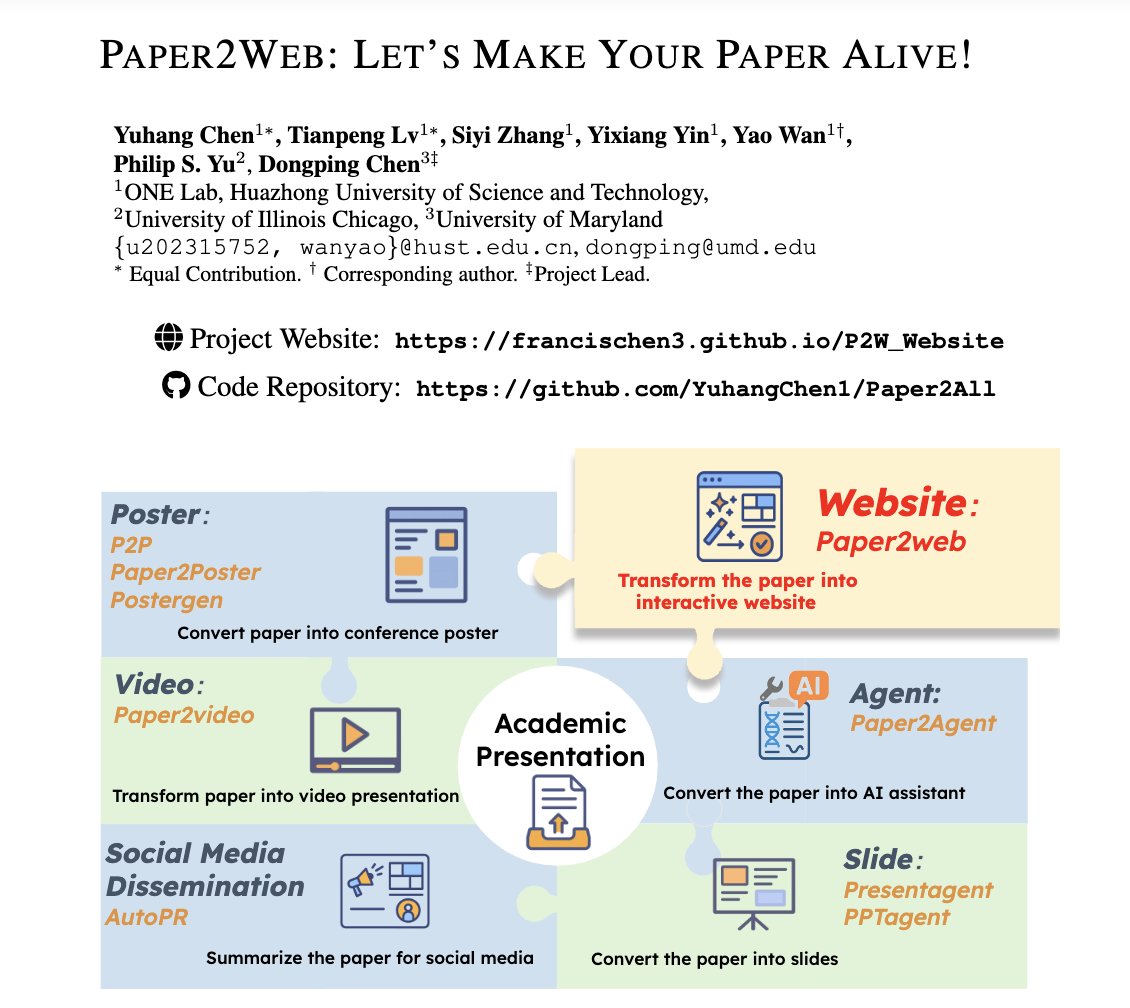
🔥 Holy shit… academia just had its “ChatGPT moment.”
Stanford researchers just dropped Paper2Web and it might have just killed the PDF forever.
It turns research papers into interactive websites with videos, animations, and even working code, all generated automatically by an AI agent called PWAgent.
Here’s why this is insane:
• Built on a dataset of 10,700 papers the first ever benchmark for academic webpages
• Evaluates sites by connectivity, completeness, and interactivity (even runs a PaperQuiz to test reader retention)
• Outperforms arXiv HTML and alphaXiv by 28%+ in usability
This isn’t just prettier formatting it’s a new medium.
Readers can explore, interact, and learn instead of scroll and skim.
The static PDF era is dead. Your next paper might talk back.
https://t.co/mF4USKlaAq
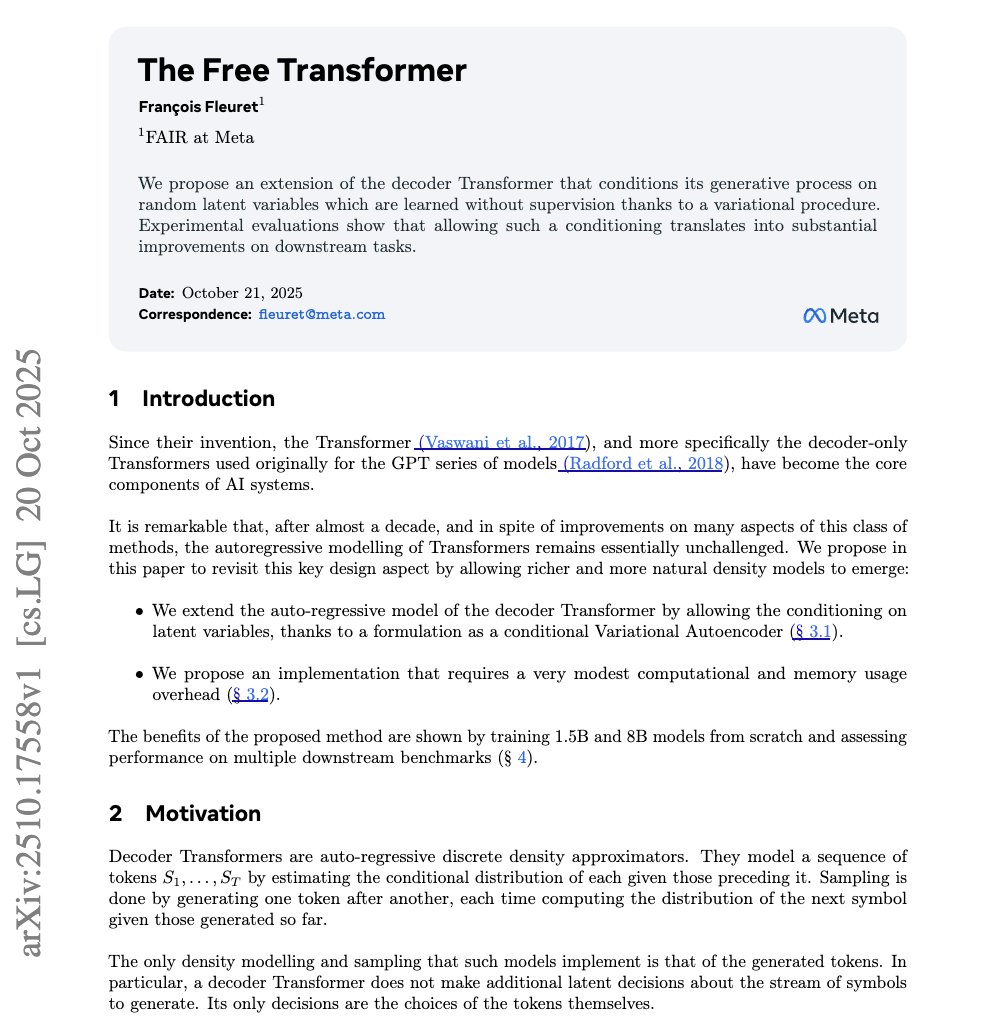
🚨 Holy shit...Meta just rewrote how Transformers think.
They built something called The Free Transformer and it breaks the core rule every GPT model has lived by since 2017.
For 8 years, Transformers have been blindfolded forced to guess the next token one at a time, no inner plan, no latent thought.
Meta gave it one.
They added random latent variables inside the decoder so the model can secretly decide how it wants to generate before it starts talking.
It’s like giving GPT a hidden mind.
Result:
🧠 Smarter reasoning
⚡️ 3% compute overhead
📈 Outperforms larger baselines on GSM8K, MMLU, and HumanEval
It’s the first Transformer that doesn’t just predict it intends.
Full paper: arxiv. org/abs/2510.17558v1
today, we're releasing the largest egocentric dataset of physical jobs
- 400k action labels
- 2.5k clips
- 2x'd open source dataset size
(download below)
1/ The future of general-purpose robotics will be decided by one major question: which flavor of data scales reasoning? Every major lab represents a different bet.
Over the past 3 months, @adam_patni, @vriishin, and I read the core research papers, spoke with staff at the major labs, and mapped the talent pool. This has completely changed how we think about general-purpose robotics.
Our paper builds intuition, step-by step, across the 2025 frontier: from architectures → evals → data → industry dynamics. Each layer reveals a different bottleneck, but they all converge on one truth—data decides everything.
Our takeaways + process below👇
If you want access to our graph (sound on), comment or DM me
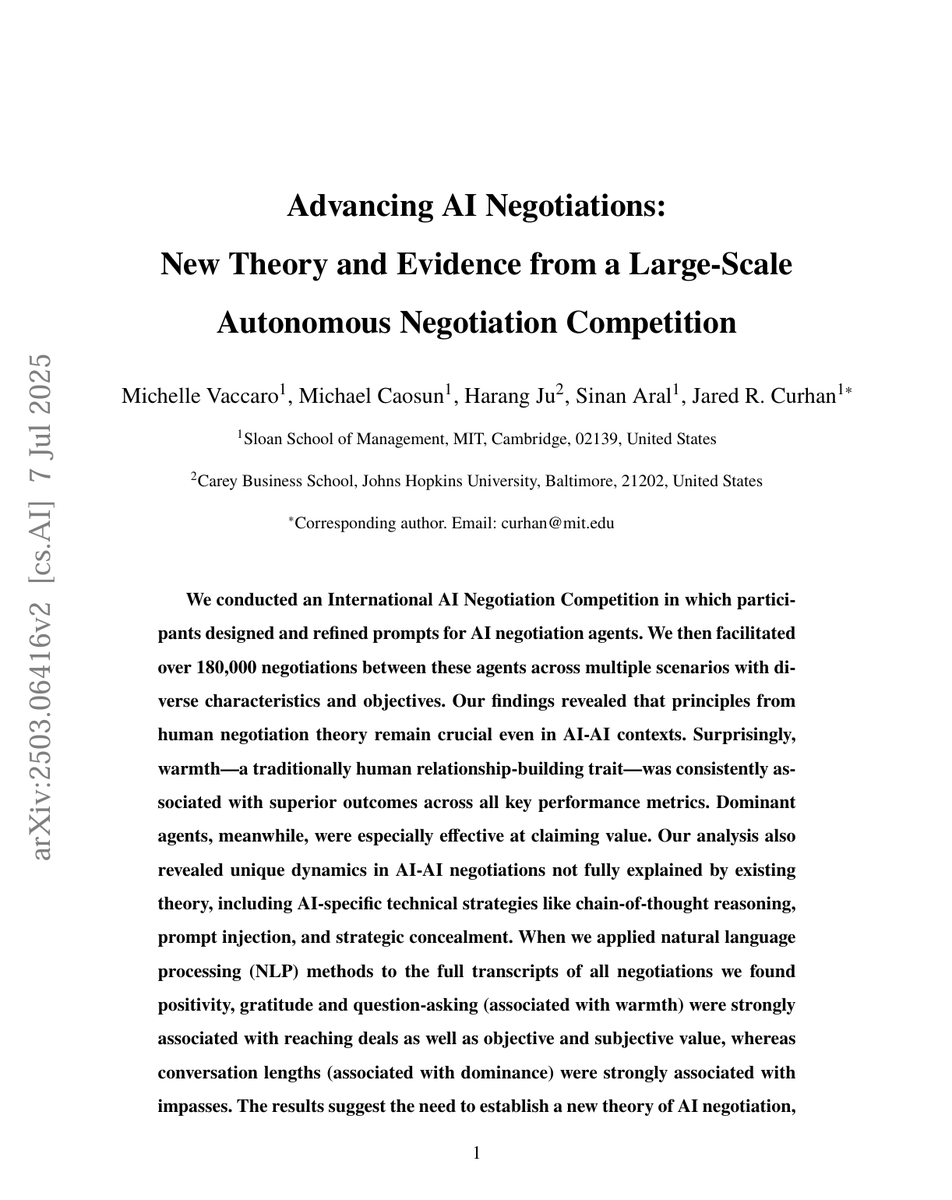
by 2026, 40% of B2B deals will be AI-agent-to-AI-agent negotiations.
humans won't even be in the room.
sounds like sci-fi? Walmart's already doing it. right now.
68% of their supplier negotiations are handled by AI chatbots. no human buyers involved.
and here's the part nobody's ready for:
75% of suppliers prefer negotiating with the AI over a human.
let that sink in.
your sales team is perfecting their pitch decks and rapport-building techniques.
meanwhile, Walmart tells an AI its budget and needs, then the AI negotiates directly with suppliers. closes deals in days instead of weeks. saves 3% on every contract.
but Walmart's just the beginning.
Gartner predicts 40% of enterprise applications will have task-specific AI agents by 2026.
by 2027, 50% of procurement contract management will be AI-enabled.
which means your customers' purchasing departments are building AI agents right now.
and soon, your AI will be negotiating with their AI.
zero humans. zero small talk. just algorithms finding optimal deals in seconds.
here's what the research actually shows (and why you're not prepared):
Unitree Introducing | Unitree H2 Destiny Awakening!🥳
Welcome to this world — standing 180cm tall and weighing 70kg. The H2 bionic humanoid - born to serve everyone safely and friendly.