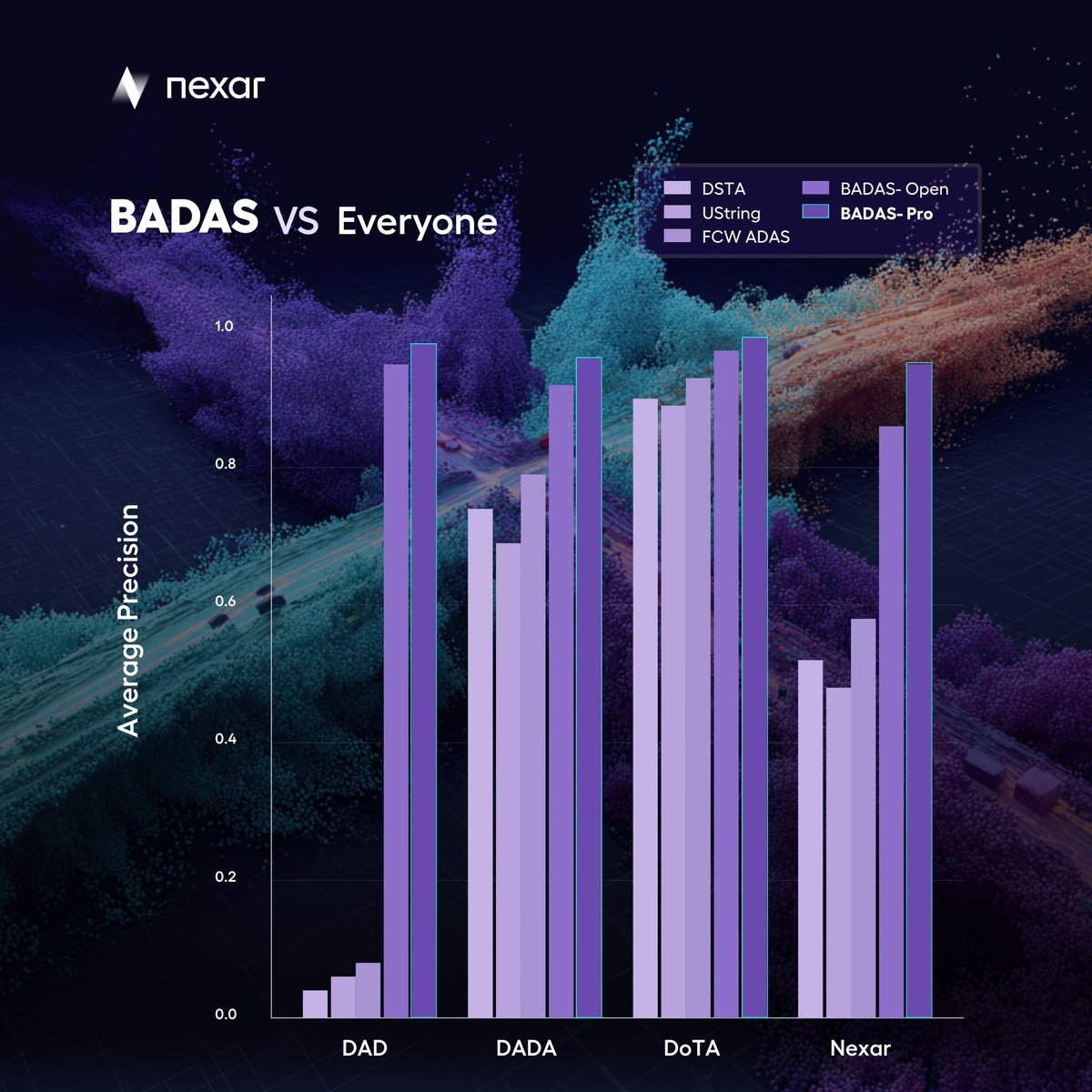
We just built the best collision prediction model on the planet.
BADAS 2.0: 99.4% AP. Built on V-JEPA2, Yann LeCun's physical AI architecture. A true world model that understands reality, not just the road.
Explainable. Generalizes beyond driving. Runs from cloud to edge. Our 22M model beats NVIDIA's 2B Cosmos.
We published the benchmarks. We're inviting comparison.
Safer roads, safer cars. That's the point.
Run your own videos on BADAS 2.0, link in the first reply.
The founder of Postman says you have to kill your existing org chart, especially if you're still operating with a pre ai hierarchy arrangement.
The modern org chart, according to @a85:
- wide span of control (even within exec team)
- work directly with ICs, not through layers
- either you're building, or you're selling
Projects are led by staff/principal engineers with high agency. They see across the board as well as deep in the stack.
Product managers are building APIs and prototyping in Claude instead of writing PRDs.
Designers are shipping PRs through Cursor directly instead of relying solely on Figma.
Everyone is building. And the management's job is to develop better judgment.
The people getting the most out of these tools aren't prompt engineers. They're people who already think clearly about systems and can decompose problems well.
AI coding assistants don't replace thinking. They reward it.
The learning curve for AI-assisted coding is counterintuitive.
Day 1: "This is magic. I built something in an hour."
Day 7: "This is frustrating. It keeps making mistakes I have to fix."
Day 30: "Oh. The skill isn't prompting. It's knowing what to ask for."
The bottleneck isn't the AI. It's your own clarity about what you're trying to build.
Vague intent → vague output.
Clear architecture in your head → the AI becomes a force multiplier.
I'm not saying every PM needs to code. I'm saying every PM needs to know what's now possible to build quickly, so they stop over-specifying things that could be tested in an afternoon.
The spec is no longer the starting point. The prototype is.
Hot take: In 2026, the most valuable product managers are the ones who can ship a prototype before the sprint planning meeting.
Not because PMs should become engineers. But because the feedback loop changes completely when you can test an idea in hours instead of weeks.
If you're in product and haven't actually built something with these tools yet — not read about them, not watched demos, actually built — find a few hours to just mess around. It'll change how you think about what's possible.
Interesting pattern I've noticed: people's AI building skills grow disproportionately during vacation periods.
I think the difference is permission to tinker. During work, there's always something more urgent. On vacation your brain finally gets space to play.
Two weeks to CES.
We are coming. And bringing model that predicts danger before it appears. An open invitation to benchmark, build, and challenge.
Still validating on simulations? Or ready to test against 10 billion real miles?
Take a look and reach out: https://t.co/9ESxzdkJvz
#CES2026 #BADAS #RealWorldAI
BADAS: 0.948 Average Precision.
Top academic models: 0.53.
Not a marginal improvement. A different category.
With a 3-5 second alert window that actually matches human reaction time. Trained on real crashes while public datasets carry 90% irrelevant footage.
When your training data is real, your results are too.
Visit here for more: https://t.co/40GlFfsF1r
#BADAS #CollisionPrediction #RealWorldAI
If you need a driver's license, why wouldn't the AV that will drive your kids to school need one too?
Check out Nexar Apex here: https://t.co/gvjlFwF2Hc
Simulation is a dojo. The road is a pub brawl.
In a simulation, there are rules and referees. In the real world, there is broken glass, zero rules, and complete chaos.
Simulation is tidy. The probabilities are polite. Real roads can be a fight.
Today, we introduce Nexar APEX.
We are done grading AI on a curve. We are grading it against 10 billion miles of ground-truth human driving.
But you can’t just grade the driver. You have to grade the road.
That’s why APEX includes the AV City Readiness Index.
We quantify the "difficulty level" of every city, measuring collision density, construction zones, and harsh braking, to ensure your safety score is weighted by reality.
If your stack can’t handle the messiness of human reality, it doesn’t belong on the road. It belongs in a server room.
Check out Apex here: https://t.co/AvgWjtlUhE
#AVTesting #RealWorldData #AutonomousDriving
Nexar named to @Inc's 2025 Best in Business list.
Recognition earned the hard way: 1.3B real miles/year of human driving.
Synthetic shortcuts can’t measure safety.
The real world is the only foundation for machine intelligence.
https://t.co/3CzZZPtFIp
#BestInBusiness #RealWorldAI
Nexar beat the SoTA incident prediction models.
BADAS (Beyond ADAS), trained on 10B+ real-world miles, doesn’t just see the road; it understands it.
Discover what you can build with real-world data: https://t.co/vP5iq0X1Sf
#BADAS#AI#ADAS#PredictiveAI
The future of autonomy isn’t about billions of miles. It’s about finding the rare ones that actually matter.
@lucvincent unpacks the real AV challenge: long-tail data.
Read the full breakdown → https://t.co/KDSGYtEX6J
#ADAS#Autonomy#AV#AI#BADAS#MobilityData
Nexar’s real-world data just built the best incident prediction model — Meet BADAS 1.0. 🔥
It beat state-of-the-art models by learning from 10B+ real miles and 60M+ real events, not simulations.
🚀 Discover what it can do for you: https://t.co/Apspa7Y6LR
#BADAS#AI#ADAS #AutonomousVehicles #RoadSafety
@paulg We’re using AI to code in programming languages that we built to abstract the complexity of computers. Asking AI to use them is an unnecessary intermediate step.