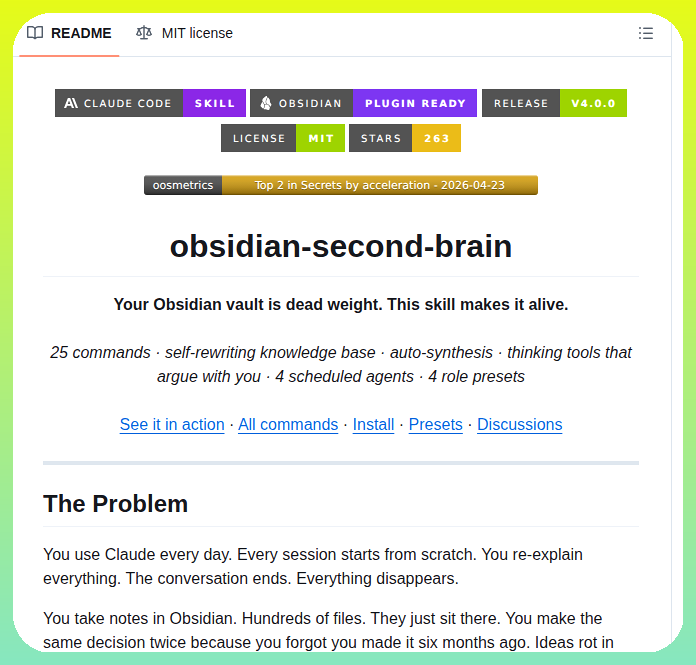
El ingeniero que creó claude code acaba de soltar un video de 28 minutos donde te enseña a escribir prompts que realmente funcionan.
He visto cursos de 300 dólares que no llegan ni a la mitad de lo que explica en los primeros 10 minutos.
Archivos CLAUDE.md, atajos de memoria, sesiones paralelas y patrones de prompting que cambian el juego.
Todo en un solo video y completamente gratis.
Da igual si eres desarrollador, principiante o ya llevas meses usando Claude. Esto te va a volar la cabeza.
THIS IS KARPATHY'S OBSIDIAN VAULT, THE BRAIN BEHIND A MILLION-DOLLAR COMPANY
This is every idea, every decision, and every connection one person has made over years of work, visualized in real time.
The human brain processes up to 11,000,000 bits of information per second, but consciously uses only 50.
Inside this network:
→ thousands of nodes
→ hundreds of active links between ideas
→ 140+ decision-making processes per hour of work
→ years of compressed thinking living inside a single system
make sure to bookmark it before it gets lost in your feed
below I wrote a guide on how you can build yours for FREE (2 mins setup)
> do you understand what Claude Opus 4.8 just did to the Google job market
> a senior Google engineer with 11 years of experience
> stacked 32 Claude skills on top of his workflow
> 8hrs → 2-3hrs per day
> $95K developer vs $300K AI architect
> same job. different stack. very different salary
> the exact skill list is here 👇
Atlassian's CEO after firing the engineer who built their $1.79B infrastructure and the guy released a 38-minute breakdown of everything he built, free for anyone to copy
andrej karpathy spent two hours teaching one thing: tokens are the atom of llms. tokenization is at the heart of every llm weirdness you've ever debugged.
[watch the 15-min clip below. then run the 7-day playbook]
↓ save this before everyone copies it
learn how the tokenizer works. understand how your llm actually consumes input. then run the engineering roadmap that took one production agent from $4,800/mo to $620/mo in 7 days.
87% reduction. no model swap. no framework migration. no quality drop on the eval set.
token cost in 2026 is an engineering discipline. every line of your system prompt is rent you pay forever.
what was eating the budget:
→ a single forgotten cron job ate 47% of one team's bill. they turned it off on a tuesday and the bill dropped before they wrote any optimization code.
→ anthropic ships a 90% discount on cache reads. one config line, cache_control ephemeral, break-even after one hit. most teams cache the volatile parts of the prompt and watch their hit rate sit at 12%.
→ one production agent went from 14,500 tokens of context overhead per turn to 850. a 94% drop. output quality held within 2% of the uncompressed baseline.
→ 60% of agent calls are haiku-tier work running on opus rates. classify the task first. pick the model second.
→ retry loops are the silent killer. no MAX_STEPS bound, one bad search query, $14 burned in a single session. one team traced 38% of their bill to this single pattern.
karpathy gave you the atom. the playbook below gives you the harness.
watch the lecture. read the playbook ↓
У червні в Японії презентують ще одну манґу, присвячену українським оборонцям 🇯🇵🫶🏼🇺🇦
Ілюстратор Мацуда Джюко, який у 2022 році випустив популярний в Японії комікс про Привида Києва, випустить нову роботу про воїнів української ППО.
Shahed Hunter («Мисливець на “шахеди”») — історія про тих, хто береже українське небо й відбиває російські атаки. Її офіційна презентація відбудеться під час фестивалю авторських коміксів Comitia 156, що пройде 7 червня в Токіо.
фото і новина: matsudaHI, X (Twitter)
🚨 BREAKING: Someone just built a web-based System Design Simulator.
It's called Paperdraw. It lets you drag and drop components to see how they handle real-world conditions like traffic, failures, latency, and scaling in real time.
100% free to try.