Honestly, i don't understand this economy when nursing homes are so expensive they bankrupt our grandparents but nursing home aides need to use food banks.
daycare is so expensive it eats up one parent's entire paycheck and yet daycare providers only make $10/hr and need second jobs.
college costs hundreds of thousands of dollars and puts students into debt for life and yet we have thousands of professors living in their cars.
everything we need is astronomically expensive and yet almost none of the money we pay is going towards the people actually doing the work and providing the services.
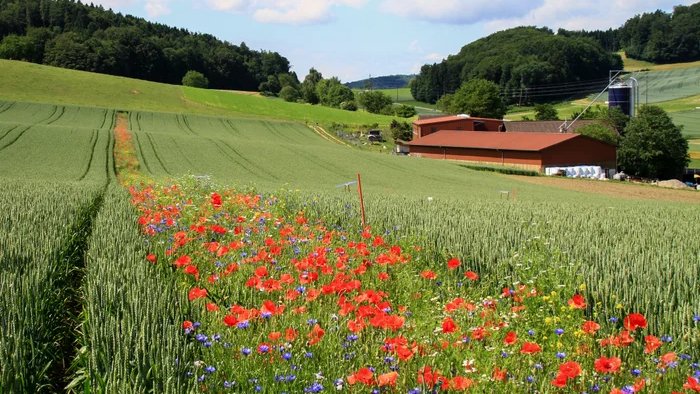
Farmers have figured out that the cheapest pesticide is a strip of flowers.
When you plant wildflowers through a crop field, not just around the edge but in strips running through the middle, you get ladybugs, lacewings, hoverflies, and parasitic wasps living in the field instead of visiting it.
They eat the aphids, the caterpillars, and the mites for free, all summer long.
In controlled trials, fields with tailored flower strips had leaf-beetle numbers 40 to 50% lower and crop damage cut by around 60%, enough to drop below the threshold where spraying was even considered worth it.
The flowers attract a standing army to our fields.
We spent decades engineering chemicals to kill the insects eating the crop, when the insects that eat those insects would have worked for the price of seed.
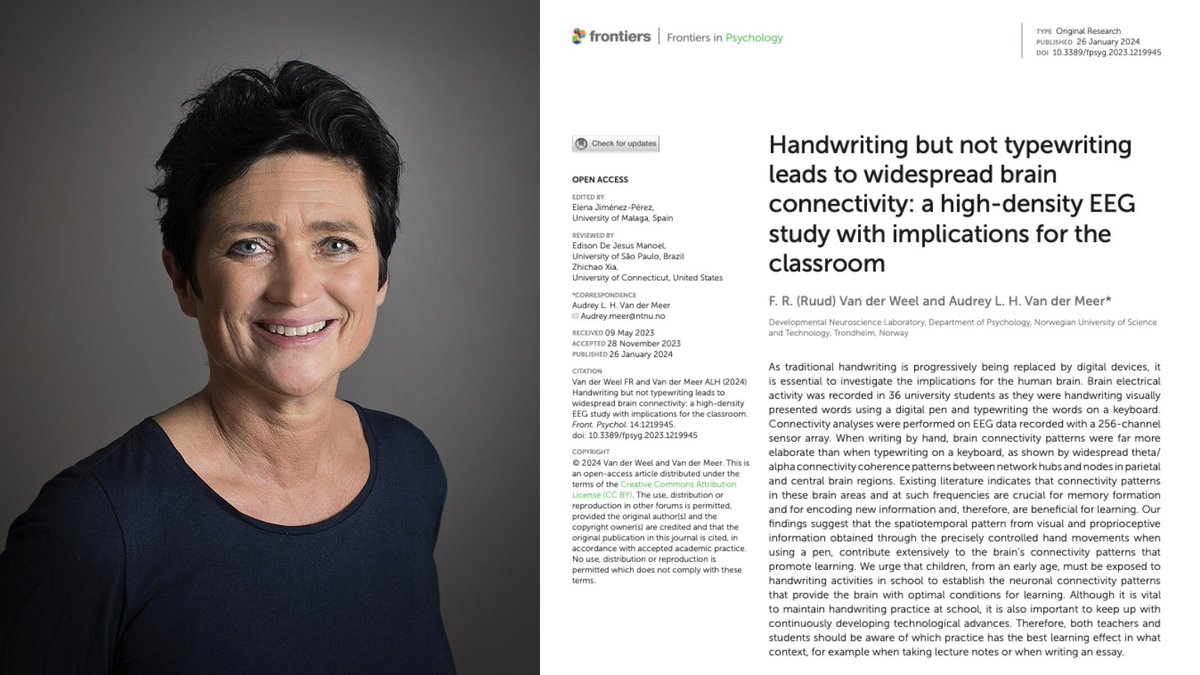
A Norwegian neuroscientist spent 20 years proving that the act of writing by hand changes the human brain in ways typing physically cannot, and almost nobody outside her field has read the paper.
Her name is Audrey van der Meer.
She runs a brain research lab in Trondheim, and the paper that closed the argument was published in 2024 in a journal called Frontiers in Psychology. The finding is brutal enough that it should have changed every classroom on Earth.
The experiment was simple. She recruited 36 university students and put each one in a cap with 256 sensors pressed against their scalp to record brain activity. Words flashed on a screen one at a time.
Sometimes the students wrote the word by hand on a touchscreen using a digital pen, and sometimes they typed the same word on a keyboard. Every neural response was recorded for the full five seconds the word stayed on screen.
Then her team looked at the part of the data most researchers had ignored for years, which is how different parts of the brain were communicating with each other during the task.
When the students wrote by hand, the brain lit up everywhere at once.
The regions responsible for memory, sensory integration, and the encoding of new information were all firing together in a coordinated pattern that spread across the entire cortex. The whole network was awake and connected.
When the same students typed the same word, that pattern collapsed almost completely.
Most of the brain went quiet, and the connections between regions that had been alive seconds earlier were nowhere to be found on the EEG.
Same word, same brain, same person, and two completely different neurological events.
The reason turned out to be something nobody had really paid attention to before her work. Writing by hand is not one motion but a sequence of thousands of tiny micro-movements coordinated with your eyes in real time, where each letter is a different shape that requires the brain to solve a slightly different spatial problem.
Your fingers, wrist, vision, and the parts of your brain that track position in space are all working together to produce one letter, then the next, then the next.
Typing throws all of that away. Every key on a keyboard requires the exact same finger motion regardless of which letter you are pressing, which means the brain has almost nothing to integrate and almost no problem to solve.
Van der Meer said it plainly in her interviews.
Pressing the same key with the same finger over and over does not stimulate the brain in any meaningful way, and she pointed out something that should scare every parent who handed their kid an iPad.
Children who learn to read and write on tablets often cannot tell letters like b and d apart, because they have never physically felt with their bodies what it takes to actually produce those letters on a page.
A decade before her, two researchers at Princeton ran the same fight using a completely different method and ended up at the same answer. Pam Mueller and Daniel Oppenheimer tested 327 students across three experiments, where half took notes on laptops with the internet disabled and half took notes by hand, before testing everyone on what they actually understood from the lectures they had watched.
The handwriting group won by a wide margin on every question that required real understanding rather than surface recall.
The reason was hiding in the transcripts of what the two groups had actually written down.
The laptop students typed almost word for word, capturing more total content but processing almost none of it as they went, while the handwriting students physically could not write fast enough to transcribe a lecture in real time, which forced them to listen carefully, decide what actually mattered, and put it in their own words on the page.
That single act of choosing what to keep was the learning itself, and the keyboard had quietly skipped the choosing and skipped the learning along with it.
Two studies. Two countries. Same answer.
Handwriting makes the brain work. Typing lets it coast.
Every note you have ever typed instead of written went into your brain through a thinner pipe. Every meeting, every book highlight, every idea you captured on your phone instead of on paper was processed at half depth.
You did not forget those things because your memory is bad. You forgot them because typing never woke the part of the brain that would have made them stick.
The fix is the thing your grandmother already knew.
Pick up a pen. Write the thing down. The slower road is the faster one.
Young people today don't hate rich people they are mad that...
- they were talked into too much student debt
- they can't buy homes
- their wages are up 2x while houses up 9-10x
- inflation is eating them up and they own no assets
No wonder they don't like capitalism. They haven't been able to truly participate in it yet.
every school should have a "fix-it lab" where students learn to repair their clothes, bikes and electronics. we should grow up knowing that not everything is disposable, that care and repair are part of living well on this planet.
A cow, given grass and rain, produces:
Meat. Complete protein, top of the bioavailability table.
Milk. So nutritionally complete we feed it to our young.
Leather. Ten thousand years of footwear. Composts when you're done.
Tallow. Stable cooking fat, soap, candles. Currently being sold back to us as skincare at eight times the butcher's price.
Bones. Broth, tools, fertiliser.
Organs. The most nutrient-dense food on earth, ignored by the culture that buys three supplements to replace them.
Manure. Grows the grass. The cycle runs again.
Try to engineer that. A machine that takes rain and a patch of grass and produces six complete products while improving the soil and reproducing itself.
You can't. We haven't.
We're being told to eliminate them. While flying almonds in from California.
Beautiful workmanship of Ukrainian pysanka. Even in the darkest times, Ukrainians create beauty.
Traditionally, pysanky are created during Lent. This is a 1,000-year-old Ukrainian tradition of decorating eggs with intricate, symbolic designs, created using a wax-resist method passed down through generations.
Each pattern tells a story. Every color carries meaning. Red symbolizes love and life. Black represents eternity. Yellow reflects the sun and harvest.
But a pysanka is more than art. It is a language. A quiet prayer. A message of protection and hope.
For centuries, Ukrainians have created these eggs in times of both peace and hardship. And today, as Ukraine endures war, this tradition continues, reminding the world that culture, identity, and faith cannot be broken.
Fascinating! And the exact opposite of what's happening with LMM's and social media.
So what if this was the first step? Finding the creativity inside us instead of trying to outsource that piece and then losing it completely...
Every writing teacher who told you "be concise" accidentally murdered your best ideas.
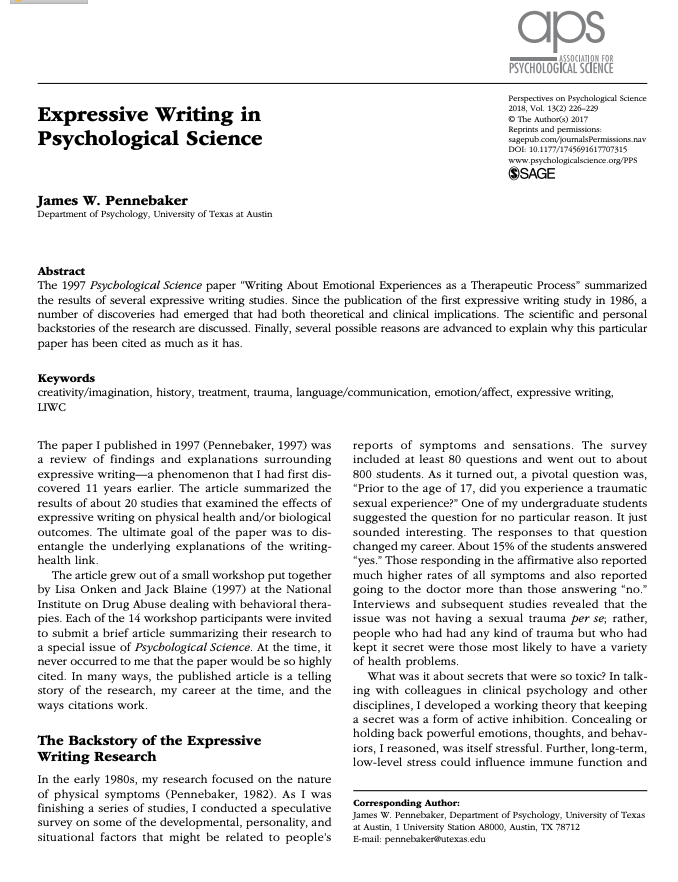
In 1987, psychologist James Pennebaker ran an experiment that broke every assumption about how human creativity works. He divided college students into two groups and gave them the same creative writing prompt. Group A had to write for 15 minutes without stopping, elaborating on every thought that surfaced. Group B had to write concise, polished responses in the same time frame.
The elaborate writers didn't just produce more ideas. They produced fundamentally different types of ideas. Brain scans showed their prefrontal cortex entered a state resembling REM sleep, where distant neural networks suddenly started talking to each other. The concise writers showed patterns identical to focused problem-solving mode, which actively suppresses creative connections.
Six months later, Pennebaker tested both groups again. The elaborate writers had continued generating novel solutions to unrelated problems at twice the rate of the concise group. The act of elaborative writing had permanently rewired their associative thinking patterns.
The advice sounds logical. Cut the fat. Trim the excess. Get to the point faster. What they missed is that ideation and communication are completely different cognitive processes, and optimizing for one destroys the other.
When you write elaborately, your brain enters what cognitive scientists call "divergent thinking mode." Each additional sentence forces your mind to find new angles, make unexpected connections, discover relationships between concepts that would never surface in a stripped-down version. The elaboration itself becomes the thinking tool.
Watch what happens when you try to explain a simple concept in 2000 words instead of 200. Your brain refuses to repeat itself. It starts mining deeper layers, pulling up examples you forgot you knew, connecting dots that seemed unrelated five minutes ago. The constraint of length becomes a creativity multiplier because your mind has to work harder to fill the space meaningfully.
Most people reverse this process. They think first, then write down the conclusions. They treat writing as a documentation tool for thoughts that already exist. This kills the discovery mechanism completely.
Real creative thinking happens during the writing, not before it. The elaborate sentences force your brain to search its entire knowledge network for supporting ideas, contradictory evidence, parallel examples, deeper implications. Every time you expand a thought, you're asking your neural pathways to surface material that stays buried when you think in headlines.
Professional researchers figured this out decades ago. They don't brainstorm in bullet points. They write massive exploratory documents where every paragraph spawns three new questions. They let themselves ramble across pages because they know the rambling is where breakthrough insights hide. The connections emerge in the elaboration, not despite it.
There's another layer most people miss. When you write elaborately about a topic, you're not just exploring what you already know about it. You're discovering what you didn't realize you knew about it. The act of expansion forces you to reach into adjacent knowledge areas, pull connections from unrelated experiences, surface insights that were sitting just below conscious awareness.
Pennebaker's follow-up studies revealed something even stranger. Students who wrote elaborately about completely unrelated topics showed improved creative problem-solving across all domains. The cognitive muscle of elaborative thinking transfers. Train it on one subject, and it enhances your ability to find novel solutions everywhere else.
Your brain was designed to think in stories, not summaries.
Feed it complexity and watch creativity multiply.