Head of UK- France at MBDA, PhD in War Studies from Kings College London, Mountain Leader, amateur political scientist and beer enthusiast. All views my own.
Remembering the Polish men and women who, on their release from Soviet camps in 1941, undertook perilous journeys across the USSR to join the Anders Army and continue the fight for Polish independence.
Buzuluk, 1941
#RemembranceDay
MBDA is ready to kick-off the 2024 @FIAFarnborough International Airshow tomorrow! 🛫
📍 Come and discover our latest innovations all week long on our booth: E032!
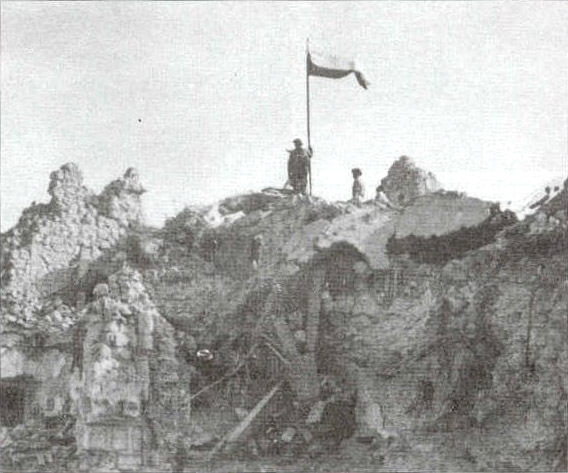
Polish troops captured Monte Cassino on this date in 1944
About the Poles at Monte Cassino:
British soldiers readily acknowledged the fighting spirit of the Poles. An Irish Guards officer in the 78th Division described his encounter with them.
“Their motives were as clear as they were simple. They only wished to kill Germans and did not bother about the usual refinements when taking over our posts. They just walked in with their weapons, asked where the Germans were, and that was that.”
The 78th Division history wrote this entry. “Of their resolve, there was no doubt. For whose gallantry the Division soon learned to feel an awed yet amused admiration. They exposed themselves with the most reckless abandon. They seem to know no fear.”
The 3rd Carpathian Division’s first patrol was on February 21, northwest of San Angelo.
It moved up to Monte Cassino in May, where the Poles proved their worth in capturing the destroyed abbey high atop a mountain that commanded the Allied approaches through the valley below.
The German defenses at Cassino had not been penetrated despite three assaults and heavy bombing.
After previous attempts had failed to take Cassino, General Leese called General Anders and his chief of staff, General K. Wisniowski, to Eighth Army headquarters on March 24.
Leese told Anders of the planned offensive, Operation Diadem, to open the road to Rome.
Leese offered the Polish Corps the mission of taking Monte Cassino. After a brief discussion with Wisniowski, Anders accepted the task.
General Anders’ order of the day just before the assault on Cassino read: “Soldiers, The task assigned to us will cover with glory the name of the Polish soldier all over the world. The moment for battle has arrived. At this moment, the thoughts and hearts of our whole nation will be with us. We have long awaited the moment for revenge and retribution over our hereditary enemy. For this action, let the lion spirit enter your hearts, keep deep in your heart God, honor, and our land—Poland! Go and take revenge for all the suffering in our land, for what you have suffered for many years in Russia and for years of separation from your families.”
For the night assault, the Polish troops blackened their faces and equipment and donned camouflage wraps.
A 40-minute barrage opened the assault. Immediately, the Poles caught an unlucky break. The Germans planned to relieve defenders with fresh units, and they had nine battalions in the strong points when the assault started.
The 1st Carpathian Battalion’s attack on Massa Albaneta failed with heavy losses, due mainly to German artillery. By 2:30 am, the assault battalions had lost one of every five men.
The 2nd Carpathian Battalion of the 1st Carpathian Brigade carried Point 593. Four counterattacks by German paratroopers, the final ending with bitter hand-to-hand fighting, left few Poles in the position at dawn.
Forced to retreat, the entire 2nd Battalion numbered at most a few dozen men. The 3rd Carpathian Battalion strike on Hill 569 also failed.
The 5th Kresowa Infantry Division’s 5th Wilenska Brigade jumped off a half hour after the Carpathian Brigade to seize Colle Sant’ Angelo, Hills 706, 601, and 575. The infantry ran into heavy fire. By 3 am, all three battalions were engaged along Phantom Ridge.
The division commander, Brig. Gen. Nikodem Sulik, committed the 18 battalions of the 6th Lwowska Brigade to reignite the advance, but it was not possible to continue the attack.
The 13th and 15th Battalions of the 5th Wilenska Brigade were decimated. According to the brigade diary, “In the valley and on the slope of the ridge lay corpses, twisted human shapes, shattered limbs, bloody bits of bodies.” General Anders had no alternative but to terminate the assault.
The Poles had attacked with panache and skill but took heavy casualties. The Germans committed a horrific atrocity after the assault. Two young officer cadets were captured, and the Germans crucified them with barbed wire and nails. No quarter was given by either side from that moment on.
The II Corps staff immediately began drawing plans for a second assault. Leese arrived and expressed satisfaction with the Poles’ attack because it was “of great assistance” drawing artillery fire and reserves away from the British...
Anders used the same basic strategy, but this time the attack would be made by both entire divisions. Brigades of the 5th Kersowa Division were directed on Colle Sant’ Angelo. The 3rd Carpathian Division focused both brigades on just Albaneta.
The Poles concentrated their artillery support and planned a rolling barrage for the advancing infantry. Polish sappers and engineers cleared minefields and obstacles during the interim. Leese endorsed the entire endeavor.
The second assault jumped off at 10:30 pm on May 16. New brigades were leading the assaults, supported by 200 air sorties at daybreak. One observer wrote, “When the second attack began the soldiers were drained physically and psychologically. The issue hung on a knife edge, only vigorous leadership could overcome the exhaustion and inertia.” Fighting raged all night.
Lance Corporal Dobrowski of the 5th Battalion described the assault on Hill 593: “We begin to ascend Hill 593, the weakest soldiers can no longer keep pace. We are in no particular formation. No sections; no platoons. The situation is such that we must use our own initiative. Now we engage the enemy. All is confusion and the Germans’ positions are mixed with ours. With munificent impartiality, we hurl our hand grenades. From the neighboring heights Spandaus, Schmeissers, and heavy machine guns catch us in a murderous crossfire.”
The hill was taken and held.
By May 18, the Poles had seized the objectives. The French Expeditionary Corps breakthrough south of Cassino forced the German Tenth Army to order the withdrawal of the 1st Parachute Division from Monte Cassino.
The Poles intercepted the radio message but were too weary to pursue the paratroopers. Corps headquarters sent word to the 3rd Carpathian Division to send a patrol from the 12th Podolski Lancers Reconnaissance Regiment to scout the abbey. The scouting party, led by Lieutenant Casimir Gurbiel, entered the ruins of the abbey and found them empty except for a few wounded German paratroopers. A homemade regimental pennant was raised at 9:50 am above the ruins.
A Lancer bugler played the medieval Polish military signal, the “Krakow Hejnal.” When the notes were heard in the 4th Carpathian Battalion’s command post, officers and enlisted men unashamedly cried.
A Polish officer wrote in his diary about that occasion. “We hung on grimly until the exciting news arrived that the monastery was in our hands. I shall never forget the pure joy of that moment. We could hardly believe that our long task was done.”
General Anders walked up to the abbey late in the afternoon. He recounted the moment in his postwar memoirs. “The battlefield presented a dreary sight. Corpses of Polish and German soldiers, sometimes entangled in a deadly embrace, lay everywhere, and the air was filled with the stench of rotting bodies. There were overturned tanks with broken caterpillars. Crater after crater pitted the sides of hills and scattered over them were fragments of uniforms, helmets, Tommy guns, Spandaus, Schmeissers, and hand grenades. The slopes of hills where fighting had been less intense were covered with poppies in incredible numbers, their red flowers weirdly appropriate to the scene.”
The Poles continued fighting until May 25, by which time the positions of Saint Angelo Hill, Point 575, Passo Corno, and Mount Cairo were captured.
The Poles immediately attacked east to penetrate the Hitler Line before the Germans could man it.
The British and Canadian rifle companies had 30 percent casualties. The American casualty rate was 41 percent, but the Polish II Corps had the highest with 43 percent, sustaining 3,784 casualties of which 860 were killed.
Field Marshal Bernard Montgomery wrote after the war, “Only the finest troops could have taken that well-prepared and long-defended fortress.”
Immediately after the battle, General Charles de Gaulle commented to the press, “The Polish Corps lavished its bravery in the service of its honor.”
Polish troops finally captured Monte Cassino on May 18, 1944, five months into the bloody campaign and four months after the monastery was leveled.
The Polish II Corps received an honorary decoration after Cassino. Eighth Army Order No. 65 granted the right of all individuals who took part in the Cassino operation to permanently wear the Eighth Army shield on their right shoulder even if in the future they were no longer part of the Eighth. Later, Order No. 95 extended the privilege to any soldier of the Polish II Corps.
Still, because of the Soviet occupation of Poland, most of the Cassino veterans never returned to their homeland andthe Poles were not allowed to participate in the massive victory parade in London.
Ten members of Parliament signed a letter published in the Daily Telegram in June 1946, objecting to the treatment of the Poles. The letter read, “Polish dead lay in hundreds on Monte Cassino. The Poles fought at Tobruk, Falaise, and Arnhem. Polish pilots shot down 772 German planes. The Polish Forces who fought under British command have not been invited to the Victory march on June 8. Ethiopians will be there, Mexicans will be there, the Fiji Medical Corps, the Labuan Police, and the Seychelles Pioneer Corps will be there—and rightly too. But the Poles will not be there."
Sources for the article.
https://t.co/4MDbTaGglg
https://t.co/lv6Or32yaf
HM The King has done us a huge honour by choosing France for his first visit abroad since his accession to the throne. We look forward to welcoming him a few days after @EmmanuelMacron hosts @RishiSunak in Paris for our bilateral summit. 🇫🇷🇬🇧
A #Londres pour dév. la relation 🇫🇷🇬🇧 franco-britannique de Défense.
Notre géographie, notre histoire et nos projets méritent que l'on dépasse nos différences pour un monde meilleur.
Une exigence autant politique pour nos concitoyens que stratégique dans un monde en turbulences.
Fascinating chat with @eric_beranger, CEO of missile manufacturer @byMBDA, which includes 🇫🇷🇬🇧 companies as major shareholders.
As a leader in Franco-British industrial cooperation, MBDA is a central player in strategic defence and European autonomy.
Good morning. Day 2 of the most recent Kyiv blackout. Day 274 of the war. There is no electricity, no heating, no water. Outside temperature is around freezing. The apartment is still warm from the previous days. We will see how long it lasts. We have blankets, sleeping bags, 1/
@SilenceInPolish My dad also one of those Poles. He anglicised his name after he arrived in UK. If you can get hold of a copy this book by General Anders tells the story and is an epic….
An Army in Exile: The Story of the Second Polish Corps (Allied Forces Series)
President @EmmanuelMacron congratulates Rishi Sunak on becoming PM, and voices willingness to work closely with him to deepen the 🇫🇷🇬🇧relationship, particularly on defence, strategic affairs & energy.
They also agree to prepare a bilateral summit in 2023: https://t.co/KmnGXmQBUx
The UK and France are allies with cultural links that span centuries. Our cooperation is vital across a huge range of areas, from supporting Ukraine to our own defence and energy security.
It's in that spirit that I am looking forward to working with President @EmmanuelMacron.
Very proud of my daughter Léa who came 3rd in the women’s rankings in today’s fantastic Paris 20km 🇫🇷! Perfect conditions and a great crowd. Her dad finished a bit lower down the order (1hr 40mins in case you’re asking) but not too bad… Merci Paris!
The "Mała #NAREW" short-range anti-aircraft set includes: the SOŁA radar station, the ZENIT weapon control device, 3 iLaunchers on JELCZ chassis, 2 transport and loading vehicles based on the same manufacturer's chassis and #CAMM effectors.