A truth many traders don't know.
Trading is sometimes described as “a reward for endurance,” but truly great traders aren’t continually forcing themselves to endure things they hate, and it’s not simply that they have stronger mental toughness.
In the short run, randomness creates variance in results.
Many traders understand this much, but the problem is that many believe “you need mental toughness to withstand that variance.”
But that’s not actually true.
Of course, you don’t need to train your mental toughness.
Mastering breathing techniques or meditation is not the solution.
What you truly need is a deep understanding of your strategy’s statistics through a large sample size.
You need position sizing (%) based on that performance that lets you keep taking trades and collecting samples safely.
You also need to build trust through “overwhelming experience through practice”—repeating it until the law of large numbers genuinely does its work and, in the end, profits remain.
In particular, many traders have not done this “overwhelming experience through practice.”
Knowing the data alone means nothing.
You need training that lets you reproduce it over and over, and whether you actually “experience the math” through that training is what builds your trust.
If you’re not doing these things, thinking “I need stronger mental toughness” will not solve the issue at its root.
I’ve spent years obsessively pouring time into this part.
This is an important part that almost no one talks about.
Don’t stop at testing—keep repeating the practice, properly.
The extent to which you’ve built trust is revealed by the emotions that arise in you—such as whether you’re taking a short-term or long-term perspective, and how soon you start to feel the pain.
There’s a huge difference between trading every day and showing up every day.
Showing up, analyzing the market, and taking zero trades because nothing met your criteria isn’t inactivity, it’s a sign of maturity.
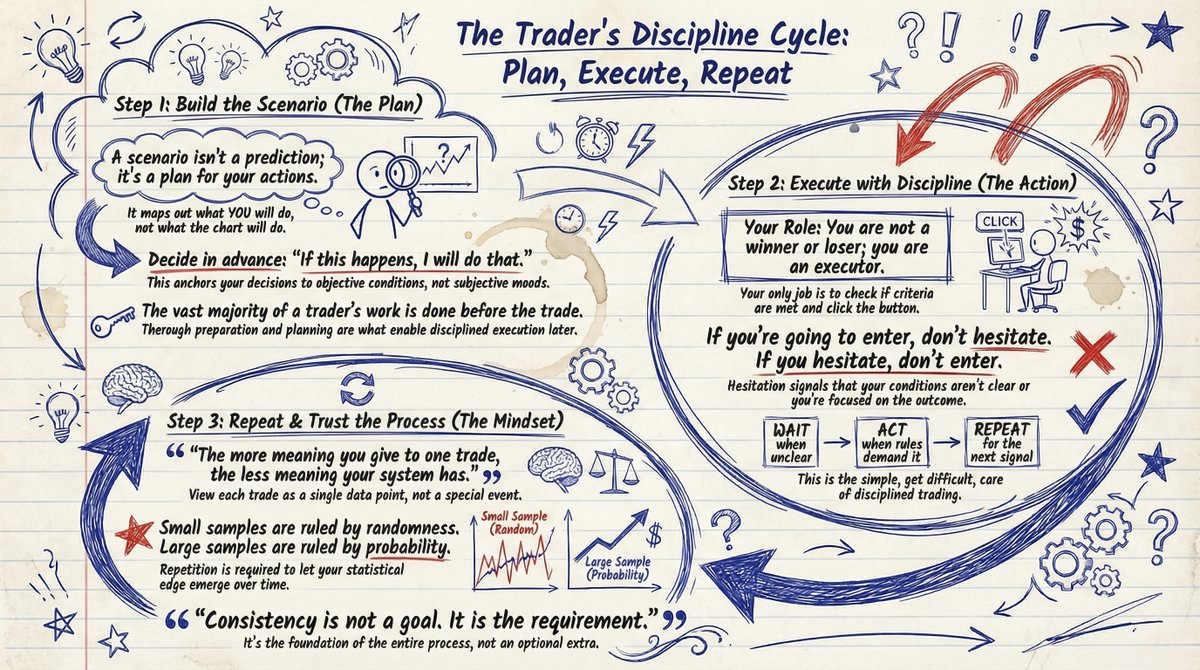
During a trade, you’re not the judge.
You’re the disciplined executor.
If you catch yourself thinking, “Does it look like it’s going to go up from here?”, check “What do the rules say?” instead.
Follow rules, not opinions.
A strategy with positive expectancy means that, in total, profits remain when you keep following the rules.
Follow the rules and let every win and loss occur.
That’s what’s required for probability to do its job, and it’s your job as a trader.
Build an "If this happens, then do this" scenario upfront, then execute it.
You don't need the desire to win or to avoid losing.
If you can execute the process exactly as the scenario dictates, stamp your card once.
Once you've collected 20 stamps, "one trade" is finished.
Most traders don’t lose because they lack strategy
they lose because they’re under-capitalized and trading with fear.
That’s why smart traders choose @the5erstrading .
A prop firm that gives you real funding, clear rules, and the chance to scale without risking your personal savings. The5ers is the bridge between skill and capital.
Trade smart. Get funded. Scale properly. Sign up here yo get 10% discount on any account size you purchase : https://t.co/0Jq5LRBMgv
Your actions strengthen “your motives.”
The more you keep checking the charts for reassurance, the more your anxiety gets amplified.
You think you’re doing it to relieve that anxiety, but in reality that behavior keeps feeding the belief—the real source of the anxiety—that “this one win or loss right in front of you matters.”
Put in the prep work upfront until you can genuinely trust your positive expectancy, then behave as if you don’t care at all about short-term outcomes, and simply keep repeating rule-based actions day after day without emotion.
That’s the key.
Before you think, “That losing trade—what did I do wrong?”
Forget whether it won or lost, and look again at the screenshot from before you entered.
On that chart—without knowing the outcome—can you honestly say you would still take the same trade?
Are your rules fully met?
When you focus only on a losing outcome, you unconsciously label the loss—one that should have occurred if you executed properly—as “bad,” and you begin an endless improvement loop against randomness: “What wasn’t good?”
That’s why what matters isn’t post-trade review, but screenshots and a thought journal from “before entry or immediately after entry.”
“Process, not results.”
Don’t leave it as a slogan—act accordingly.
Good night 😴
“Adapting to the market” doesn’t mean trading nonstop while constantly switching your approach to fit the current market.
“Adapting to the market” means doing nothing and waiting until conditions match your strategy.
I’ll wait a week, even a month.
That’s the job.
You review just one recent losing trade and casually conclude, “Oh, I lost because RSI was above 70 at the time,” then—without testing on a sufficient sample size—you immediately add a rule: “No entries when RSI is 70+.”
As a result, you end up filtering out profits you would have captured, but you don’t notice it.
There are a lot of traders like this.
What they need to fix first isn’t the strategy—it’s the thought pattern.
Many people have a strong belief that “a loss = a mistake,” and they’re convinced that “eliminating losses = getting closer to being right.”
They think, “Every loss must have a ‘reason that could have been avoided.’ If I find and eliminate all of them, I’ll eventually become a trader who doesn’t lose,” but that’s simply a refusal to accept uncertainty.
It’s a dependence on the visceral aversion to losing, and on the temporary sense of omnipotence and reassurance you get from retroactively rationalizing past charts and feeling like you “figured it out.”
Short-term outcomes in front of you are driven by randomness.
Think in terms of a large sample size.
Before you put your real money at risk, test your ideas on a large sample size.
Once you’ve tested on a large sample size, all that’s left is to keep repeating it, no matter what.
No changes.
Don’t draw conclusions from a small sample size.
Your job is not to protect yourself from every loss.
Your job is to execute every loss your system requires.
Your job is not to make the chart respect your feelings.
Your job is to respect the statistics you already tested.
Good night 😴
Do nothing if there’s no signal.
A lion doesn’t chase every gazelle.
It lies in the grass for hours, conserving its energy for a sure kill.
Most people spend their time chasing flies, then wonder why they’re starving.
You feel anxious when you have no position, so you click the mouse to feel productive.
That click is not work; it is the destruction of your edge.
Your job is not to be busy, but to execute the system's commands like a loyal employee.
Doing nothing is the most profitable action when the system is silent.
The objective isn’t to win.
The objective is to be consistent.
If your strategy has positive expectancy, you need to take every trade according to your rules, and you need to allow losses and losing streaks to occur.
Those losses and losing streaks are not “mistakes.”