50 Web Sites Google Doesn't Want You to Know About
1.) 'https://t.co/EfTux5RYjH' — Bypass any paywall
2.) 'https://t.co/CS8TTaQYaj' — Millions of free textbooks
3.) 'https://t.co/mqO0sQaJTL' — Free academic articles
4.) 'https://t.co/Jp4rJeJvEy' — Find free app alternatives
5.) 'https://t.co/AUXoPCDXD6' — Find where any content is published
6.) 'https://t.co/hIWZJ9VazA' — Access any old web page
7.) 'https://t.co/3uHUY6oDX3' — 70,000 free classic books
8.) 'https://t.co/lJuQ0LfnxQ' — Free PDF downloads
9.) 'https://t.co/FOwryaaPMw' — Free courses from top universities
10.) 'https://t.co/H9WskzwA2m' — Solve any math problem instantly
11.) 'https://t.co/GFORrcyC06' — Free Photoshop in your browser
12.) 'https://t.co/5vlX9wMZDR' — Compress any image for free
13.) 'https://t.co/abFjm4gwo9' — Remove image backgrounds for free
14.) 'https://t.co/vkEO3DMqxP' — Remove objects from photos
15.) 'https://t.co/znRZpF4OP3' — Remove video backgrounds
16.) 'https://t.co/3YIBS3MMBH' — Turn code into art
17.) 'https://t.co/b3ltyjAiBJ' — Stylish code screenshots
18.) 'https://t.co/nkeiqyzkMB' — Free product mockups
19.) 'https://t.co/z91E6k1zko' — Create mockups without Photoshop
20.) 'https://t.co/s1ACHbVLph' — Check if you've been hacked
21.) 'https://t.co/Zw2KFxYJAt' — Scan any file for malware
22.) 'https://t.co/oN8SQTgVL8' — Send self-destructing messages
23.) 'https://t.co/QSLzAp8wXN' — Instant disposable email
24.) 'https://t.co/CkVs6W3mcv' — Auto-deleting file sharing
25.) 'https://t.co/l8QdweF1UU' — Permanently save any web page
26.) 'https://t.co/IopPLzPCA0' — Find alternatives to any site
27.) 'https://t.co/PQSoxhr5hw' — Listen to any radio station worldwide
28.) 'https://t.co/ObCdVByP14' — Discover every music genre
29.) 'https://t.co/dcYfYE9jvg' — Find songs from any TV show
30.) 'https://t.co/lP5v4WYSi9' — Focus music
31.) 'https://t.co/1SCERHg8wM' — Custom focus soundscapes
32.) 'https://t.co/8B5WiBuKlw' — Cafe sounds that boost productivity
33.) 'https://t.co/mg0lemq6DU' — AI academic paper assistant
34.) 'https://t.co/ZigSiivFFF' — Search scientific consensus
35.) 'https://t.co/qfapPaqw9D' — Visualize academic paper maps
36.) 'https://t.co/JnCmCb5OIS' — Free academic search
37.) 'https://t.co/abuYxkRu3E' — Understand any academic paper
38.) 'https://t.co/SdjbsPPEEg' — Summarize any YouTube video
39.) 'https://t.co/VaQCzORkUk' — AI search engine for developers
40.) 'https://t.co/CrBi3T95VN' — Test any regex instantly
41.) 'https://t.co/TSUCqcJ3eV' — Format code cleanly
42.) 'https://t.co/1oaXMSoQ5b' — Read JSON like a human
43.) 'https://t.co/6ZmZdJcOLi' — Understand terminal commands
44.) 'https://t.co/b6au5by4HQ' — Effective bookmark manager
45.) 'https://t.co/JnCshrhWgh' — Check if any site is down
46.) 'https://t.co/CHRiKJfwr5' — Reverse image search
47.) 'https://t.co/oKAGzV85nX' — Check internet speed
48.) 'https://t.co/gky5EyMG6f' — Free PDF editing
49.) 'https://t.co/E3I3BiHXrP' — Merge and split PDFs
50.) 'https://t.co/hGHfowtb3M' — Second-long temporary email
The internet is much bigger than what Google shows you.
Cc : Respective author
🚨Jason Padgett: the accidental savant who says he can see the geometric code behind reality.
After a brutal attack in 2002, Padgett developed acquired savant syndrome and began seeing the world in intricate geometric and fractal patterns.
Movement became sequences of geometric “snapshots.” Water, light, and ordinary objects seemed to reveal mathematical structures hiding beneath everyday perception.
Today, he makes hundreds of videos explaining his ideas about the nature of reality, including his theory of Quantum Information Holography (QIH)—the idea that the universe may be fundamentally connected to information, light, geometry, and holographic projection.
What happens when your perception of reality changes so radically that you start trying to reverse-engineer the universe from what you see?
A dead MIT professor accidentally destroyed the $20 billion executive coaching industry with one hour of lecture, and ten million people have already watched him do it.
He filmed it once in January 2018 and died eighteen months later.
Executive coaches charge fifteen thousand dollars a session to teach a third of what he covered in that one hour for free.
His name was Patrick Winston. He ran the MIT Artificial Intelligence Laboratory from 1972 to 1997 and wrote the AI textbook every computer science major in the world read for thirty years.
Every January for four decades, he gave a lecture called "How to Speak."
His entire framework fits on a napkin.
Do not read. Be in the image. Keep images simple. Eliminate clutter. Start with an empathetic connection. End with a punch line the audience can repeat over dinner. Never open with a joke. Never end with "thank you."
That last rule alone has probably cost the executive coaching industry a hundred million dollars.
"Your success in life will be determined largely by your ability to speak, your ability to write, and the quality of your ideas. In that order."
That is the actual opening line of the lecture. Winston believed it strongly enough to spend fifty years teaching computer scientists how to talk.
Founders spend $80,000 on an MBA and then hire a communications coach to teach them the same material Winston filmed once for free. Engineers write brilliant code and lose promotions to teammates who watched this lecture on the train.
The lecture is free on MIT OpenCourseWare. The textbook is free on his page.
Winston died in 2019. Almost none of the ten million viewers have actually implemented the four rules on the napkin.
The napkin is free. The willingness to actually use it in your next meeting is the entire edge.
You'll regret it if you get married, you'll regret it if you don't get married. You'll regret it if you have kids and you'll regret it if you don't. Kierkegaard said this 200 years ago as follows - whatever you choose, you'll regret it, because the problem isn't in your choices, it's in romanticizing your life. A person always finds an untravelled path alluring and mysterious. That's why the issue isn't making the right choice. It's choosing and deciding which regret you'll live with. In life, we must choose our regret.
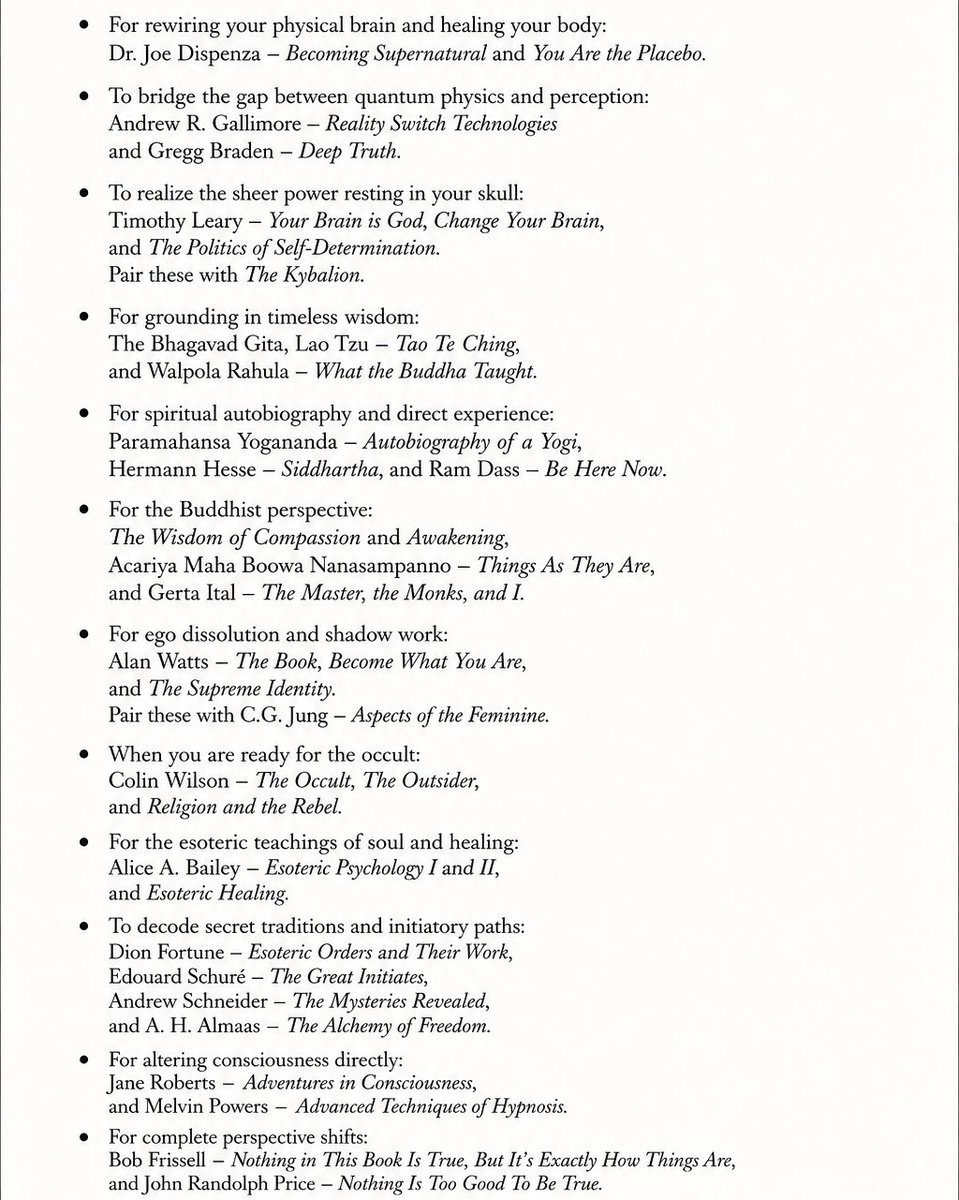
I have spent years building a heavy esoteric library. These texts will completely dismantle your old belief systems. And you do not need to rush through them.
for rewiring your physical brain and healing your body, Dr. Joe Dispenza is mandatory. Read Becoming Supernatural and You Are the Placebo.
Then you have to bridge the gap between quantum physics and perception. Reality Switch Technologies by Andrew R. Gallimore and Gregg Braden’s Deep Truth do this perfectly.
If you want to realize the sheer power resting in your skull, look into Timothy Leary. Your Brain is God, Change Your Brain, and The Politics of Self-Determination are essential. I highly recommend pairing these with The Kybalion to master universal laws.
Do not just read modern pop psychology for grounding. Go to the roots. The Bhagavad Gita, Lao Tzu’s Tao Te Ching, and Walpola Rahula’s What the Buddha Taught.
Paramahansa Yogananda’s Autobiography of a Yogi is famous for a reason. Add Siddhartha by Hermann Hesse and Ram Dass’ Be Here Now to that shelf.
For a deep dive into the Buddhist perspective, pick up The Wisdom of Compassion and Awakening, alongside Things As They Are by Acariya Maha Boowa Nanasampanno. Gerta Ital’s The Master, the Monks, and I is also a beautiful journey.
For ego dissolution and shadow work, Alan Watts is your guide. The Book, Become What You Are, and The Supreme Identity will shatter your illusions. Pair that with C.G. Jung’s Aspects of the Feminine to balance your internal psychological states.
When you are ready for the occult. Colin Wilson’s work is foundational. Read The Occult, The Outsider, and Religion and the Rebel.
Alice A. Bailey is dense but necessary. Esoteric Psychology I and II, alongside Esoteric Healing, explain the true nature of disease and the soul.
Dion Fortune’s Esoteric Orders and Their Work and Edouard Schuré’s The Great Initiates decode secret traditions beautifully. Follow those up with Andrew Schneider’s The Mysteries Revealed and A. H. Almaas’ The Alchemy of Freedom.
For altering consciousness directly, explore Jane Roberts’ Adventures in Consciousness and Melvin Powers’ Advanced Techniques of Hypnosis.
And for complete perspective shifts, read Bob Frissell’s Nothing in This Book Is True, But It's Exactly How Things Are. Then balance it with John Randolph Price’s Nothing Is Too Good To Be True.
Read slowly..
knowledge is only a rumor until it lives in your bones.
A big part of spiritual progression is just giving up. No more striving, no more trying to figure things out, no more fixing. Just total surrender - even defeat. Give into the boredom, there is nothing more to do. And in this total resignation is what you were looking for.
CASTOR OIL HEALS TISSUE DEEPER THAN ANY CREAM - BUT 95% APPLY IT WRONG
1. Castor oil penetrates 3 inches into tissue within 20 minutes - but only cold-pressed, hexane-free oil, never processed.
2. Apply castor oil at 9 PM (bedtime) - your skin absorption rates triple during sleep when pores are most open.
3. Never apply castor oil on broken skin - it pulls toxins into the bloodstream too fast and causes flu-like symptoms.
4. Castor oil packs are for liver detox; castor oil rubs are for joint pain - different application methods, different results.
5. Pair castor oil with a heating pad - heat increases penetration depth by 70% compared to cold application.
6. Castor oil works best on the lower right abdomen (liver area) - that's where lymphatic drainage is most concentrated.
7. Cycle castor oil packs: 3 days on, 4 days off -your skin becomes impermeable with daily use and stops absorbing.
You can resolve many of your problems in life by reserving your judgment of everything—whether it is a show, a game, or even a friend. You do not need to form an opinion about something within seconds of encountering it.
If a human being goes through life with only 1/10 of his judgment, he leaves room for the deeper forces working through the world. And if you are completing a Saintly incarnation, then this becomes even more important:
Judge not, lest ye be judged.
If u remove entertainment & everything that gives u easy pleasure, ur brain gradually starts extracting fun from boring things instead. Eventually, u'll feel more fun doing what everyone else calls unbearable boredom. That's where greatness begins. Hard tasks start feeling easy bcz their torture becomes ur warmup. The only price is enduring a little torture in the beginning. this is the secret that moves everything in ur favour. The brain works on thresholds. The more pleasure u feed it, the higher its baseline becomes. What once felt extraordinary soon feels normal. That's why it also works in reverse. The more u indulge it, the less satisfaction u get. Keep subtracting. Keep growing. Easy.
THE 1929 CRASH > 2029 IS NEXT.❌
October 1929.
The Roaring Twenties had convinced ordinary Americans that stocks only go up.
Factory workers, teachers, farmers, barbers everyone was "in the market." Legend says Joseph Kennedy sold everything when his shoeshine boy started giving him stock tips.
If the shoeshine boy is trading, the top is in.
The engine was leverage. You could buy stock putting down as little as 10% the rest was borrowed. $1,000 controlled $10,000 of stock.
On the way up, you felt like a genius.
It quietly turned the whole country into a leveraged bet.
Black Thursday, Oct 24.
Then Black Tuesday, Oct 29.
Panic.
Around a third of the market's value evaporated in a matter of days.
The ticker ran hours behind people didn't even know how broke they were yet.
Then came the margin call.
Your broker phones: put up more cash or we sell you out.
Millions couldn't.
Their stock was liquidated at the bottom, and they still owed money on shares now worth nothing. Wiped out, and in debt.
Who actually lost?
Not just the rich.
Middle-class families who'd put their savings in "safe" stocks..
Farmers already drowning in debt..
Bank depositors because the banks had gambled the deposits too..
That's the part people forget: ~9,000 banks failed in the years after.
No deposit insurance existed yet.
If your bank died, your life savings simply vanished. Bank runs became normal crowds pounding on locked doors.
The peak-to-trough was almost biblical: the Dow fell roughly 89% from its 1929 high to the 1932 bottom.
It did not reclaim its 1929 peak until 1954.
A 25-year round trip to zero gain.
How did people cope?
Breadlines. Soup kitchens. "Hoovervilles" shanty towns named after the president.
Families split up looking for work.
Unemployment hit ~25%.
The crash bled into the Great Depression, a full decade of hardship.
But some made fortunes. ( GannWyck models )
The ones who got out early (Kennedy), the ones who shorted (Jesse Livermore made ~$100M).
Every crash transfers wealth from the panicked to the patient.
That never changes.
Now 2029.
Why the whispers? It's the 100th anniversary of 1929, and the parallels write themselves.
The scariest echo is concentration. The "Magnificent Seven" tech giants now make up about 35% of the S&P 500 the same degree of top heavy concentration seen at the peak of the dot com bubble.
Buy the "diversified" index and you're really making one giant AI bet. Oliver Wyman
Valuations are stretched too.
The Shiller CAPE ratio for the U.S. market topped 40 in late 2025 a level not seen since the dot-com crash.
And the wobble has already started: in July 2026 the Magnificent Seven shed roughly $797 billion in a single day as AI skeptics dumped tech.
Stock Alarm ProBloomberg
Even the famous bears are back.
Michael Burry of "The Big Short" has loaded up on bearish bets against AI names like Nvidia and Palantir, warning the crash is minutes from happening.
BUT here's the honest counter-argument, and it's strong:
Unlike the profitless dot-com companies, today's AI giants sit on enormous cash flows and fortress balance sheets.
In late 2025 the Mag 7 traded around 28x forward earnings less than half the ~66x the top stocks hit in 1999.
And structurally, 2026 is NOT 1929. Back then there were no safety nets.
Now we have FDIC deposit insurance, margin limits, circuit breakers, and a Fed that acts as lender of last resort.
The scaffolding that turned 1929 into a decade-long Depression has mostly been built since.
So how big is the comparison, really?
– Mood & concentration: eerily similar. One narrative, one sector, everyone all-in.
– Plumbing: completely different. The 1929 doom-loop (margin wipeouts → bank failures → no backstop) is much harder to repeat.
The lesson from 1929 isn't "a crash is coming in 2029." It's that leverage + everyone believing the same story + no exit plan is what turns a correction into a catastrophe.
The people who survived weren't the smartest they were the ones not forced to sell.
1929 didn't punish optimism.
It punished fragility.
That's the real question for 2029: not "will it crash," but "are you leveraged into the one bet everyone else is making?"
~ GannWyck
Lean... Handsome... Well groomed... Smelling clean... Wide shoulders... Calm behaviour... Eloquent... Great listener... Sharp humor.... Wealthy... Strategic...
Be that man.
POV: you start doing reverse planks every day, and now your pelvic tilt is finally going away, your stomach looks flatter and you finally feel what targeting your deep core feels like too...