Great day supporting @MNDVic & the Great MND Relay with colleagues & family.
Amazing effort by the “VU research in MND team”, with our own @Andrew7Barrett finishing second for number of laps completed.
This systematic review and meta-analysis finds that exercise is likely to increase plasma heat shock protein 70 (HSP70) concentrations, with V̇O2max, exercise duration and intensity, and environmental temperature explaining a considerable degree of variation in exercise-induced plasma HSP70 expression.
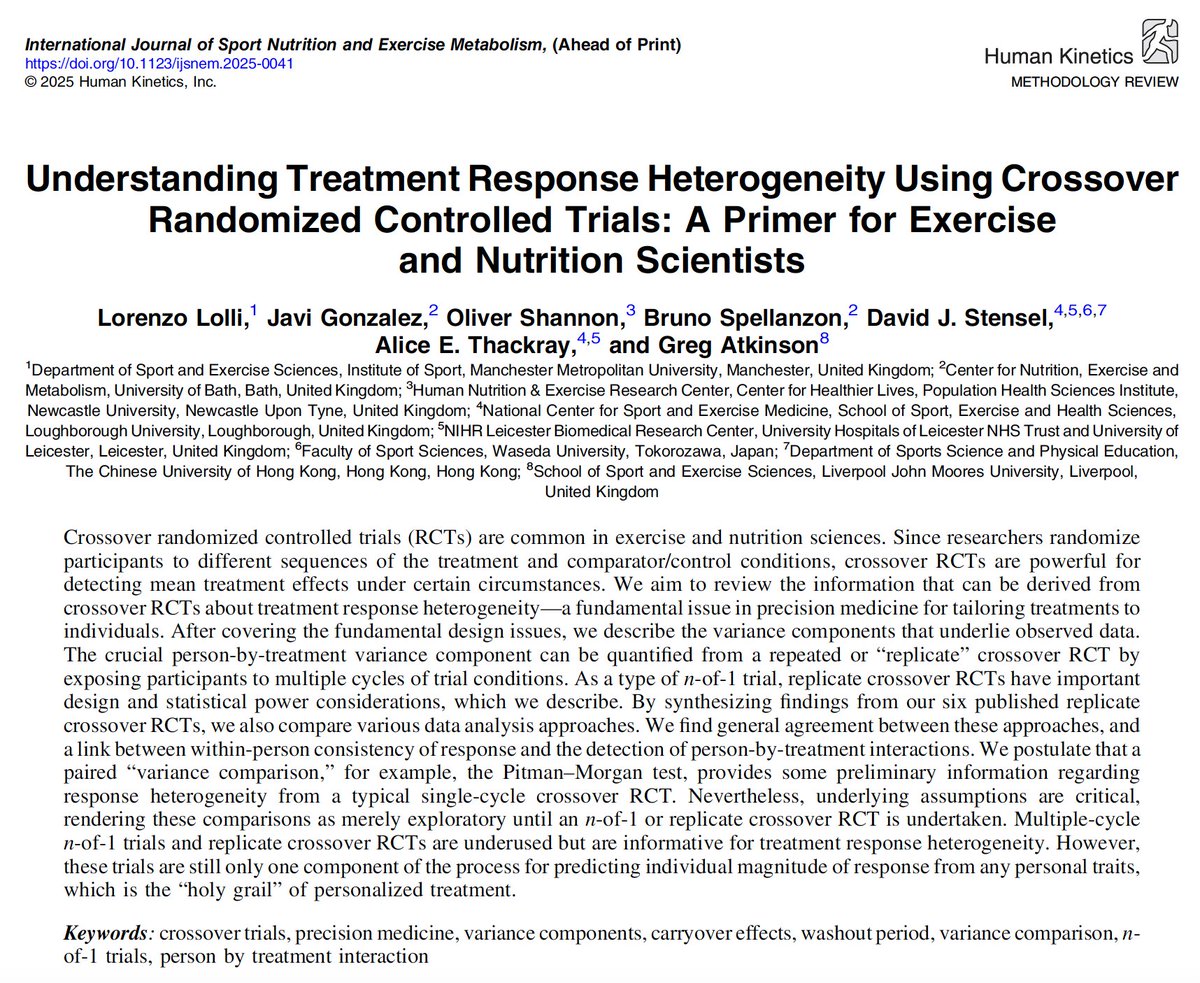
NEW PAPER
At recent conferences I still see people reporting "responders" & 'non-responders" often prematurely
See our latest paper led by Lorenzo Lolli & Greg Atkinson on how to detect responders & non-responders (treatment response heterogeneity)
https://t.co/EuPg9gn8nt
Congratulations Andrew Barrett on your first publication!
Continuing our durability work...
Prolonged running reduces speed at the moderate-to-heavy intensity transition without additional reductions due to increased eccentric load
https://t.co/G6pQ10fXNu
@EJAP_official
Here, prolonged moderate-intensity running reduced speed at the moderate-to-heavy intensity transition, largely due to decreased metabolic power and increasing the eccentric load did not influence the magnitude of the speed decline at this transition.
We are thrilled to see this one published just in time for Christmas!
Carbohydrate ingestion during prolonged exercise blunts the reduction in power output at the moderate-to-heavy intensity transition
Congrats @Harrison7738800
@CarynZinn@theplews1
https://t.co/koBJl8rw0v
Backyard running: Pushing the boundaries of human performance - De Pauw - European Journal of Sport Science - Wiley Online Library https://t.co/bVYnMYRnnG
Great start to the weekend… my first, first author paper🥳
Hopefully an important addition to the dietary #nitrate literature🥬
Big thank you to @BTRosier for your support and guidance throughout!
@miaburleigh8@mira_ale
Summary thread incoming…
https://t.co/VSSyChTOFh
I'm delighted to announce I have been elected to the RCVS Council (from July 2024) in the recent elections
@theRCVS
I'd like to thank the c1,750 colleagues who put their trust in me. I'll strive to do all I can for the profession over the next 4-years. Thank you.
The normalization of a lack of physical activity in our modern society has led to the perception that exercise is an “intervention”.
However, physical activity remains the modus vivendi engrained in our genes and being sedentary has been the real intervention and collateral effect of modern societies.
Human genome hasn’t evolved yet to be sedentary…Hence, being sedentary is still the intervention…It has been in front of our eyes and one of the most profound biological interventions in the history of humankind...
For decades, most medical research studies have used "healthy sedentary" individuals as the control group.....How much good information have we missed or how much misleading information have we obtained?...
Time to think differently...
Have you ever wondered if the underband of a sports bra can restrict breathing mechanics and increase oxygen consumption?
I figured we needed to do a study: https://t.co/1TckhjbQ4n
@Mick_Leahy_@UBCKin
The Dutch invest €595 million annually on urban biking, resulting in €19 BILLION saved in public health care costs alone. That’s how smart govts do the math on investing in better mobility.
Let’s be clear — it wastes public money to NOT do it.
#CityMakingMath HT @modacitylife
Can we please start placing “anaerobic threshold” where it really belongs? 🙏. It is not that difficult.
Anaerobic threshold means the transition from an aerobic state to aerobic one. That happens at your VO2max when you reach your maximal aerobic capacity and past that point, muscle cells need to rely on the ATP/PC system for muscle contraction, which is purely anaerobic. We are talking about pure sprinting to a maximal of 1-2 min efforts…
But please, the term “anaerobic threshold” to describe a “transition” point from low to high intensity is NOT anaerobic by any means. During those 5-10-20min efforts where very high intensity efforts are deployed, “anaerobic threshold” is where it is mostly used. There is a massive lactate production due to high glycolytic flux and this lactate can be produced under FULLY aerobic conditions.
Excessive glucose flux into mitochondria cannot be oxidized entirely and pyruvate is reduced to lactate in the cytosol which is key for the continuation of glycolysis.
This was discovered by Dr. George Brooks over 35 years ago! . It is really old stuff…
Please let’s place the poor “anaerobic threshold” concept where it really belongs 🙏
(Sorry it is a huge pet peeve of mine)
In just under 2 weeks I will be running the Edinburgh Marathon (my first marathon!) in aid of the John Muir Trust, a charity that cares for wild spaces in Scotland and other parts of the UK. Any donations would be greatly appreciated.
Thanks!
https://t.co/1dCWh1IA0r
What's the best running shoe for you?
We can measure a ton of variables. The science has advanced a lot. We should be able to match our form with a shoe that'll help?
What does research tells us is most important for picking a shoe for you?
Comfort
There's a lesson here
Big moment for me - my first publication🎓Special thanks to @OllyWitard and all others involved!
Many more to come I hope…
Check it out, more data on the role of omega-3 PUFAs on muscle damage and repair following eccentric exercise in trained men🏃♂️🐟
https://t.co/yPW60SYRDD
For decades, so many research studies have used sedentary “healthy” individuals as controls. However, the real controls are physically active individuals. Humans are born to be active. Being sedentary has been the intervention of progress…IMHO it’s time to re-think this concept