@Annettelevesqu_ Thanks for hosting such a thoughtful conversation! It was a privilege to discuss AI’s potential in reshaping education and share @scalelearning's mission to create impactful, human-centric solutions for our clients. Looking forward to continuing the dialogue!
@emollick Could be a timing play. Cash out before larger models or AGI eats them.
If they really believe AGI is coming soon from one of the big labs, they don’t have great alternatives.
@tamaybes Great paper! Is it clear if the tends are continuing into 2024? It has been suggested that the pace may have slowed recently...
https://t.co/sKDoWhkQsU
The data go through sometime in 2023; they don’t show a doubling etc running to now.
(More carefully: the paper is describing an earlier period in development, and there is some informal evidence that the pace may have slowed, given that there is no decisive leap forward since GPT-4, released 13 months ago, as opposed to the prediction 2-4x projected.)
@GaryMarcus@emollick What's the recent data that no longer fits the curve?
IMO The paper focuses more on LLM efficiency "compute required to reach a set performance" rather than growth of new capabilities. Efficiency seems easier to measure than new capability growth.
@dwarkesh_sp #1 reminds me of the quote: "Not everything that counts can be counted, and not everything that can be counted counts."
It's easier to eval AI (& humans) on knowing stuff that can be counted. Easier to train on too.
There's fuzzy stuff that counts that's hard to count/eval.
@DonaldClark@NickCorston This is accurate. Faculty that do invest in their teaching do so despite recommendations to the contrary from peers, course evaluations that often aren't aligned with promoting teaching & learning, and a tenure and promotion process where research output rules.
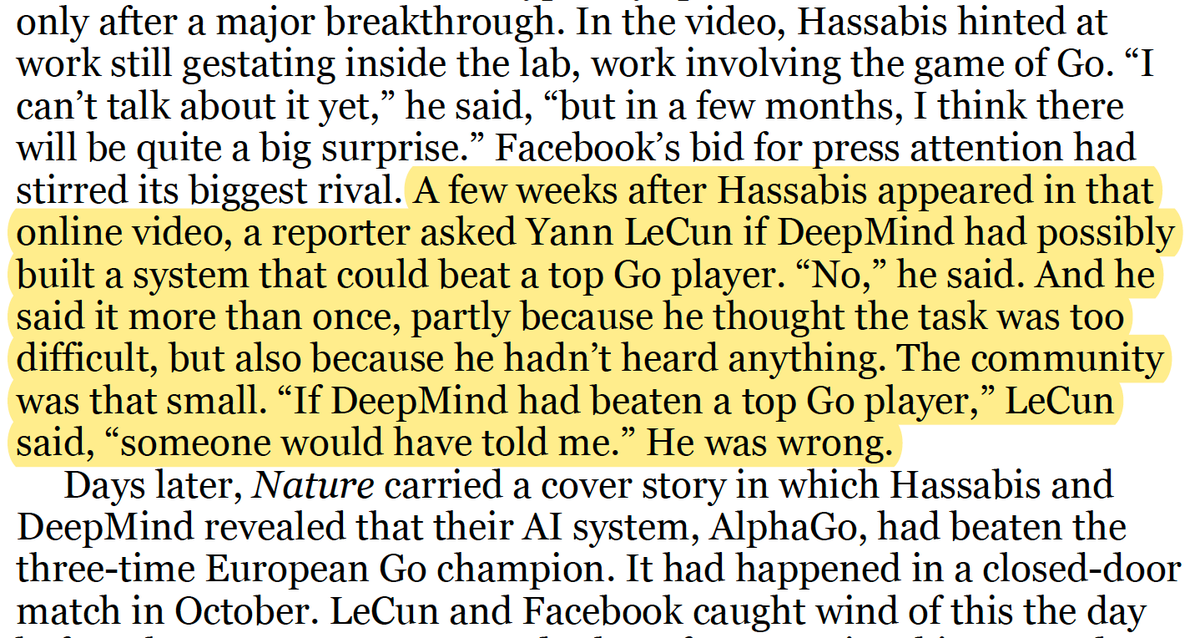
@markwgilson@emollick Confident statements of what LLMs will never be capable of may not age well. No one really knows for sure.
For example...
https://t.co/XaEc1ybyTB
He was also off about AlphaGo being able to beat a "top Go player". See quote from the book Genius Makers from Cade Metz.
@emollick Agreed. People want simple answers but assessing intelligence of AIs (and people for that matter) is tricky business with all sorts of tensions & high stakes consequences. Standardized benchmarks are important but, by design, may not predict performance in specific contexts.
@PradyuPrasad@ScottHYoung completed the entire 4-year MIT curriculum for computer science, without taking any classes, in just under a year. I read about this in his book "Ultralearning", which is worth checking out. https://t.co/KTGgGVqmwe
@aigs_ca 😍 Loving Chart 1!
It clearly articulates 3 areas of uncertainty in a straightforward way.
1. How many technical breakthroughs are needed to reach AGI
2. Whether the current exponential rate of progress will continue
3. How much time governments have to prepare...
@Simeon_Cps@tobi Even before AGI, Artificial Capable Intelligence (ACI) poses significant risks. I recommend @mustafasuleyman's book 'The Coming Wave' for a look at the near term concrete dangers of ACI and synthetic biology and what to do about it. https://t.co/GkU1z3jtqI
Our second post in the weekly #WisdomGap series is out!
𝗟𝗲𝗮𝗿𝗻𝗶𝗻𝗴 𝗳𝗿𝗼𝗺 𝗖𝗢𝗩𝗜𝗗-𝟭𝟵 𝘁𝗼 𝗣𝗿𝗲𝗽𝗮𝗿𝗲 𝗳𝗼𝗿 𝗔𝗜 𝗗𝗶𝘀𝗿𝘂𝗽𝘁𝗶𝗼𝗻: 𝗪𝗶𝘀𝗱𝗼𝗺 𝗚𝗮𝗽 𝗜𝗺𝗽𝗮𝗰𝘁𝘀 𝗢𝗻 𝗟&𝗗
Let us know what you think!
https://t.co/3aBtyDFf9G