@innovationweare It might be better to look at tobacco / nicotine overall use instead, as a surprisingly large percentage of Swedes use snus instead of smoking.
Watch Firefly land on the Moon! After identifying surface hazards and selecting a safe landing site, #BlueGhost landed directly over the target in Mare Crisium. A historic moment on March 2 we'll never forget. We have Moon dust on our boots! #BGM1
Rise and shine! Firefly’s #BlueGhost lander captured its first sunrise on the Moon, marking the beginning of the lunar day and the start of surface operations in its new home. Our #GhostRiders have already begun operating many of the 10 @NASA payloads aboard the lander and will continue operations over the next two weeks and into the lunar night. #BGM1
We have confirmation #BlueGhost stuck the landing! Firefly just became the first commercial company in history to achieve a fully successful Moon landing. This small step on the Moon represents a giant leap in commercial exploration. Congratulations to the entire Firefly team, our mission partners, and our @NASA customers for this incredible feat that paves the way for future missions to the Moon and Mars.
Standby for the first image, expected in the next 30 minutes! #BGM1
I’m excited since I had a small role in one of the payloads: PRIME-1. It will measure the ice in the lunar soil that gets drilled up by the Trident Drill. Originally this payload was only going to verify the presence of ice, not measure how much ice there is. 🧵/1
Genentech is the flagship example of an industrial research organization. Their culture of open science and free flowing publication is rooted in a strong contrarian foundation we should all remember.
In the 1980s, secrecy, siloes, zero sum IP fear was far more rampant in biotech than today:
Kary Mullis discovered PCR at Cetus in 1983 (tripping on acid) but it remained unpublished for two years until patents were secured.
Amgen's recombinant EPO, a blockbuster candidate for the enormous anemia market, was filed secretly in 1983, partially published in 1985 and fully described on patent approval in 1987.
Genentech was a startup of scrappy scientists (and a single brother of finance) and dead by default. The lore is riddled with the usual heroics: regular all night cloning sessions sustained with coffee, pizza and lots of beer (they called this "pizza and plasmids"). In competition with global scientific talent, they were the first to clone human insulin with recombinant DNA. They succeeded in 1978 and filed a patent.
What is often glossed over is they then immediately published a detailed description of how they did this in a now legendary paper. Enough information for anyone to copy it. Well before their patent was approved and sabotaging their lead commercializing the tech.
It seems kind of stupid to give every enormous and well-capitalized pharma juggernaut an actual blueprint to cannibalize your product. Sure the founding team achieved eternal scientific fame with this discovery but they could have met the same fate in the capital markets as our friend Kary Mullis: a $10K bonus from Cetus, a nobel prize (very nice) and a later life surfing in sunny La Jolla coping hard on the $300M sale of his PCR patent by Cetus (of which he received not one penny).
The resources, clinical expertise and odds were stacked against Genentech and they just gave up their hand. Why? I think two big reasons.
The first is very B2B SAAS coded: Boyer and Swanson needed to create a market for this new technology or their company would fail. Skepticism, from both Wall Street and the ivory tower, around recombinant cloning as a viable way to treat actual people of disease, was very high.
This is a strange thing to think about with a hard science venture, where success seems purely contingent on fighting nature and making a working drug. But the mechanics of drug development are much more intertwined with normative value and human perception than one would think.
From the obvious (who decides to fund you so you can live and not die) to the less obvious (great scientists need to believe in the technical viability of your mission to join your team) to the 4D chess (convincing regulators to even allow FIH trials and approve an IND before you run out of cash, convincing PIs + hospitals to then enroll their patients in trials and of course selling big pharma on the concept to manufacture + distribute the drug throughout this process)
Publication in a prestigious journal like Nature created a scientific market. They raised $10M in 1979, established their young team as world leaders in arguably the most important biotechnological revolution to date and put their company on the map of every bright-eyed bioengineer hungry to change the world. This brings us to reason number two (the bigger one).
When you think of the dominant technology industries today - semiconductor manufacturing, enterprise software, "AI" - their culture and structure looks very different from the siloed and paranoid biotech sector of the late 1900s. Speed and execution matter more than IP. Tacit knowledge of process and methods cannot be copied without ripping out the mesh of humans that defines the org. A competitor could steal every single blueprint, process instruction, and piece of equipment from TSMC and be hopelessly unable to fab 2nm chips.
Talent and accumulated tacit knowledge is the scarce resource.
Nowhere was this more true than the emerging field of recombinant protein therapies. It ran on a cottage industry of artisanal talent in molecular cloning.
Hand two researchers the same bacterial pellet and one will extract high-quality, high-yield plasmid DNA, while the other gets degraded crap. The same talent might transform cells with 1 ng of plasmid DNA and get 100,000 colonies, while the other gets barely 100. Same DNA, same protocol.
A company could copy a lab’s exact plasmid, bacterial strain, and IPTG induction protocol but still fail to express a functional protein. They don't know to tweak growth temperature, induce at lower OD600, or switch to a different expression host.
You can't put this in a patent. You can't copy this. Boyer somehow saw the writing on the wall. It was a competition for people and a first mover advantage to build a moat of compounding process knowledge.
The smartest people wanted to work with the best scientists. Those scientists were at Genentech, not Merck or Pfizer. After all, they published THE paper that established molecular cloning as a legitimate method in great detail. You have to trust them. They told you exactly how they did it. Those scientists trained the next generation, embedding even more tacit knowledge inside Genentech. This compounded over time, making the expertise impossible to replicate externally.
This flywheel ended up working really, really well.
They expanded their lead by tackling the next hardest problem - human growth hormone - just a year later in 1979. They followed that with two more bangers in the 1980s: recombinant interferons (cancer/antiviral therapy) and tissue plasminogen activator (tPA, a clot-busting drug for heart attacks and strokes), moving recombinant proteins past metabolic hormones into tx proteins with bigger markets. By the late 1980s, they were global leaders in mAB therapy, which would eventually revolutionize oncology and autoimmune disease treatment.
And the culture of open and free publication continues to capture the best talent in the world. I stood in a standing-room only seminar in Boston last Fall where Aviv Regev described the scale and complexity of their emerging research platform.
Aviv herself is a great example of continued talent capture: a world renowned researcher who picked up her lab from MIT to join gRED in 2020. She has attracted top tier machine learning and software engineers to work in tight integration with wet lab data generation at a mind boggling scale.
Genentech is now a juggernaut. One of the "pharmas". But their origin, and DNA, could not be more different from Bayer or AstraZeneca. They bet on innovation, told the world exactly what they were doing without fear and moved quickly to engineer + industrialize technology. Lesson in there.
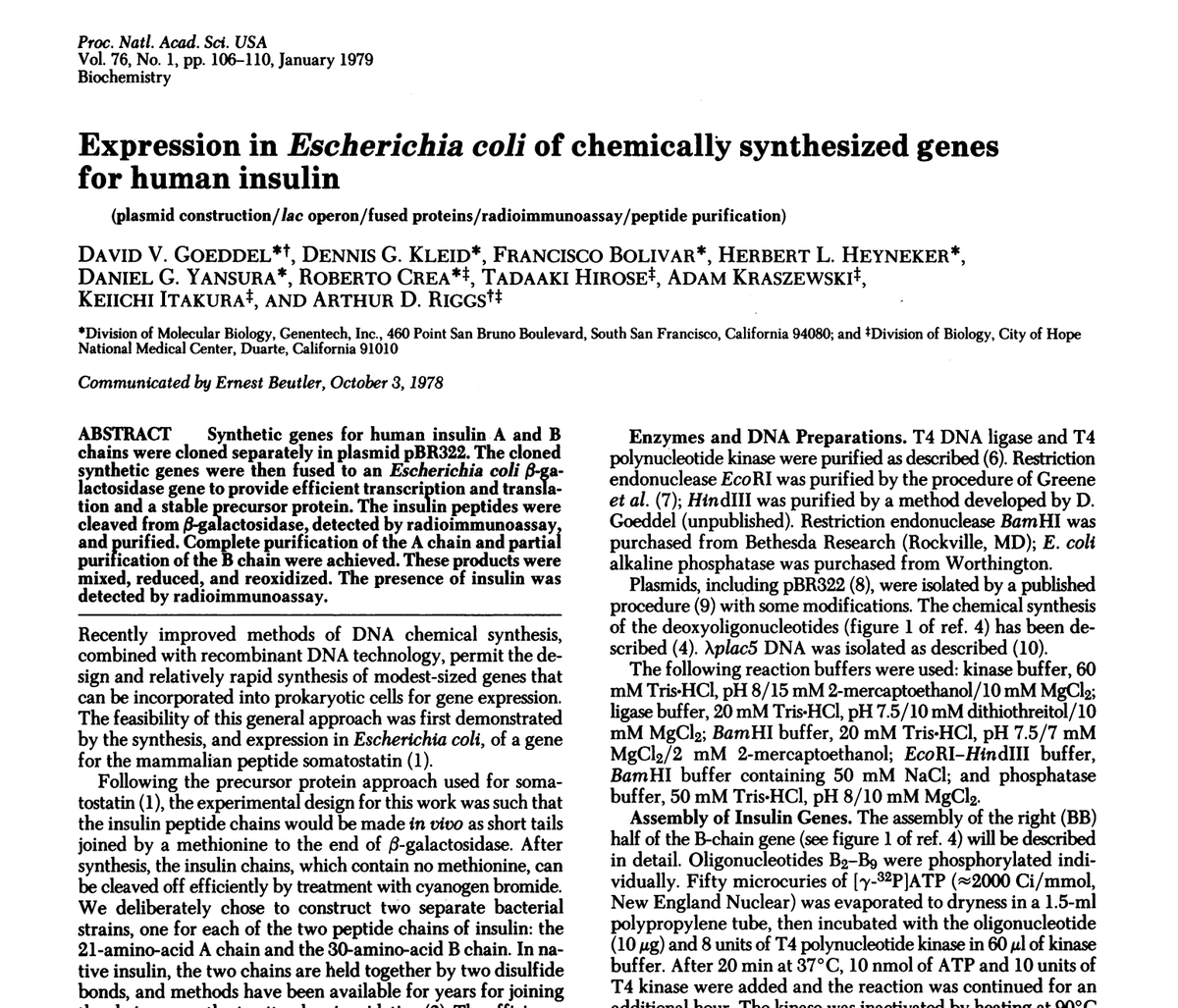
Check out the OG paper, linked below, about recombinant insulin. What do you notice about the author list? Boyer isn't on there. At Genentech, researchers owned their discoveries.
Gently, softly, calmly, let’s talk about what’s happening in DC right now.
Friends, have you ever been through a ZBB process? If not, let me give you my take. So, in a corporation where expenses are out of control, you have to put the entire company through a zero based budgeting process. It is one of the most painful things that people in a company experience.
You basically have to justify every. single. expense. And you also cut a bunch, and then only add back after you’ve gone through a proper ZBB cycle.
The US government is going through a ZBB right now. And that is necessary because spending is out of control. The complexity is so vast that I expect it will take AI to decipher.
You cannot tell me that a government that accidentally wires hundreds of millions of dollars to the Taliban has its finances in order. That signals an underlying disaster. That signals bad stewardship of resources.
In fact, it is a disaster. Over the last 20 fiscal years, the US government has made ~$2.7 trillion in "improper payments," according to the US Government Accountability Office. Trillion! With a T!
That financial management disaster was not caused by @elonmusk. And there is no painless way to clean it up.
Elon is doing what any executive would do walking into a giant mess. You ZBB and then build back.
So, I don’t believe that America is going to be on the wrong side of global right and wrong, as some are saying. I don’t believe that America is going to be permanently isolationist. I do believe that unwatched finances will get out of control in any human system, and that the GAO has been trying to ring this bell for years, and that scaled complexity requires scaled financial management.
Because the US has the largest budget in the world, it will now go through the single most complex ZBB ever undertaken in the history of the world.
Some states do ZBB, but it's never been done at the federal level. President Jimmy Carter tried, but the bureaucratic systems were too complex, and President Ronald Reagan abandoned the attempt.
So, if there is one person in the world chosen to lead this Grand Canyon of projects, we would hope for the president to choose one of the best capital allocators on the planet. Better if that human is also one who can leverage AI and technical talent to manage the massive complexity.
Anyone who has lived through a ZBB at the corporate level will tell you that it’s hell and everyone hates it. This is why I feel really bad for federal workers -- I have a lot of empathy for civil servants and people doing a great job every day for the United States. No doubt, the uncertainty is trying and stressful for many. It's an unfortunate situation.
So, that's my take. I don't want to speak beyond what I know and can observe from the other side of the country. I've worked both in the private sector and the public sector -- the cultures are different. And an Elon-Musk-style culture is going to be the most hard core of them all. No doubt, it's jarring. It's gonna be a lot.
But what I also know is that every time I have ever doubted Elon, I ended up being the one who was wrong.
This wildly misleading tweet, and the mostly hateful replies, is like entering an alternate version of reality.
If anybody is interested in the truth behind this claim, and what that Swedish poll actually asked, I'll go through it.
Probably banging my head against a wall. 😂
We are pleased to announce the publication of 1-year patency data for our coronary artery bypass conduit XABG in @EACTS_Journals.
The successful 12-month follow-up of the first patient treated, represents a significant milestone for CABG procedures.
https://t.co/7kp5roDoJU
Every time I order something from the UK into Sweden I get shocked by the insane import duties and remember how last time I promised myself never to do it again.
This time: 120sek import duty on 1 replacement Lamy safari pen cap. It would have been cheaper just to buy a new pen!
The first air crash investigation on another world has concluded that the crash of the Ingenuity helicopter on Mars was caused by the inability of the navigation system to track the relatively featureless terrain.
This resulted in a touchdown with too much lateral velocity, applying a hard banding moment to the rotor blades causing them to snap.
You can watch the full presentation from @theAGU
https://t.co/MeR1DVcuuh
One of the biggest mysteries of biology is why life on Earth has a specific chirality: left-handed amino-acids and right-handed sugars
This is less surprising if you consider that amino acids come from stellar nebula
The building blocks of life then 'rain down' onto planets 🧵
It’s shocking how much we know about how learning happens, all the way down to the mechanics of what’s going on in the brain.
And it’s not just how learning happens, but also, what we can do to improve learning.
There are plenty of learning-enhancing practice strategies that have been tested scientifically, numerous times, and are completely replicable. They might as well be laws of physics.
For instance: we know that actively solving problems produces more learning than passively watching a video/lecture or re-reading notes.
(To be clear: active learning doesn’t mean that students never watch and listen. It just means that students are actively solving problems as soon as possible following a minimum effective dose of initial explanation, and they spend the vast majority of their time actively solving problems.)
Another finding: if you don’t review information, you forget it. You can actually model this precisely, mathematically, using a forgetting curve. I’m not exaggerating when I refer to these things as laws of physics – the only real difference is that we’ve gone up several levels of scale and are dealing with noisier stochastic processes (that also have noisier underlying variables).
Okay, but aren’t these findings obvious? Yes, but…
Yes, but in education, obvious strategies often aren't put into practice. For instance, plenty of classes that still run on a pure lecture format and don't review previously learned unless it's the day before a test.
Yes, but there are plenty of other findings that replicate just as well but are not so obvious.
Here are some less obvious findings.
-- The spacing effect: more long-term retention occurs when you space out your practice, even if it's the same amount of total practice.
-- A profound consequence of the spacing effect is that the more reviews are completed (with appropriate spacing), the longer the memory will be retained, and the longer one can wait until the next review is needed. This observation gives rise to a systematic method for reviewing previously-learned material called spaced repetition (or distributed practice). A "repetition" is a successful review at the appropriate time.
-- To maximize the amount by which your memory is extended when solving review problems, it's necessary to avoid looking back at reference material unless you are totally stuck and cannot remember how to proceed. This is called the testing effect, also known as the retrieval practice effect: the best way to review material is to test yourself on it, that is, practice retrieving it from memory, unassisted.
-- The testing effect can be combined with spaced repetition to produce an even more potent learning technique known as spaced retrieval practice.
-- During review, it's also best to spread minimal effective doses of practice across various skills. This is known as mixed practice or interleaving -- it's the opposite of "blocked" practice, which involves extensive consecutive repetition of a single skill. Blocked practice can give a false sense of mastery and fluency because it allows students to settle into a robotic rhythm of mindlessly applying one type of solution to one type of problem. Mixed practice, on the other hand, creates a "desirable difficulty" that promotes vastly superior retention and generalization, making it a more effective review strategy.
-- To free up mental processing power, it's critical to practice low-level skills enough that they can be carried out without requiring conscious effort. This is known as automaticity. Think of a basketball player who is running, dribbling, and strategizing all at the same time -- if they had to consciously manage every bounce and every stride, they'd be too overwhelmed to look around and strategize. The same is true in learning.
-- The most effective type of active learning is deliberate practice, which consists of individualized training activities specially chosen to improve specific aspects of a student's performance through repetition (effortful repetition, not mindless repetition) and successive refinement. However, because deliberate practice requires intense effort focused in areas beyond one's repertoire, which tends to be more effortful and less enjoyable, people will tend to avoid it, instead opting to ineffectively practice within their level of comfort (which is never a form of deliberate practice, no matter what activities are performed).
-- Instructional techniques that promote the most learning in experts, promote the least learning in beginners, and vice versa. This is known as the expertise reversal effect. An important consequence is that effective methods of practice for students typically should NOT emulate what experts do in the professional workplace (e.g., working in groups to solve open-ended problems). Beginners (i.e. students) learn most effectively through direct instruction.
Now, this might seem like a lot of new information -- a common reaction is “Wow, the field of education is experiencing a revolution!”
But here’s the thing:
Most key findings have been known for many decades.
It’s just that they’re not widely known / circulated outside the niche fields of cognitive science & talent development, not even in seemingly adjacent fields like education.
These findings are not taught in school, and typically not even in credentialing programs for teachers themselves – no wonder they’re unheard of!
But if you just do a literature review on Google Scholar, all the research is right there – and it’s been around for many decades.
Naturally, this leads us to the following question:
Why aren't these key findings being leveraged in classrooms? Why do they remain relatively unknown?
Here are a handful of reasons that I’m aware of.
1. Leveraging them (at all) requires additional effort from both teachers and students.
In some way or another, each strategy increases the intensity of effort required from students and/or instructors, and the extra effort is then converted into an outsized gain in learning.
This theme is so well-documented in the literature that it even has a catchy name: a practice condition that makes the task harder, slowing down the learning process yet improving recall and transfer, is known as a desirable difficulty.
Desirable difficulties make practice more representative of true assessment conditions. Consequently, it is easy for students (and their teachers) to vastly overestimate their knowledge if they do not leverage desirable difficulties during practice, a phenomenon known as the illusion of comprehension.
However, the typical teacher is incentivized to maximize the immediate performance and/or happiness of their students, which biases them against introducing desirable difficulties and incentivizes them to promote illusions of comprehension.
Using desirable difficulties exposes the reality that students didn’t actually learn as much as they (and their teachers) “felt” they did under less effortful conditions. This reality is inconvenient to students and teachers alike; therefore, it is common to simply believe the illusion of learning and avoid activities that might present evidence to the contrary.
2. Leveraging cognitive learning strategies to their fullest extent requires an inhuman amount of effort from teachers.
Let’s imagine a classroom where these strategies are being used to their fullest extent.
-- Every individual student is fully engaged in productive problem-solving, with immediate feedback (including remedial support when necessary), on the specific types of problems, and in the specific types of settings (e.g., with vs without reference material, blocked vs interleaved, timed vs untimed), that will move the needle the most for their personal learning progress at that specific moment in time.
-- This is happening throughout the entirety of class time, the only exceptions being those brief moments when a student is introduced to a new topic and observes a worked example before jumping into active problem-solving.
Why is this an inhuman amount of work?
-- First of all, it's at best extremely difficult, and at worst (and most commonly) impossible, to find a type of problem that is productive for all students in the class. Even if a teacher chooses a type of problem that is appropriate for what they perceive to be the "class average" knowledge profile, it will typically be too hard for many students and too easy for many others (an unproductive use of time for those students either way).
-- Additionally, to even know the specific problem types that each student needs to work on, the teacher has to separately track each student's progress on each problem type, manage a spaced repetition schedule of when each student needs to review each topic, and continually update each schedule based on the student's performance (which can be incredibly complicated given that each time a student learns or reviews an advanced topic, they're implicitly reviewing many simpler topics, all of whose repetition schedules need to be adjusted as a result, depending on how the student performed). This is an inhuman amount of bookkeeping and computation.
-- Furthermore, even on the rare occasion that a teacher manages to find a type of problem that is productive for all students in the class, different students will require different amounts of practice to master the solution technique. Some students will catch on quickly and be ready to move on to more difficult problems after solving just a couple problems of the given type, while other students will require many more attempts before they are able to solve problems of the given type successfully on their own. Additionally, some students will solve problems quickly while others will require more time.
In the absence of the proper technology, it is impossible for a single human teacher to deliver an optimal learning experience to a classroom of many students with heterogeneous knowledge profiles, who all need to work on different types of problems and receive immediate feedback on each attempt.
3. Most edtech systems do not actually leverage the above findings.
If you pick any edtech system off the shelf and check whether it leverages each of the cognitive learning strategies I’ve described above, you’ll probably be surprised at how few it actually uses. For instance:
-- Tons of systems don't scaffold their content into bite-sized pieces.
-- Tons of systems allow students to move on to more material despite not demonstrating knowledge of prerequisite material.
-- Tons of systems don't do spaced review. (Moreover, tons of systems don't do ANY review.)
Sometimes a system will appear to leverage some finding, but if you look more closely it turns out that this is actually an illusion that is made possible by cutting corners somewhere less obvious. For instance:
-- Tons of systems offer bite-sized pieces of content, BUT they accomplish this by watering down the content, cherry-picking the simplest cases of each problem type, and skipping lots of content that would reasonably be covered in a standard textbook.
-- Tons of systems make students do prerequisite lessons before moving on to more advanced lessons, BUT they don't actually measure tangible mastery on prerequisite lessons. Simply watching a video and/or attempting some problems is not mastery. The student has to actually be getting problems right, and those problems have to be representative of the content covered in the lesson.
-- Tons of systems claim to help students when they're struggling, BUT the way they do this is by lowering the bar for success on the learning task (e.g., by giving away hints). Really, what the system needs to do is take actions that are most likely to strengthen a student's area of weakness and empower them to clear the bar fully and independently on their next attempt.
Now, I’m not saying that these issues apply to all edtech systems. I do think edtech is the way forward here – optimal teaching is an inhuman amount of work, and technology is needed. Heck, I personally developed all the quantitative software behind one system that properly handles the above challenges. All I’m saying is that you can’t just take these things at face value. Many edtech systems don’t really work from a learning standpoint, just as many psychology findings don’t hold up in replication – but at the same time, some edtech systems do work, shockingly well, just as some cognitive psychology findings do hold up and can be leveraged to massively increase student learning.
4. Even if you leverage the above findings, you still have to hold students accountable for learning.
Suppose you have the Platonic ideal of an edtech system that leverages all the above cognitive learning strategies to their fullest extent.
Can you just put a student on it and expect them to learn? Heck no! That would only work for exceptionally motivated students.
Most students are not motivated to learn the subject material. They need a responsible adult – such as a parent or a teacher – to incentivize them and hold them accountable for their behavior.
I can’t tell you how many times I’ve seen the following situation play out:
-- Adult puts a student on an edtech system.
-- Student goofs off doing other things instead (e.g., watching YouTube).
-- Adult checks in, realizes the student is not accomplishing anything, and asks the student what's going on.
-- Student says that the system is too hard or otherwise doesn't work.
-- Adult might take the student's word at face value. Or, if the adult notices that the student hasn't actually attempted any work and calls them out on it, the scenario repeats with the student putting forth as little effort as possible -- enough to convince the adult that they're trying, but not enough to really make progress.
In these situations, here’s what needs to happen:
-- The adult needs to sit down next to the student and force them to actually put forth the effort required to use the system properly.
-- Once it's established that the student is able to make progress by putting forth sufficient effort, the adult needs to continue holding the student accountable for their daily progress. If the student ever stops making progress, the adult needs to sit down next to the student again and get them back on the rails.
-- To keep the student on the rails without having to sit down next to them all the time, the adult needs to set up an incentive structure. Even little things go a long way, like "if you complete all your work this week then we'll go get ice cream on the weekend," or "no video games tonight until you complete your work." The incentive has to be centered around something that the student actually cares about, whether that be dessert, gaming, movies, books, etc.
Even if an adult puts a student on an edtech system that is truly optimal, if the adult clocks out and stops holding the student accountable for completing their work every day, then of course the overall learning outcome is going to be worse.
@LayerLux3D@cgallaty I made a much simpler servo tester a while back but didn't mount the headers on a PCB, just glued them into a 3d printed lid. That wasn't reliable, the pins always shifted around.
Your tester looks great!