@JacquelynGill Earth has a thick atm because it has strong gravity, is not too close to the sun, and the sun is a quiet start heat that does not though out much extreme UV.
@JacquelynGill The bottom line is that saying that Earth has a thick atm because of its strong geodynamic magnetic field is not consistent with the (literal) textbook understanding of atm erosion mechanisms.
@JacquelynGill This is a myth. Earth’s magnetic field has a negligible effect on the rate of atm loss. Venus has no magnetic field is closer to the sun and has an atm 90x thicker than Earth’s. For a planet of Mars’ mass a magnetic field would make a difference. …
How confidently can scientists record key milestones in #ClimateChange, such as greenhouse gas emissions, warming, or reaching #NetZero?
A new paper by @AndrewHMacDoug1, @JoeriRogelj, Giacomo Grassi & others answers this question 👇🌍🔥
https://t.co/KA8MGX2ZrR
@EliotJacobson Note peak CO2 concentration is not net zero. Peak concentration is likely to occur years to decades before net zero CO2 emissions https://t.co/W8SRH4XeqU
Results peak CO2: Detecting that CO2 concentration has peaked is far easier, and a drop in CO2 concentration of 3ppm is consistent with a greater than 99% chance that CO2 has peaked in all scenarios examined.
Overall it is sobering that even under aggressive mitigation scenarios a conclusive end to global warming is at the very outer edge of the living future, with only a small number of the very youngest children alive today likely to witness this climate milestone.
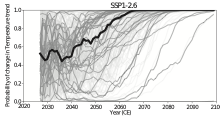
Results warming slowdown: We estimate that it will take 40 to 60 years after a slowdown in warming rate, to robustly detect the signal in the global average temperature record.
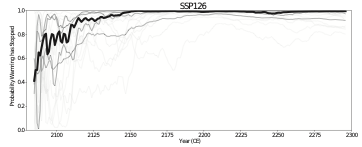
Results warming stopped: It takes until the mid 22nd century to have enough data to conclude warming has stopped when solely based on information provided by the observational temperature record.