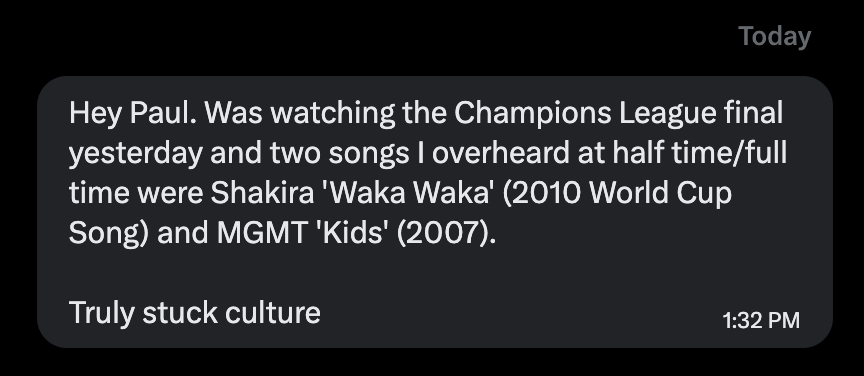
Aggregators are a cancer to social networks; they’re all running on auto-pilot.
Instagram killed aggregators in 2022 (e.g., “thefatjewish” and “middeclassfancy”) and it led to an explosion of original content.
It is going to work much better for X:
Our users are smarter and have a lot more to say—as long as their voices are not drowned out by automated accounts.
We are publicly demonetizing the most egregious aggregators and using them as examples, so the rest can start evolving.
The endstate of X in a month: we will never pay twice for the same content. We will only reward for net new contributions to the Timeline.
This Thursday: Idea → Money.
@raymmar and I are taking a real project live, all the way from prototype to monetized:
1. Prototype the idea into a working build
2. Build in the monetization
3. Set up the marketing to actually get users
No theory. Just the mechanics you can copy for your own build.
Plus live Q&A. Pro members get pulled on stage from our Discord to ask about whatever they're building.
📆 Thursday, June 4 · 9AM PT
📺 Live on YouTube + LinkedIn + X
RSVP: https://t.co/WKDostmovU
In the last 6 months at @Ahrefs, we analyzed over 1 billion data points across 14 studies. Here's what we learned about AI search optimization:
1) "Best X" blog listicles are the single most prominent content format cited by AI chatbots. They make up 43.8% of all page types cited by ChatGPT specifically.
2) 67% of ChatGPT's top 1,000 citations come from sources marketers can't influence: Wikipedia (29.7%), homepages (23.8%), app stores (6.6%). Only 32.3% are influenceable content like educational pages, reviews, news, and blog posts.
3) 28.3% of ChatGPT's most-cited pages have zero Google organic visibility. These pages get cited repeatedly by ChatGPT despite not ranking in Google at all. A completely separate discovery layer.
4) ChatGPT only cites about 50% of the URLs it retrieves. It fetches dozens of pages per query but uses half as background context without attribution. This means that being retrieved and being cited are very different things.
5) Adding schema markup had zero meaningful impact on AI citations. AI Overviews actually dipped −4.6%, while AI Mode (+2.4%) and ChatGPT (+2.2%) showed changes indistinguishable from zero.
6) YouTube mentions have the highest correlation (0.737) with AI brand visibility out of all the factors we studied (including all the conventional SEO metrics like backlinks, page count, DR, etc). This held true for both Google-owned and OpenAI products.
7) AI Overviews reduce clicks to the #1 result by 58%. That’s up from 34.5% just 10 months earlier. The trend is accelerating.
8) 99.9% of AI Overviews appear on informational intent queries. Transactional, navigational, and local searches are almost entirely AIO-free. Shopping triggers AIOs just 3.2% of the time.
9) For a given search query, Google’s AI Mode and AI Overviews reach the same conclusions 86% of the time — but cite almost entirely different sources (only 13.7% citation overlap).
10) AI Overviews change every 2.15 days on average, with 70% of content differing between consecutive observations. But semantic similarity stays at 0.95. The words, sources, and entities constantly shuffle, but the actual meaning barely moves.
BREAKING: get rich building websites for local businesses!
As of today, Shipper finds local businesses, builds each one a website, and drafts a personalized pitch email to the owner. AI does all of it.
Here's the flow:
• Pick a city + business type (restaurants in Miami, salons in Copenhagen)
• Shipper finds matching local businesses, with their info and photos
• AI builds each one a personalized sample website with its own live preview URL
• AI drafts a short, personalized pitch email for every business • You review, approve, and send
Find clients, show them a better version of their online presence, and pitch the work. All in one flow.
Live now. Go try it.