But if AI mathematics continues to progress at anything like its current rate -- which is what I expect to happen -- then we will face a crisis very soon, and mathematics departments, who owe a duty of care to their students, should be urgently preparing for it.
@eigenknight I hope that you can come! I’ve been here all semester and I’ll be at the workshops/summer schools. I have friends from UGA coming, and some had to go to DC/Chicago to get their visas, but they were processed quickly
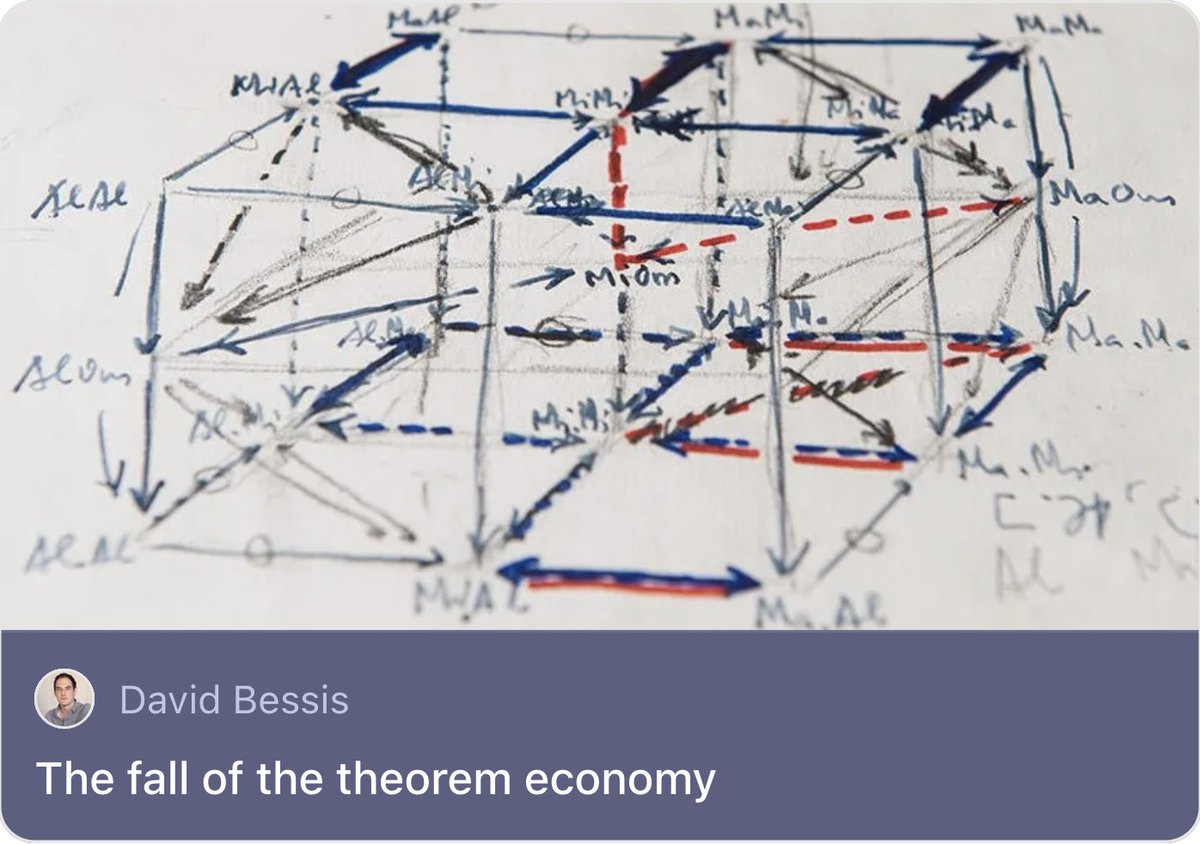
@mathandcobb@littmath This is a great example of something David Bessis was talking about in his essay. These people don’t understand what math research is and they’re misinterpreting benchmarks. This is really bad for our reputation, and there is not a lot we can do about it https://t.co/ETIZM12Icu
@AcerFur A special case is the Furstenberg-Sárközy theorem on square differences. This is a two term polynomial progression but the best known upper bound (Green-Sawhney) is still far from the lower bound (Ruzsa) This one is interesting because traditional Fourier analysis applies
Thank you, everyone, for the incredible feedback on "the fall of the theorem economy"!
The subject is of course bigger than just AI and math—it's about the future of human cognition. A few remarks that didn't make it to the published version:⤵️
@AcerFur Wow I figured you would be a senior. Haha it’s impressive that you already know so much.
Honestly I think you should finish the degree so that you don’t accidentally shut any doors. I guess Silicon Valley has a lot of drop outs though.
@AcerFur How much time do you have left to finish your degree? At least in the US most universities have rules that require graduate students to have undergraduate degrees. Maybe Europe is different
Also, if you’re curious: the statue is of the chronicler of Béla III. He wrote a book called Gesta Hungarorum (Latin for “The Deeds of the Hungarians”) https://t.co/MMacBBdKgS