(1/3) I am setting up shop and will be hiring #PostDocs & #PhD students to join my independent #Theory group at the Helmholtz Centre for Infection Research and the Lower Saxony Center for AI and Causal Methods in Medicine (@CAIMed_de).
Pre-print alert! With experimental collaborators at the Young lab (MIT), we investigate how (i)active rRNA transcription maintains the size, spacing, and number of nucleolar fibrillar centers, (ii) the consequence of this arrangement on rRNA processing.
https://t.co/Pm0FMqPp5G
This was a very fun project which taught me more about droplet physics and showed how conservation laws and thermodynamic reasoning can be exploited to derive a self-consistent theory which does not depend on model details. (7/n)
Our theoretical work on self-consistently recapitulating the dynamics of chemically active, self-propelling condensates is now out in Physical Review Research: https://t.co/jC6Zr5HLUw. Big thank you to Leonardo Demarchi, Ivan Maryshev, and Erwin Frey (@PhysOfLifeLMU). 1/n
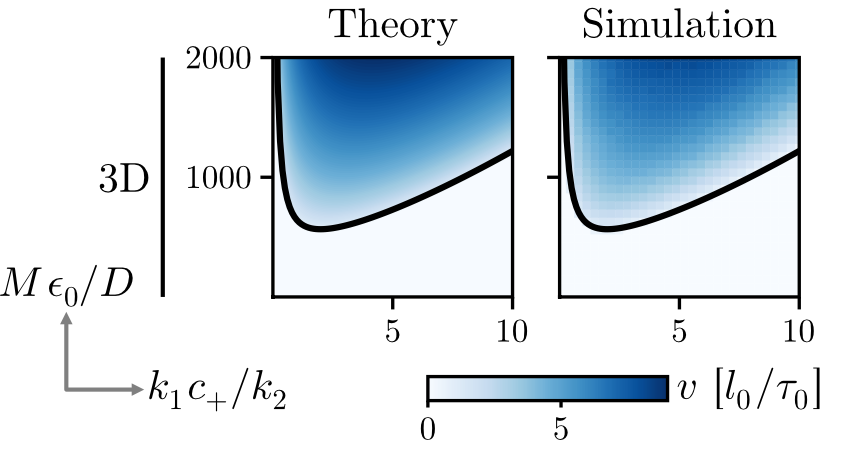
We used thermodynamic consistency as criterion to select the droplet velocity from this set of possible states, and found that it explained our FEM simulations. With this framework, we then interrogated the onset of droplet motion in the presence of reciprocal interactions. 6/n
Very excited that our work on how a single condensate is formed and drives the polymerziation of the tubulin homolog FtsZ in the bacterium M. xanthus is out in @NatureComms: https://t.co/ZwIIp9UTzR. Fantastic collaboration with Dominik Schumacher, @LotteSogaard & Schwille Labs.
(6/6) To then elucidate how much of chromatin folding depends on active processes, we believe that dynamic data and measurements of pairwise fluctuations will play a major role!
(1/6) How will a pattern of active processes along the sequence of a polymer affect its conformation? In our new article (https://t.co/GgvMLKfRxz) with @kannandeepti, Arup K. Chakraborty, and Mehran Kardar, we make several predictions based on analytical theory and simulations.
(5/6) So, how can we tell if these effects play a role in chromatin? Unfortunately, contact data alone seems insufficient, because the same distribution of conformations could arise in a purely passive polymer that folds due to appropriately chosen pairwise attraction/repulsion.