Destacada representación de nuestra especialidad y de la AMCI en los Premios de Investigación 2026 de la @ANM_Colombia, con reconocimientos que reflejan el compromiso con la investigación, la excelencia académica y la generación de conocimiento. @AndromedaShock
@InternSupp@yoshiaki_666_ We have a paper with Gustavo Ospina Tascon some years ago where it points that it can also track MC abnormalities, but in clinical practice etc the first thing we rule out is stagnation and there are nice data in the literature on that also. Doubtlessly it is a complex variable
@icmteaching Dear Ashley when I read “complicated ways to learn very little” I saw red (jaja Latin). We have been working a lot on this. I apologize again! Will read the doc at depth. We may organize a debate 2027 with GOT, JLT and you within the Network agenda. Science in the right place😍
Dear friends, I apologize for my angry reaction yesterday on comments challenging physiological precepts on which we strongly believe and practice for years. I deleted the posts. Every opinion is legitimate. We profoundly disagree but will respond with our studies in next posts
All the hot topics in septic shock resuscitation with the ANDROMEDA-SHOCK- NETWORK at full throttle; First World Summit! 53 faculties. Our next research projects discussed at length. Registration open, full programme (QR). Bidirectional translation. Videos available 6months
Super excited about the launch and the rapid growth (almost 500 members in 3 weeks!) of the https://t.co/iVaZzVmphG, but mostly about the building of a community of like-minded, forward looking clinicians of all levels of experience, a way to extend the unbelievable HR experience worldwide and year round. Thanks to the amazing faculty for all your help! As always, we are totally inclusive in terms of fields of expertise and especially growing the concepts of physiology and resuscitation outside of critical care/emergency/anasthesia into the spheres of internal medicine and those who take care of a large number of patients on the wards.
When you are away just for a couple of days for congresses or whatever, the extreme happiness of my dogs Klaus and Wilson, is so thrilling, touching, almost makes me cry. So loyal, so simple. Arrived at 5 AM from Brazil and they almost made a party😍😍😍😍😍
Concerning pulse pressure unfortunately cannot spoil the results of the big ANDROMEDA-PEGASUS (3000 pts almost 200 centers) because under review but: septic shock pt with PP<40 almost 80% probabilities of low VTI, if PP >55, only 9% probability. Great for initial decisions
@Mlbirch11 True, in the review we discuss it at length. In the 3000 pts of PEGASUS we analyzed the impact of several contextual modifiers and in pts as you cite, prediction of a low SV loses precision, but for the vast majority it functions. Echo is not immediately available everywhere
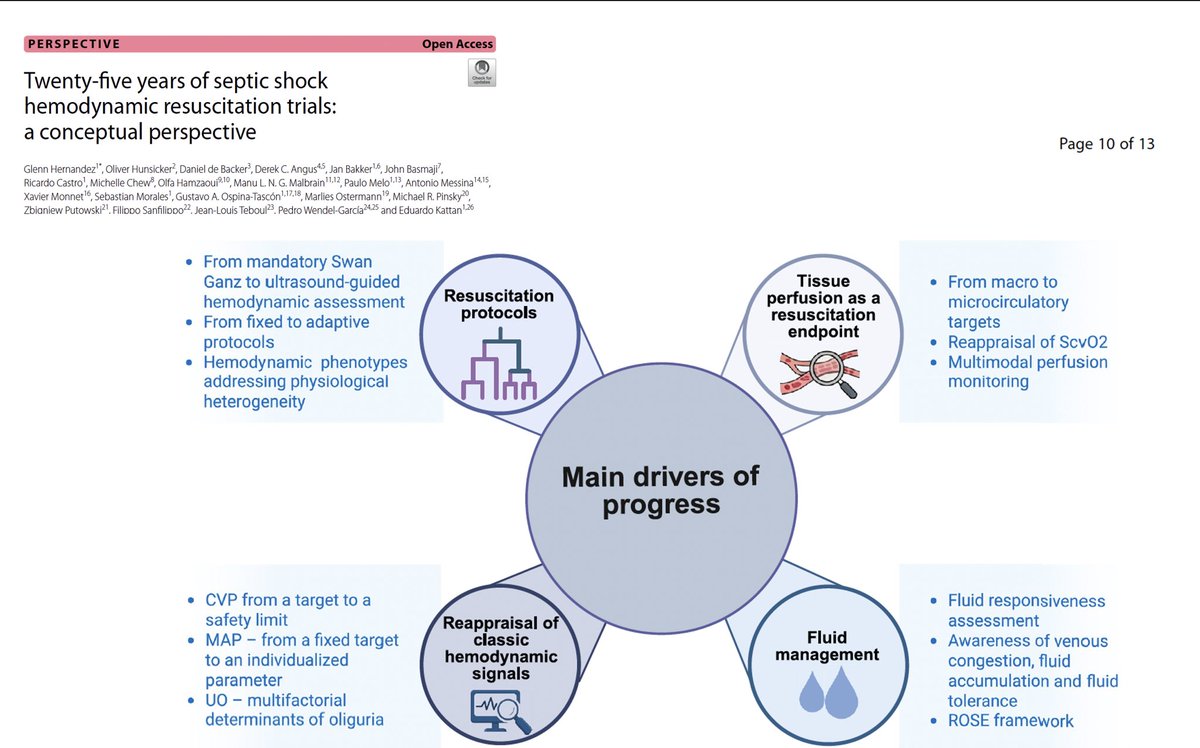
@ThinkingCC True, but anyway we have progressed a lot! As we showed in the recent 25 years paper, the main drivers of progress have been the things you cite, perfusion oriented protocols, personalized approaches, all the aspects of fluids including FR, tolerance, congestion, POCUS etc
@ThinkingCC True, but anyway we have progressed a lot! As we showed in the recent 25 years paper, the main drivers of progress have been the things you cite, perfusion oriented protocols, personalized approaches, all the aspects of fluids including FR, tolerance, congestion, POCUS etc
Who really knows, but the key thing that you have resuscitated in resuscitation is anchoring around tissue perfusion, for now we use capillary refill time, but I do believe this will become more precise and improve in the next few years and that is a huge step forward and away from the nonsense of using lactate and MAP etc. And we understand understanding that one does not need to maximize cardiac output despite this having been proven clearly in the late 80s, it was somehow brought back to life in the early 2000s and the dawn of protocol medicine.
@ThinkingCC Thanks dear Phil. After so many years of Burton, little progress. Operational definitions and methods to estimate such as beat-to-beat vs zero flow (with dangerous MV maneuvers) lead to different values. Conceptual idea vs factual dilemmas! Sometimes I ask myself: is it for real?
Friends, our 7th Hemodynamic monitoring and tissue perfusion online bilingual Course is just 2 weeks ahead. Also the first world summit of the Andromeda Research Network! Many of these topics will be addressed there! Can be followed offline for 6 months! Welcome😍
Finally, crit closing pressure and waterfall. I confess that for me the concept is not clear, far from that. I am lucky since I share office with the great Kattan and Ricardo Castro. Ricardo is working very hard on deep physiology on this with Pierre G Guinot. Follow them💪
A funny thing is that for ANDROMEDA -SHOCK 2019, we had no clue of the complexity of CRT. A long story. Now we know better but still amazed. With the Copernicus study group and the great Ricardo Castro we recently tried to summarize the known and potential pathogenic mechanisms