The aim of teaching is to help learners make new connections and organise connections into meaningful schema. Share the cue that will help pupils recall and organise the learning.
Check out our sketchnote ⬇️Contact us for bespoke professional learning [email protected]
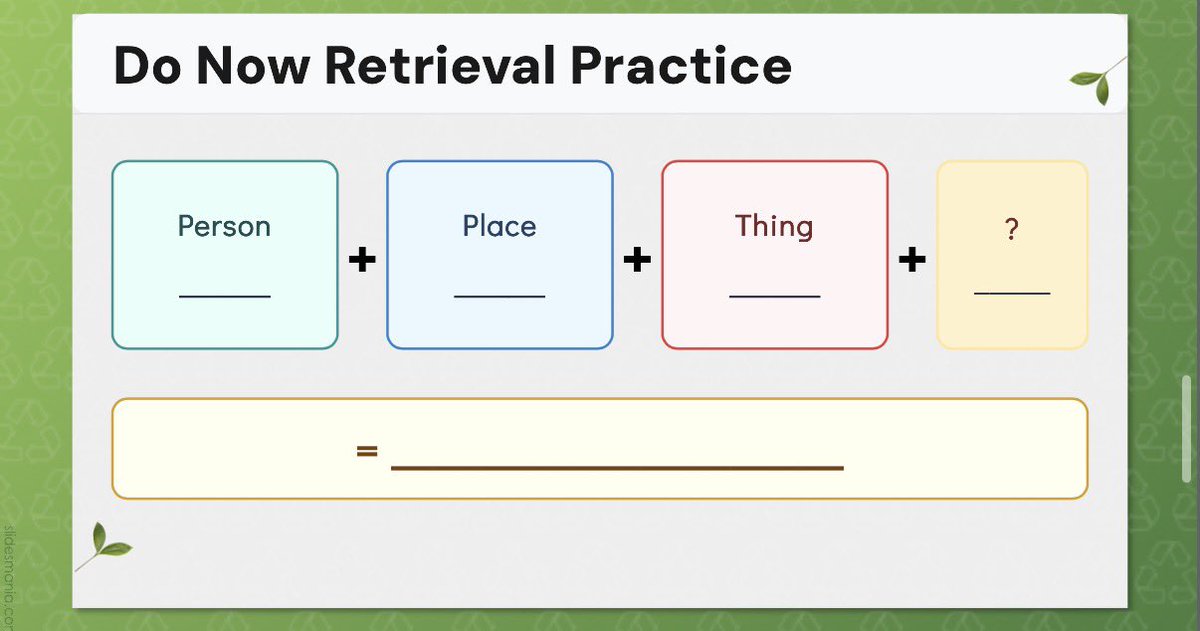
This is one of my favorite retrieval practice techniques. Students begin by essentially brain-dumping all the people, places, and things they know about a concept. Then, they select one from each category, build an interaction among the three, and think through what would result from that interaction. After that, they exchange papers with a shoulder partner, who introduces a fourth element and determines how the interaction, and resulting outcome, changes.
What I appreciate about this process is that it moves students beyond simple rote memorization of inert knowledge, which can happen when retrieval practice becomes little more than answering the same rotation of recall questions repeatedly, and toward more meaningful learning that is connected to prior knowledge across different contexts and, ideally, more transferable. Students are not just recalling isolated facts; they are actively building relationships among concepts, causes, systems, and outcomes.
I’d also note that this is not a technique I would use while students are still in the acquisition phase of the instructional hierarchy, when much of the knowledge has not yet been solidified in long-term memory. This strategy is better suited for the fluency and application phases, when students are ready to manipulate, connect, and extend what they know.
Sidenote: Slides are still something I use sparingly when they suit the purpose better than live diagramming, modeling, or writing on the visualizer. In this case, a slide format like this is simply more efficient for student completion and pacing. I mention that because of some recent black-and-white discussion around “never using slides again.” There’s obviously far more nuance to it than that.
1/ Retrieval practice works best when teachers apply it thoughtfully and reflectively rather than treating it as a mandated "one-size-fits-all" technique.
Strong evidence. Patchy practice. Here's where the gaps are. 🧵
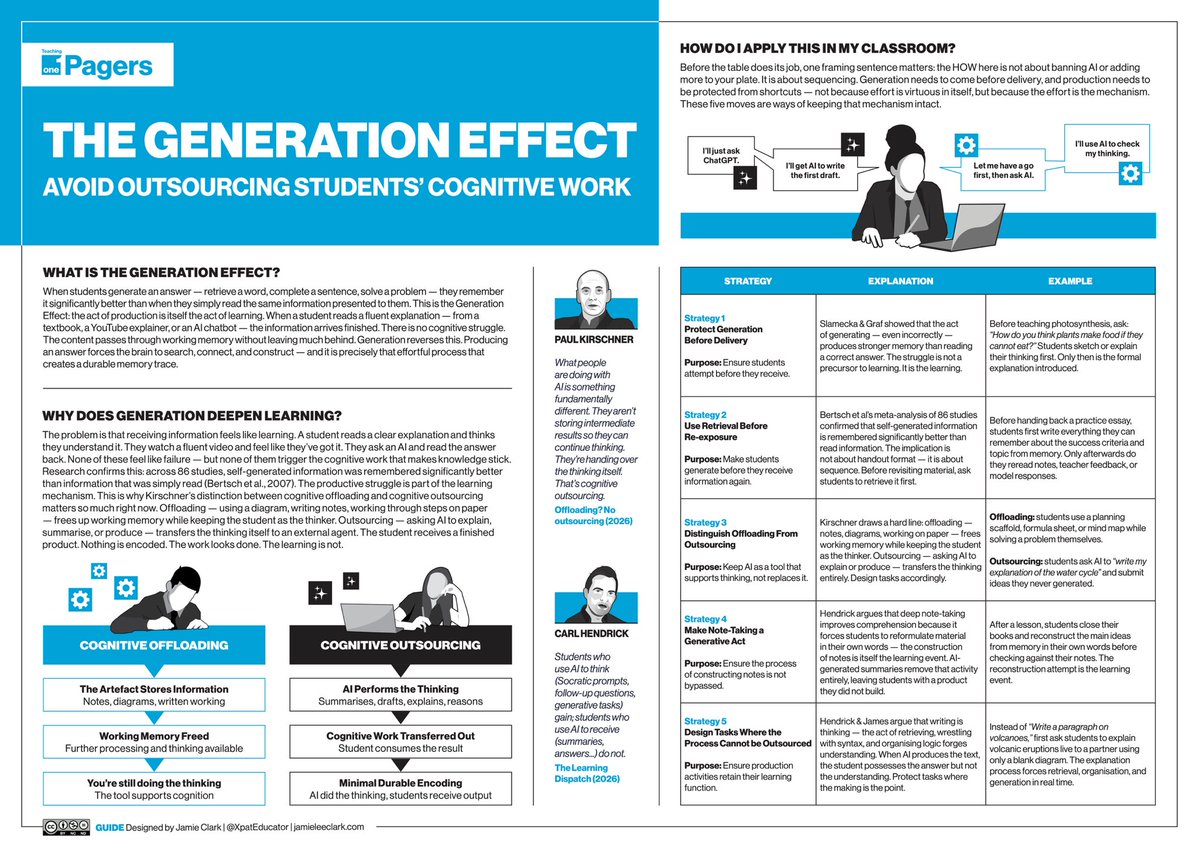
🤖 “What people are doing with AI is something fundamentally different. They aren't storing intermediate results so they can continue thinking. They're handing over the thinking itself. That's cognitive outsourcing.” — @New_Old_Paul
📄 New FREE one-pager on the Generation Effect and what AI is doing to learning. Also draws on @C_Hendrick and others.
https://t.co/yHBoZfameE
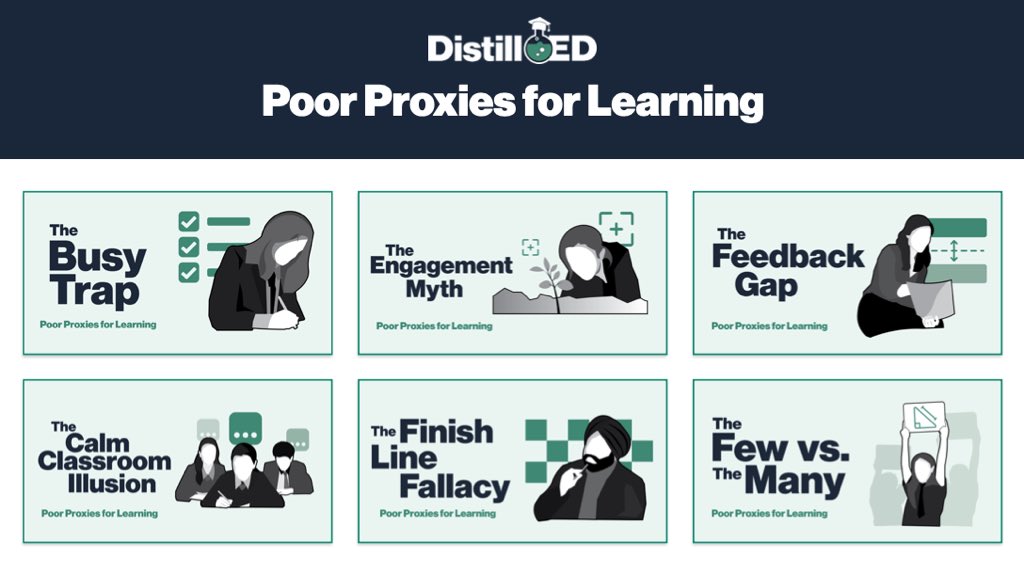
The Poor Proxies for Learning series is complete. 6 editions. 6 things that look like learning — but aren't. A full reading list 👇
1️⃣ The Busy Trap https://t.co/CGVxuNhnOK
2️⃣ The Engagement Myth https://t.co/1Bdi0EtNG0
3️⃣ The Feedback Gap https://t.co/FhRd6GNP2j
4️⃣ The Calm Classroom Illusion https://t.co/KwesjAZdar
5️⃣ The Finish Line Fallacy https://t.co/d5YbeoPgil
6️⃣ The Few vs. The Many https://t.co/K27bDMJL68
What a PLEASURE to make summary of @greg_ashman's EXCELLENT (and very short!) book on Cognitive Load Theory.
What makes it stand out? Depth and nuance throughout ensuring the classroom suggestions reach back to the original research.
Summary here:
https://t.co/O8uDMfRgaw
🚨 NEW! When we rely primarily on raised hands for answers, we fail to check the understanding of the entire class. We merely confirm the knowledge of the most confident or competent students.
This week’s ⚗️DistillED is the final part of the Poor Proxies for Learning series… Proxy 6 The Few vs. The Many.
https://t.co/evKBDuLJTR
'I've taught it' and 'they've learned it' are not the same. The Finish Line Fallacy — Poor Proxy #5 — is why curriculum coverage is one of teaching's most misleading measures.
This week's DistillED is a good one - Coe, Nuthall, Bjork all contributing — all converging on the same uncomfortable truth:
https://t.co/S6LABhG1dz
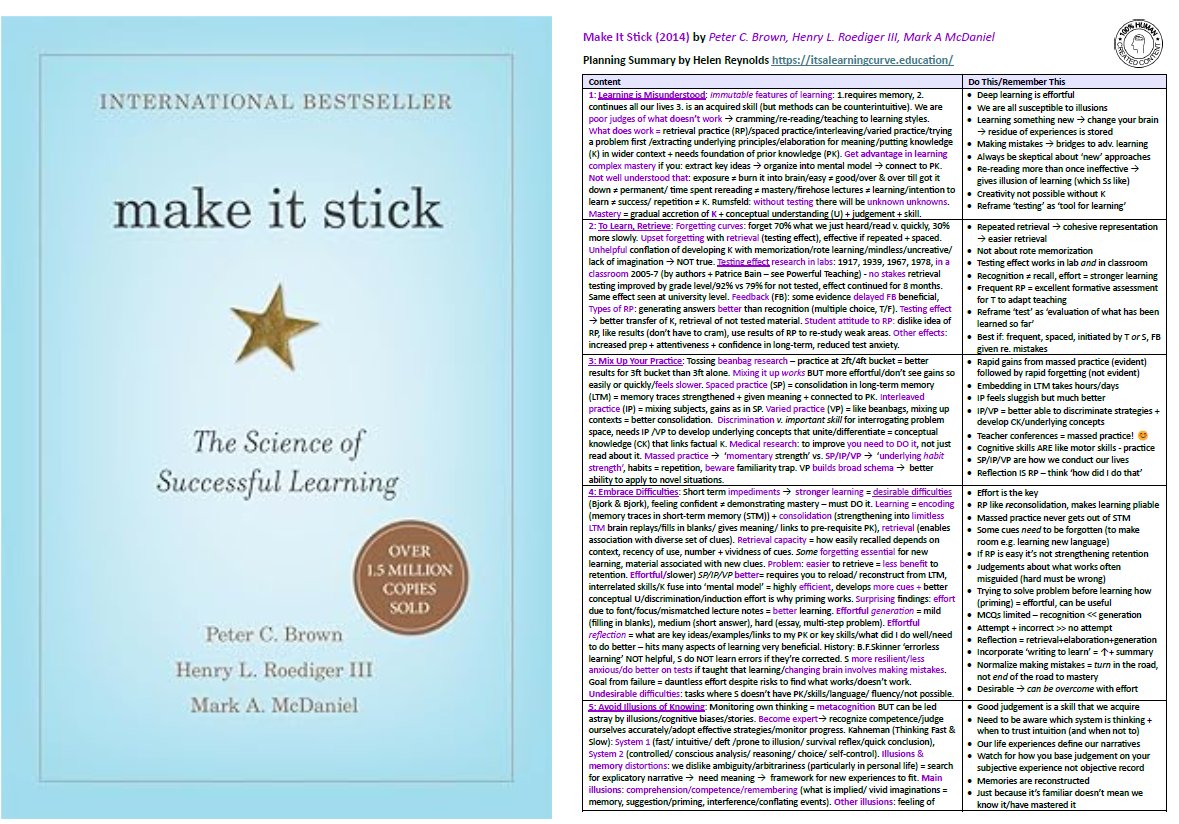
If you're just getting started with cogsci/Science of Learning, read 'Make It Stick'!
If (like me) you read it when it came out, 12 years ago, read it again! It's AMAZING.
Thanks to Peter C Brown, Henry L Roediger III, Mark A McDaniel
Summary here:
https://t.co/O8uDMfRgaw
RESPONSIVE TEACHING! A mini-collaboration with the prolific @C_Hendrick —translating his new @UNESCO guide into a clear, practical summary for busy teachers. If it’s useful, help share these principles—repost 🔁 and download it FREE here: https://t.co/QKGJjjeiKT
THE FEEDBACK GAP! Giving feedback is not the same as students learning from it. Poor Proxies #3: The Feedback Gap — why feedback given ≠ feedback used, and six practical strategies to close it. This week's ⚗️DistillED:
https://t.co/2dptHTM8Tu