Former Chief Economist @HouseBudgetGOP. Posts on developments in the U.S. economy, the federal budget, and fiscal and monetary policy. Views are my own.
Job growth slowed, the unemployment rate fell, and wage growth rose in June. Payroll employment rose 57k. Including revisions, 3-month avg. job growth slowed to 111k. The unemployment rate fell to 4.2% and avg. private-sector hourly wages rose 3.5% compared to one year ago.
Largely driven by higher energy prices, annual CPI inflation rose for the third consecutive month in May. The CPI rose 4.2% from one year ago, up from April’s 3.8%. The core CPI, excluding volatile energy & food prices, rose 2.9% from one year ago, up from April’s 2.8%.
On June 9, the #GDPNow model nowcast of real GDP growth in Q2 2026 is 3.3%: https://t.co/T7FoDdgYos. #ATLFedResearch
Download our EconomyNow app or go to our website for the latest GDPNow nowcast: https://t.co/JPMzsC5TNo
Job growth was strong in May. Nonfarm payroll employment rose 172k, more than double an expected gain of 80k. Job growth in March and April was revised higher by a combined 93k, and the 3-month avg. gain ending in May was 188k. The unemployment rate remained unchanged at 4.3%.
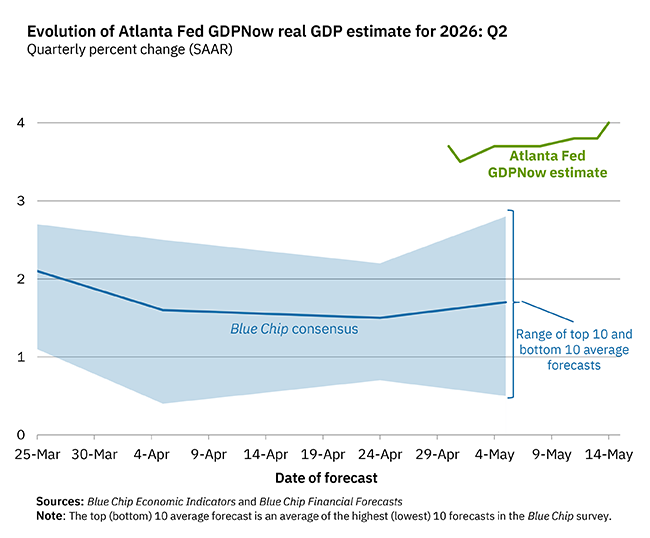
On May 14, the #GDPNow model nowcast of real GDP growth in Q2 2026 is 4.0%: https://t.co/T7FoDdgYos. #ATLFedResearch
Download our EconomyNow app or go to our website for the latest GDPNow nowcast: https://t.co/JPMzsC5TNo.
Annual CPI inflation rose for the second consecutive month in April. The headline CPI rose 3.8% from one year ago, up from March’s 3.3%. The core CPI, excluding volatile energy & food prices, rose 2.8% from one year ago, up from March’s 2.6%.
Nonfarm payroll employment rose 115k in April, higher than an expected gain of 55k, but lower than March’s revised gain of 185k. More than half of April’s job gains were in health care, transportation & warehousing, and retail trade. The unemployment rate was unchanged at 4.3%.
Real GDP increased at a seasonally adjusted annual rate of 2.0% in Q1 of 2026, up from 0.5% in the government shutdown-impacted Q4 of 2025. Consumer spending, fixed business investment and federal govt. spending contributed 1.08, 1.39 and 0.56 percentage points to growth in Q1.
The federal budget deficit totaled $1.2 trillion in the first half of fiscal year 2026, CBO estimates. That amount is $139 billion less than the deficit recorded during the same period last fiscal year.
https://t.co/IkRrRqlM3b
Job growth was strong in March. Nonfarm payroll employment rose 178k, a rebound from Feb.’s revised decline of 133k. Health care added 76k, partly reflecting an increase in physician offices as workers returned from a strike. The unemployment rate was 4.3%, down from Feb.’s 4.4%.
Jobs fell and the unemployment rate rose in February. Nonfarm payroll employment fell 92k, down from Jan.’s +126k. Employment in health care fell, reflecting strike activity. Job gains in Dec. and Jan. were revised down by 69k. The unemployment rate was 4.4%, up from Jan.’s 4.3%.
Likely impacted by the federal government shutdown, real GDP increased at an annual rate of 1.4% in the 4th quarter of 2025. Consumer spending and private fixed investment contributed 1.58 and 0.45 percentage points, but govt. spending reduced growth by 0.9 percentage points.
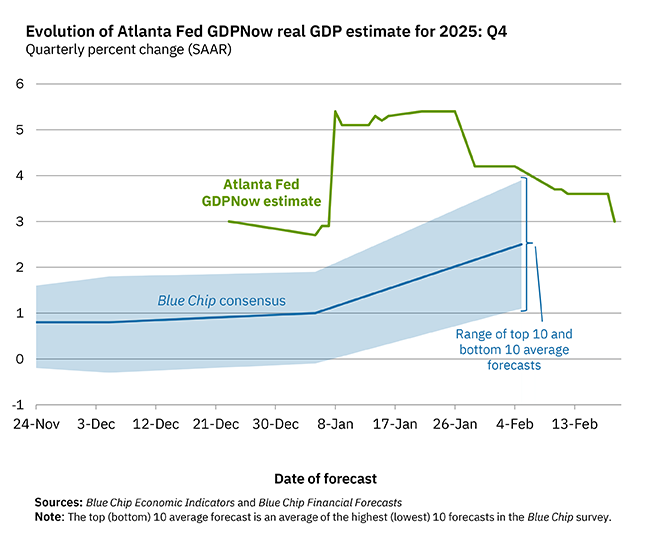
On February 19, the #GDPNow model nowcast of real GDP growth in Q4 2025 is 3.0%: https://t.co/T7FoDdgYos. #ATLFedResearch
Download our EconomyNow app or go to our website for the latest GDPNow nowcast: https://t.co/NOSwMl7Jms.
Annual CPI inflation fell in January. The headline CPI rose 2.4% from one year ago, down from 2.7% in December. The core CPI, w/o volatile food & energy prices, rose 2.5% from one year ago, down from December’s 2.6%.
Job growth was solid and the unemployment rate fell in January. Nonfarm payroll employment rose 130k, up from Dec.’s +48k. The unemployment rate was 4.3%, down from Dec.’s 4.4%. Benchmark revisions indicate total employment was 862k lower in March 2025 than previously estimated.
The federal budget deficit totaled $696 billion in the first four months of fiscal year 2026, CBO estimates. That amount is $143 billion less than the deficit recorded during the same period last fiscal year.
https://t.co/0WBCJoSfsP
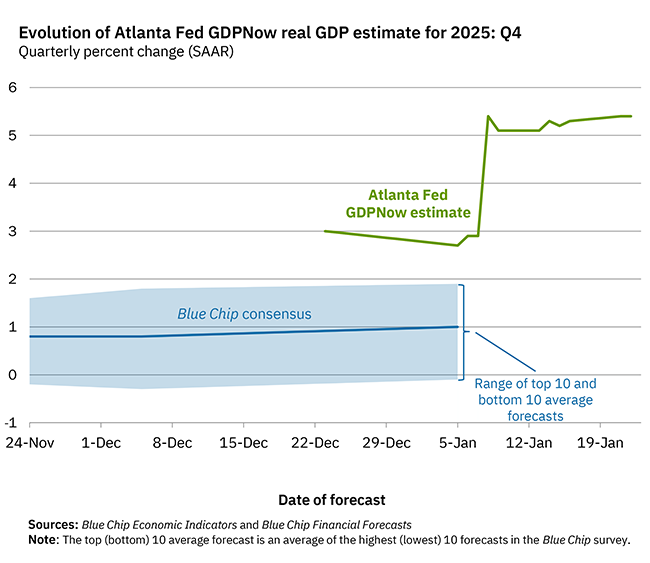
On January 22, the #GDPNow model nowcast of real GDP growth in Q4 2025 is 5.4%: https://t.co/T7FoDdgYos. #ATLFedResearch
Download our EconomyNow app or go to our website for the latest GDPNow nowcast: https://t.co/NOSwMl7Jms.