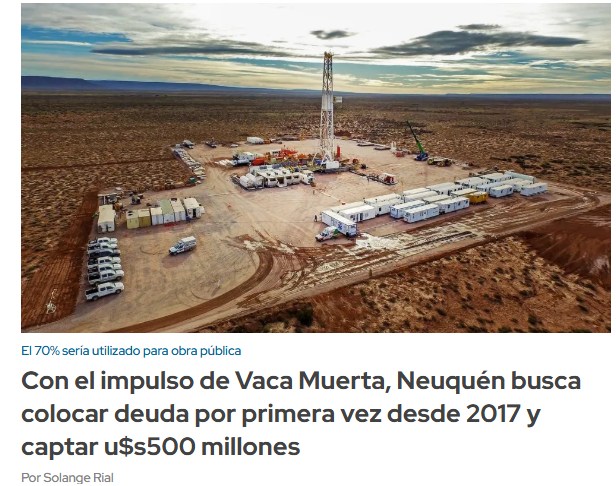
Esperemos se use para las rutas destruidas nacionales, arreglen con Nacion y el corredor norte de VM.
Salen por 500m pero a la pcia mas rica hoy de Argentina le van a ofrecer minimo 7 veces lo que piden. Esperemos ver record de tasa. Hay una gestion politica muy buena.
Desesperado por no ser el empomador del siglo. con $spcx..las $pltr hace lo mismo se llena de contratos militares y tapiza su directorio con acciones a los fans...$satl es otra...contrata gerontes jubilados de defensa y no para de distribuir acciones y pierden guita!!! Si no cambian la cabeza estas empresas, seguiran siendo las intocables del mercado. Los ejemplo de que no hacer en Ipos
@GustaFerraris Si estan con todo. Van a revolucionar el agro. Ahora marcas referenciales no tengo pero si venimos viendo c amigo en ese sector que pasa en Brasil...y veo resultados. Son mas competitivos y cambio ese nicho. Llegaron para quedarse.
VW subio 2% promedio sus precios en Julio con el argumento de la suba del dolar en Junio...que lograron?
Record de caida de participacion de mercado, una red anarquica en precios, concesionarios q cambian de manos y en el medio...el dolar volvio a retrocer poco mas de 3%. Se olvidaron que los compradores hoy miran mundial, a su seleccion.
VW tiene excelentes productos, no tan modernos como los orientales pero no dejan de ser buenos...lo que carece es de timing y cintura comercial en un mercado adverso...olvidan que no imponen mas las reglas. Los clientes mandan. El poder hoy es del cliente. La escasez paso a ser un argumento de venta del periodo Cretásico.
Esperemos otras lideres aprendan sobre esto que pasa en Julio 2026 a su competidor cercano. Deberian machacar en trasladar rapidamente iva de 10.5% que ya tienen utilitarios al segmento de entrada de gama como pasa en otras naciones que pelean con la marabunta china. Es la via mas rapida considero.
An Argentine fan captured all the Obelisk celebrations after Argentina win over England on his 8mm cassette camera and the footage feels straight out of a film.
Absolute cinema 🇦🇷
‼️‼️🇷🇺🇨🇳 BREAKING | Beijing has just delivered a stunning geopolitical betrayal to Moscow—plunging a dagger directly into Putin’s desperate pivot to Asia by freezing the Kremlin's crown jewel energy project.
According to explosive reports from the Wall Street Journal, China has indefinitely suspended all negotiations with Russia regarding the construction of the massive "Power of Siberia-2" gas pipeline. The pipeline was designed to reroute hundreds of billions of cubic meters of natural gas originally bound for Europe directly into Chinese markets, serving as Moscow's primary economic hope to replace lost Western revenues. By halting the multi-billion-dollar project indefinitely, Beijing has signaled that it refuses to bail out Russia's collapsing energy economy on Putin’s terms.
This freeze represents a catastrophic strategic defeat for Russia, exposing the brutal reality of its asymmetric dependence on Beijing. With Europe permanently locked out and China walking away from the negotiating table, Russia’s massive gas reserves are effectively trapped in the ground with nowhere to go. This move proves that China views Russia not as an equal strategic partner, but as a vulnerable, junior partner to be exploited, leaving the Kremlin's long-term economic survival in absolute tatters.
See the latest updates with us: @visionergeo
Asado Costillar
📍Argentina 🇦🇷
Taste Argentina: https://t.co/z0Eo3d3oak
Costillar refers to a whole beef rib rack, and in Argentina, it’s one of the most revered cuts for asado (Argentine barbecue). Cooked slowly over wood fire or charcoal, this cut is famous for its deep flavor, juicy meat, and crispy golden crust.
Asado a la Cruz is one of the most traditional and revered ways to cook beef in Argentina. Instead of grilling the meat over a parrilla, a whole costillar (beef rib rack), lamb (cordero), or even pork is stretched onto an “asador criollo” (iron cross) and slowly roasted upright next to an open fire. This slow, fire-kissed cooking technique enhances the meat’s natural flavors, rendering the fat beautifully while giving it a delicious smoky crust.
Video: Luciano Lopez
Trump’s Pipeline Wars: How Iran’s Gambit Exposed China
War is the continuation of politics by other means and Trump has moved that logic from the battlefield to the barrel.
The pipeline wars are his answer to Iran’s closure of Hormuz: a counter‑offensive that punishes Tehran, exposes China, and pulls Iraq, Syria, and Venezuela toward the American orbit as emerging allies.
Iran’s gambit was revolutionary bravado: slam shut the strait, choke off a third of seaborne oil, and dare America to blink. Iraq’s exports, long 90‑plus percent dependent on Hormuz—collapsed, and Baghdad discovered it was less an energy state than a client of a narrow waterway patrolled by a hostile regime and an American carrier group.
The Strait has been war‑gamed for decades. Trump tried diplomacy first. Now the world is watching what hard power looks like when the simulations go live.
His answer is to treat Hormuz as a flaw, not fate. Epic Fury broke Iran’s ability to escalate; the strategic move is what follows—build around Iran. Push Iraqi barrels toward Turkey’s Ceyhan.
Revive Mediterranean outlets. Bring back the Kirkuk–Baniyas concept: an old 1950s line from Kirkuk to Syria’s port of Baniyas, shuttered by war and neglect, now reborn as a 300,000–700,000 barrel‑per‑day artery with U.S. backing, American firms doing the studies, and sanctions eased just enough to lay steel. Iraq gets cheaper exports and diversification away from both Hormuz and Ceyhan. A post‑Assad Syria stops being a crater and starts being a corridor, earning hundreds of millions in transit fees, plus jobs and infrastructure. In practice, Syria and Iraq are being bound into an American‑centric energy system, precisely how fragile states become durable allies.
The deeper casualty is China. Beijing built its industrial machine on discounted barrels from Iran and Venezuela, moved by shadow fleets through long, vulnerable sea lanes. That is not diversification; it is dependency. Churchill warned that “safety and certainty in oil lie in variety of supply.” China concentrated risk in sanctioned regimes and contested waters, then called it strategy.
Venezuela shows the Trump doctrine at work. For years, Caracas was a major producer, enabler of state‑sponsored terrorism, and a willing ally of China.
The takedown of Nicolás Maduro was a seismic event largely ignored in polite foreign‑policy circles: a hostile petro‑regime toppled without occupation, then flipped into a grudging supplier to U.S. refiners. Oil long routed to China now flows to America, strengthening U.S. energy security and starving Beijing of friendly heavy crude.
This is Hegel’s dialectic in hard assets. Iran’s closure of Hormuz is the thesis. Trump’s strikes, pipelines, and Venezuela turn are the antithesis. The pipeline wars are the synthesis: chokepoints contested, transit states turned into allies, hostile producers pulled into an American system.
In 2026, the map matters again and Trump is redrawing it so America sits on the pipes while Iran and China sit on exposure.
Así amaneció Moscú tras un ataque con drones ucranianos a los depósito de petróleo en Noginsk en Elektrostal, cerca de la capital. Además alcanzaron dos centros logísticos de Wildberries, el Amazon ruso, en Elektrostal y Kotovsk, en la región de Tambov
videos de @bayraktar_1love
ZARPA DE GALICIA LA FLOTA DEL SAQUEO RUMBO A MALVINAS BAJO LA SOMBRA DEL DECLIVE BIOLÓGICO DEL CALAMAR
Con más interrogantes que certezas, la maquinaria ilegal pesquera que sostiene la economía de la colonia británica en Malvinas, ha puesto en marcha su segunda campaña anual.
https://t.co/hT8DcCd6Jv
En Brasil, BYD construye una fábrica. En Argentina, BYD gestiona un cupo. Todo lo que necesitás saber sobre por qué uno crece y el otro se hunde....
Podes leer el informe completo en mi substack 👇
https://t.co/pYuN560eFI
🚨🔥Argentina, su industria puede crecer....necesita que el Estado Nacional y provinciales tengan ganas de de generar empleo genuino en todo el territorio...no solo en cuatro provincias elegidas por multinacionales para extraer recursos energeticos.
El dato imposible de creer:
Le dieron 50.000 cupos para importar autos sin impuestos. Las fábricas argentinas no llenaron ni su mitad. Ford se llevó 10.000... para importar. Algo se rompió.