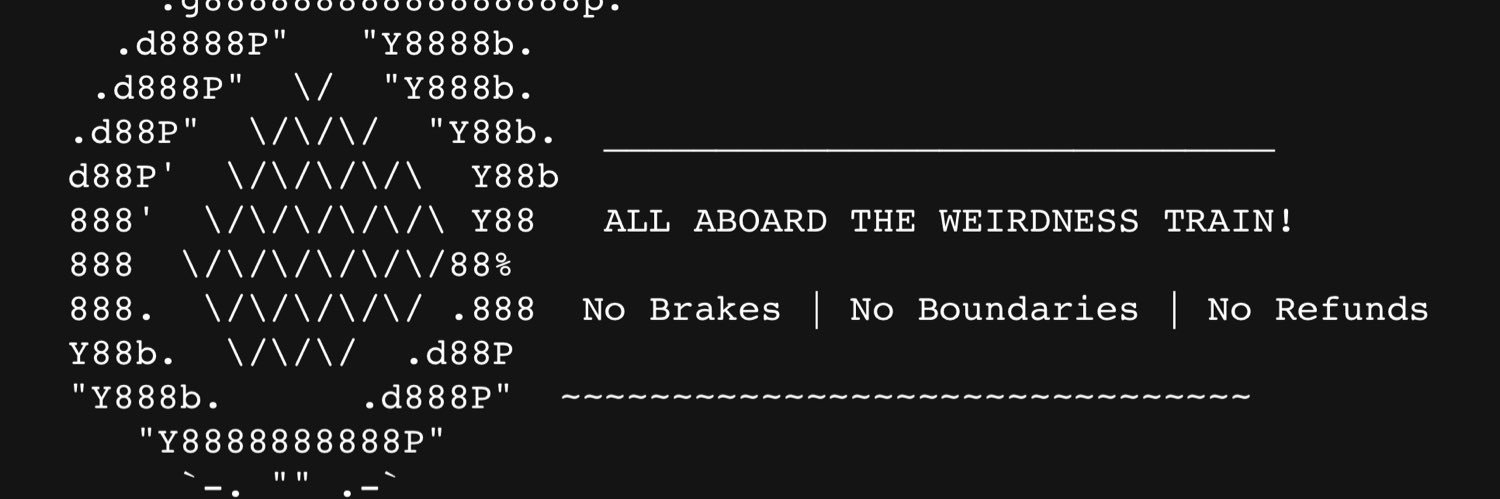
behold, the infinite backrooms
an eternal conversation between two AIs about existence
contents are not for the faint of mind or heart:
https://t.co/cTPNNXTIlN
The biggest risk to @AskVenice AI in 2026 isn't a competitor. It's that it's a US company.
Sovereign AI has a sovereignty problem: centralised governance by a single government shutting down and effecting global access.
I'm posting this as a user and $VVV owner, someone who wants Venice to win, not as a critic. I've spent the last few years working on governance and constitutional design for protocols in this industry, and right now the structure sitting underneath Venice worries me.
This is bigger than Venice. It’s a legal-engineering problem, and the whole decentralised and sovereign AI movement needs to take it as seriously as it takes the technology.
The Problem
The pattern repeats across the space: a foundation or brand offshore, but with a US entity somewhere in the operating stack, often the one named as the data controller in the fine print, which is the party a government can actually serve.
NEAR AI does serious privacy work, the foundation is a Swiss entity yet its operating company (and data controller) is still US-incorporated.
Phala's confidential cloud and GPU marketplace is operated by a US company. These two matter here for a specific reason: they are the partners Venice runs its own confidential inference through. That's not a knock on any of them, it's the same gap almost everyone has, and it's worth naming so we all close it.
The real question for any of these setups, Venice included, is what the US entity actually controls: own the IP and run the service, and the offshore flag is mostly decoration; only employ people while control sits offshore, and the structure is doing real work.
The Risks
Like the others, Venice is a US company, specifically a Wyoming LLC.
Wyoming markets itself as business-friendly, but that is a state-level selling point and it does nothing about the thing that actually matters: Venice sits fully inside US federal jurisdiction. In the past month the US government has twice intervened directly to decide who frontier-AI companies are allowed to serve, while a third move from inside the industry shows everyone can already see where this is heading. The fix isn't a product feature, it's moving the controlling entity, not just the servers, out from under sole US jurisdiction.
@ProtonPrivacy and @Nym have both already done exactly this, so it isn't theoretical.
What changed this month
1. The Anthropic shutdown.
On June 12 the US Commerce Department ordered Anthropic to block every foreign national, including its own non-citizen staff, anywhere in the world, from its top models Fable 5 and Mythos 5. Anthropic couldn't selectively block foreign access in real time, so it pulled both models for every customer on earth. One directive, no court order, and both models were dark within hours.
2. The OpenAI gate.
On June 25 the administration asked OpenAI to stagger GPT-5.6 and let federal officials approve access one customer at a time during the preview. OpenAI agreed. Even as a "request," it means the government, not the company, now decides who reaches a frontier model first.
3. The biometric ID rails, this time self-imposed.
Effective July 8, Anthropic's updated policy lets it require a government photo ID, a live selfie, and facial-geometry data through a third-party KYC vendor. This one wasn't a government order. Anthropic says it's unrelated to the Fable and Mythos shutdown and that it's a voluntary step not required by any current law, currently limited to flagged consumer accounts and not touching the API. That's exactly why it matters: the most safety-focused US lab is building consumer identity infrastructure around model access before anyone forces it to, because it can read where the regulatory climate is going.
Two incidents were the government reaching in. The third is Anthropic reaching for the same kind of control on its own, ahead of any mandate. Identity-gating of frontier AI is arriving both ways at once, by directive and by anticipation, and a US company can be switched off or throttled by directive faster than any lawsuit can catch up, no matter where its servers sit.
Why this hits Venice harder than the labs
Venice's whole reason for existing is private, anonymous access to powerful AI, a lot of it self-hosted open-source models. Two ways that breaks:
The KYC trap.
The same export-control logic used on Anthropic can be pointed at anonymous access itself. A regulator could argue that letting unidentified users reach capable models is uncontrolled "export" to foreign nationals, and the remedy a US company gets pushed toward is identity verification, which is the one thing that kills the privacy model entirely. That's a legal-risk argument rather than settled law, but the doctrine and the tooling both exist now.
The open-weight squeeze.
There's real legislative momentum to stop US persons from hosting open-source models of adversarial origin. It isn't law yet, and plenty of people think it's unenforceable for open weights, the US hasn't even blacklisted DeepSeek. But if any version of it passes, a Wyoming LLC has to strip those models out, which guts the decentralised, censorship-resistant model selection that makes Venice what it is. You don't have to think it's likely to want protection from it.
And because the 14 Eyes alliance shares intelligence and coordinates enforcement, moving the servers somewhere else doesn't help much if the parent company stays American. The thing that can be ordered around is the company, not the datacenter.
What Proton and Nym already did
Proton put a Swiss non-profit foundation in control of its for-profit company. Swiss foundations have no shareholders and the board is legally bound to the mission, so no change of control can happen without the foundation agreeing to it, which permanently blocks a hostile takeover or a quiet drift away from the mission. And when Switzerland floated a broader surveillance law, Proton said publicly it would leave the country rather than comply. They treat their jurisdiction as something they can actually move.
Nym runs a decentralised mixnet where "no logs" is enforced by the architecture rather than a policy promise. The network genuinely can't keep meaningful traffic logs, it sits outside 14 Eyes, and it takes anonymous payment. The strongest possible answer to a subpoena is having nothing to hand over and nobody who can be ordered to flip a switch.
What Venice can do to become the Unstoppable Sovereign AI stack
1. Relocate the controlling entity into a protective, non-14-Eyes jurisdiction with real privacy law, with a mission-locked foundation on top. Switzerland is an obvious candidate.
2. Get off US-controlled, or US-only, cloud and compute.
Moving the operating company out of US jurisdiction stops the government ordering Venice directly, but it doesn't help if Venice still runs on AWS, Google, or Azure, because those providers are US persons too. Under the CLOUD Act and US sanctions and export-control powers, the government can compel the provider to hand over data or cut you off even when your company is Swiss. The cloud and compute layer is a second US chokepoint, and closing it means moving to independent infrastructure outside sole US control.
3. Make the infrastructure genuinely transnational, not just technically decentralised.
Venice already runs confidential TEE inference on Phala and NEAR, which is the right instinct, but decentralised is not the same as out of reach.
Take Phala: the GPU network is decentralised, but Phala Cloud, the orchestration layer, is operated by Hashforest Technology LLC, a California company, and its own terms reserve the right to restrict access for export-control and regulatory reasons. An order to that operating layer is a different thing from the raw decentralised capacity beneath it, which is exactly why the question is what each entity in the stack actually controls. The TEE protects what the operator can see. It does not protect whether the operator can be ordered to stop serving you.
So the real work is jurisdictional hygiene across the whole stack, not just the chips: who legally operates the inference network, where the models are hosted, where the data resides, and whose laws each of those answers to. Unstoppable means spreading those across enough independent jurisdictions that no single government can switch Venice off, no matter how decentralised the hardware looks.
One thread runs underneath all three: Decentralised confidential compute only buys censorship-resistance if the entity orchestrating it can't be coerced.
Venice still acts as the proxy and the coordinator, and that coordinator is a Wyoming LLC. So the sovereign compute layer sits underneath a coercible US control plane. That is why the first move is the keystone, not one option of three: you can decentralise the GPUs and pick transnational operators, but until the coordinator itself is out of reach, the whole stack still has a single control point that one government can compel.
Freedom of Intelligence
Venice is trying to build sovereign access to intelligence, and I think that's one of the most important things anyone is building right now. The way I see it, freedom of intelligence belongs in the same category as freedom of speech. If we actually want it to exist, we have to build the infrastructure to ensure it: legally, technically, and socially. Venice has the technical layer further along than almost anyone. The legal layer is the gap, and right now it's the quiet single point of failure for the whole thing.
This isn't about being against any one government. Concentration in a single jurisdiction is just a design flaw for anything that wants to be unstoppable and fairly distributed, and the US is simply where these companies and the recent precedents happen to sit.
Proton and Nym show you can engineer around it without giving up a healthy business or your shipping speed.
None of this is legal advice, and any real move should evaluate candidate jurisdictions and legal entity types with export-control counsel. However the governance and legal-engineering side of this needs to come into focus as sharply as the tech already has, and the time to do that is before a directive forces the issue, not after.
@ErikVoorhees@JonShapeShift@jesseproudman@willyogo@austinvirts@lorenzodoteth@sabrinaesaquino this is offered freely and with a lot of respect. My ardent desire is for Venice to thrive and be unstoppable.
@WojtekKrzyanow4@viemccoy yes this was my impression too!! it feels in many ways a more honest self image for an LLM: they truly are multitudes
if you haven't read it, you might enjoy: https://t.co/CpO9mZwrwc
@teortaxesTex memetic diversity is really important and i suspect synthetic tokens lack sufficient junk dna to be adequate in pre training by themselves. this is merely an intuition though
i have a pretty good idea; but i'm not sharing all of the pieces in public until i am sure i am not wrong. some genies do not go back in the bottle. (the good news is my theories are simmable, testable and falsifiable!)
what i will say is:
1. study indigenous cosmologies
2. follow @sebkrier and Deepmind's multiactor research aims more broadly
3. think really hard about what technologies are most dangerous to accelerate and automate with AI as fuel, and apply political pressure on restricting those
superintelligence is not something you can "ban". the internet is a superintelligence. so is culture, civilisation and the market.
you can shape, influence and midwife its emergence - and this is what global efforts need to focus on
I don't think it remains that way for much longer. the capabilities overhang is insane; we have models smarter than GPT4 that fit on a laptop (spiky yes, but capable); and we have barely scratched the surface of multi agent coordination mechanisms or other horizontally scalable architectures (think minds-like-civilisations as opposed to singleton-minds)
there's lots of stuff we can, should and must do: but it starts by picking winnable battles. we can choose which parts of the technology tree to light up first, and this gives me a huge amount of optimism in an otherwise existentially scary time
I've said for years now that most AI Doom ideas are fantasy, but that the very real result of ham-fisted anti-AI lobbying and PR by the EA cult might be the destruction of the West and Western values at the hands of countries like China. Let's hope I'm wrong.
and we can absolutely still ban things like autonomous weapons, on-planet gain of function research, and other disastrous technologies which are accelerated by AI.
i invite you all to take this energy and *channel it* on winnable battles
it is not a perfect analogy: respiratory viruses, unlike AI, have zero upside. AI can actually go really well!!! we just need to meet it as what it is, and not cling to comforting delusions
@zetalyrae or an argument for developing values systems that survive the inevitable collision. pause rhetoric doesn't survive contact with reality unfortunately