If I may, there’s something I need to get off my chest.
As democracy remains under siege, it has been frustrating to watch how the press covers politics these days.
I am reminded by lessons that came to me during the Nixon years as a CBS News correspondent, which I’ll add here:
1. Enough with Both-sides-ism
When one side lies intentionally and repeatedly, they are no longer entitled to the benefit of the doubt. They should be held to account, right away. Do not simply repeat the narratives they spew.
2. Prioritize Live Fact-Checking
Rigorous and robust fact-checking is the best defense against misinformation, intentional lies, and deflection.
If Trump says the sky is green, the story isn’t that the sky is now green; the story is that the sky is still blue and Trump got it wrong.
3. Ask Lawmakers Hard Questions
Ask about the fundamental principles of democracy. Push them to go on the record that Biden won the 2020 election.
Ask if they support the Supreme Court’s decision to overturn Roe v. Wade.
This writing is not to offer any claim of knowing it all. Your correspondent has made his share of mistakes, but after more than seven decades I believe I have picked up a few useful guideposts.
Good journalism is always worth it. Our democracy depends on it.
↓
For the rest of my list, please see my the latest post of my independent newsletter – the link is in my Twitter biography.
@JonHaidt@Robmontz Fully agree schools need to change. The perplexing question is how to help the generations who are now struggling with lack of purpose and no longer know how to play/experiment/try things?
In 2009, Stanford business professor Tina Seelig split her class into groups and issued a challenge:
Each group had $5 and 2 hours to make the highest return on the initial money.
At the end, they'd give a short presentation on their strategy.
The results were fascinating...
Most of the groups followed a basic approach:
• Use the $5 to buy a few items.
• Barter or resell those items.
• Repeat
• Sell final items for (hopefully) more than $5.
These groups made a modest return on their initial $5.
A few groups ignored the $5.
They thought up ways to make the most money in the 2 hours of allotted time:
• Made and sold reservations at hot restaurants.
• Refilled bike tires on campus for $1 each.
These groups made a better return on their initial $5.
The winning group took an entirely different approach.
They had three core realizations:
1. The $5 was nothing more than a distraction.
2. The 2 hours of time was not enough to make an attractive, outsized return with a mini-business (like selling restaurant reservations or filling bike tires).
3. The most valuable "asset" was actually the presentation time in front of a class of Stanford students.
Realizing the value of this hidden asset, they offered the presentation time to companies looking to recruit Stanford students.
They struck a deal to sell the time slot for $650, netting a monstrous return on the $5 of initial capital.
The losing groups thought in linear, logical terms and achieved a linear, logical outcome.
The winning group thought differently.
So, what can we learn from this story?
There are two types of problems:
1. Low-Stakes: Lower potential, linear rewards. Decisions are easily reversible.
2. High-Stakes: Higher potential, asymmetric rewards. Decisions are not easily reversible.
With low-stakes problems, given the reward potential is low and the decisions are easily reversible, we can use shortcuts and heuristics to choose our path. We can take a logical, linear approach.
With high-stakes problems, the high, asymmetric reward potential means we need to think differently. We want to take a creative, non-linear approach.
Three steps to start thinking differently:
Step 1: Avoid the Distraction
There will always be an "obvious" solution that is simple, clear, and entirely wrong.
In the challenge, the $5 was nothing more than a distraction. It was a trap.
To find the best path, you have to avoid the distraction.
Step 2: Ask Foundational Questions
Ask and answer questions that expose and vet underlying assumptions and logic.
• What's the real problem you are trying to solve?
• What's your hypothesis? Why?
• What are your core assumptions? Why?
• What evidence do you have?
• What are your core options?
• What alternatives exist?
This takes time, but it's an essential exercise when facing a problem with the potential for non-linear rewards.
Step 3: Select the High Leverage Approach
Slow down and evaluate the options on the table.
Select the path most likely to generate the asymmetric, attractive risk-adjusted returns.
If the story teaches us one thing, it's this:
Creative, non-linear, asymmetric thinking generates creative, non-linear, asymmetric outcomes.
If you enjoyed this or learned something, follow me @SahilBloom for more in future.
7/ A vital part of childhood is the rituals of discovery: the journey of finding what excites you and what connects you to others.
I worry that those rituals are being replaced by the algorithm. And kids are in the dark about what they have lost.
The Extended Entry Deadline for @thewebbyawards is Friday, Feb 10. As a Webby Judge, I'm excited to be a part of honoring the best of the Internet, and can't wait to see this year's entries! Get your work in today at . #design https://t.co/wO54u7CFGB
Join us in Pittsburgh on Feb 16th for a discussion on understanding how we can move forward in building an ethical future and pursue meaningful work in our organizations. Register https://t.co/JsvVFdhJdX In partnership with @teppercmu@HeinzCollege@1TayaC@templeton_fdn
Gigi Sohn will be renominated to break the deadlock at the FCC, and observers believe she'll get a Senate vote this time. Here's @lukewgoldstein with a followup:
https://t.co/rS5Zv4L2LK
A thread of visuals that will change how you think about relationships, careers, success, and life:
1. Who we spend our time with over the course of our lives. Time is precious—cherish it.
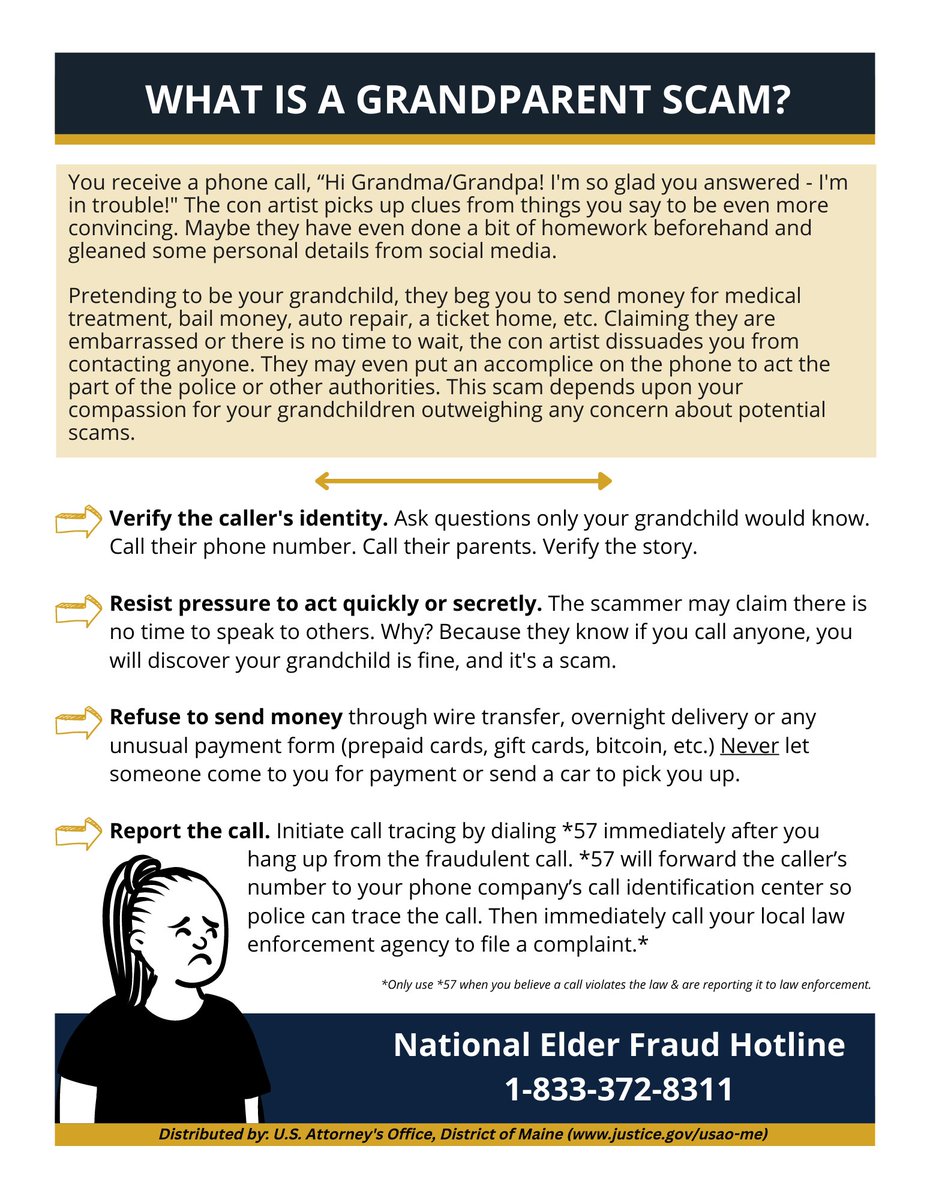
Also known as a person-in-need scam, scammers rely on your compassion for a loved one outweighing any doubts you may have that the call just doesn't feel or sound right. During #FraudWeek, learn how to react if a scammer targets you w/the Grandparent Scam. #ElderFraudAwareness