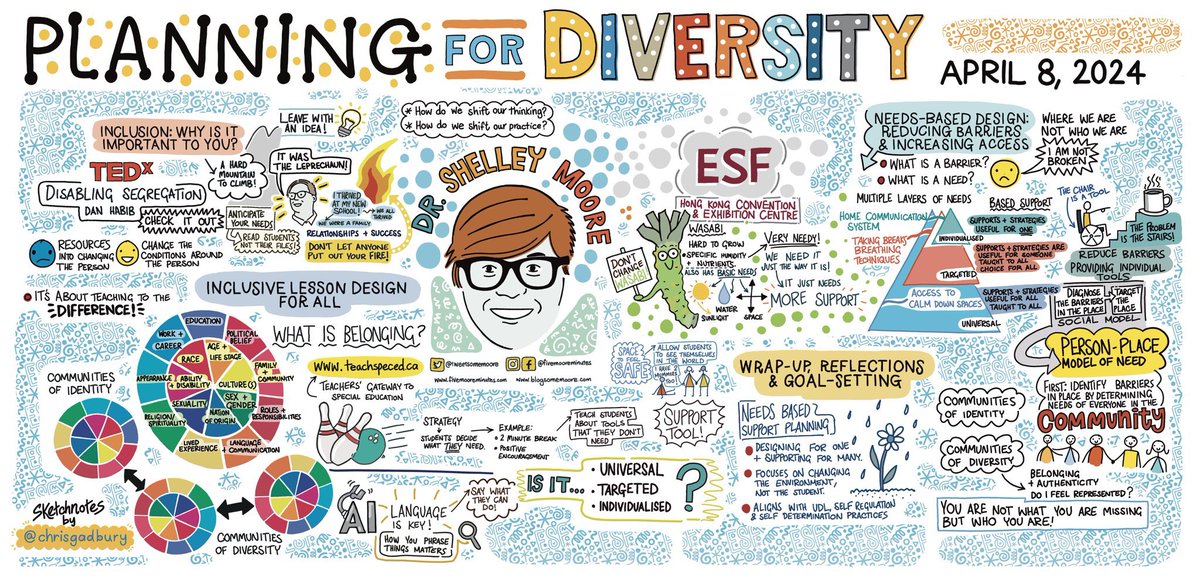
If you are at this point in your BTC journey, you will want to attend this session. I say it at #NCTM. It is awesome!!!! And it has gotten better since #NCTM.
Nature rejected her paper for not being original,
University of Pennsylvania (her employer) demoted her,
and yesterday Katalin Karikó won the Noble Prize in physiology.
In mid-2000s, Karikó and her Drew Weismann submitted their paper on mRNA (messenger Ribonucleic Acid) to Nature.
Nature desk rejected their paper for being "an incremental contribution" only. The paper was later published in another journal, Immunity.
Earlier in her career at the University of Pennsylvania, Karikó was demoted because her applications for grants kept getting rejected.
But Karikó persevered and kept on going.
In 2013, she joined BioNTech, a German company founded by two scientists, Uğur Şahin and Özlem Türeci. In 2018, BioNTech partnered with Pfizer to develop mRNA vaccines against the influenza virus.
When the COVID-19 hit the world, Karikó's research helped Pfizer to produce the first vaccine against the disease.
I don't know how the Nature editors who desk rejected Karikó's paper and the Penn administration who demoted her feel about Karikó Nobel Prize.
Takeaway: Many academics and scientists worry about getting published in "prestigious" journals. Instead of worrying about prestige, we should try to put our work out as quickly as possible like Karikó did.
Once you put your work out without caring about prestige, two good things happen:
1. Your work will lead to newer opportunities.
2. You will start getting feedback from the scholarly community, which you can use to iterate and improve.
Here's another interesting Nobel Prize story.
Peter Higgs, a British physicist, joined the University of Edinburgh in 1956. By 1964, Higgs has published his groundbreaking work about subatomic particles.
After 1964, Higgs published less than 10 papers.
When his department would ask him how many papers, he published in a given year, he would reply "None."
It happened so often that he stared feeling like an "embarrassment to the department."
The University of Edinburgh, however, never fired Higgs because in 1980 he had been nominated for the Nobel Prize.
Higgs retired in 1996 and stayed on as an emeritus professor at Edinburg.
In 2012, experiments conducted at the CERN laboratory confirmed Higgs work and the existence of Higgs Particle.
And in 2013, Higgs was awarded the Noble Prize in physics and the University of Edinburgh got rewarded for being patient.
@Paddy_Barrett Excellent thread! Thank you for summarizing the details so succinctly for us.
What’s your take on where LPa fits into the questions we need to ask?
“Well something's lost, but something's gained
In living every day”
… what is your favourite Joni Mitchell lyric or song?
#JoniMitchell#lyrics#SaturdayMotivation
Trustee Meissner has left an indelible mark on the WRDSB, former students and colleagues. He was an incredible advocate and a valued member of the WRDSB. Those wishing to share memories are invited to his Celebration of Life on June 4. Details are here: https://t.co/JQ1oyAK6VQ
In honor of the Angelman Syndrome Foundation Walk this weekend, I'd like to tell you about a recent paper I'm part of. The data come from the clinical trial that @OvidRx conducted for adults and teens with AS. There is a lesson here about society and perceptions so buckle up! /1