Merck’s Chief Medical Officer Eliav Barr said they have a very robust discovery engine & they’re always open to deals where the science is really good. They’ll be looking for immunology opportunities he said #JPM24
A lot of essay writing is not so much telling people new things as helping them to reach conclusions they were already 90% of the way to themselves.
It's easy for an uncharitable reader to dismiss such essays as obvious. That's 90% true. And yet false; that last 10% is hard.
Butterfly Network Announces FDA Clearance of its Next-Generation Handheld Ultrasound System, Butterfly iQ3 https://t.co/KP9dVHPuzY #jpm24#ultrasound@ButterflyNetInc
Can someone please make an AI generated clone of cap table management software? Make it simple, secure and $1000/yr.
There are apparently 40k customers waiting to adopt it rn…
GPT-4 for radiology. Far from perfect, but state-of-the-art performance on some tasks: “Surprisingly, we found radiology report summaries generated by GPT-4 to be comparable and, in some cases, even preferred over those written by experienced radiologists”
https://t.co/bi6RwqgeHw
@DavidPerlmutter@ouraring@ApolloNeuro Would be interested to hear how you are using these to improve sleep etc. What adjustments might they have prompted?
Things I believe are undoubtedly true about our future.
• By 2033, we're expected to have high bandwidth brain-computer interfaces, allowing direct connection of our neocortex to the cloud.
• Greenland sharks can live up to 500 years. With advancements in medical technology, why can't humans aim for similar lifespans?
• Autonomous vehicles are not just a trend; they're the future. Criticisms today echo past skepticism about cars when horse carriages dominated.
• If you're 50 today and maintain good health until 70, you're likely to benefit from breakthroughs that add a minimum of 30 more years to your life.
• For every year you're alive, science is currently extending your lifespan by about a quarter to a third of a year.
Small cancer breakthrough alert:
Three years ago we cofounded a company to improve the detection of cancers using a nanotechnology that our cofounder had pioneered in her doctoral and post doc work.
Our nanotechnology expands the boundaries of molecular diagnostic tests from single-type multiplex biomarkers to multi-omics multiplex biomarkers.
Multi-omics and multiplex: Simultaneous detection of DNAs, RNAs, proteins, and genes in a single, low-cost test for a comprehensive outlook on a disease.
No extraction or amplification. Blood and urine are used as-is, saving time while minimizing human error and variability.
Unprecedented sensitivity: 10-18 attomolar. Enables the capture of even tumor suppressor markers that are crucial for early detection.
Quantifiable test. Unbiased and objective. No Need for a bioinformatician to analyze and interpret the results.
Affordable & easy to adopt to any lab. Require simple instrumentation without needing highly skilled technicians.
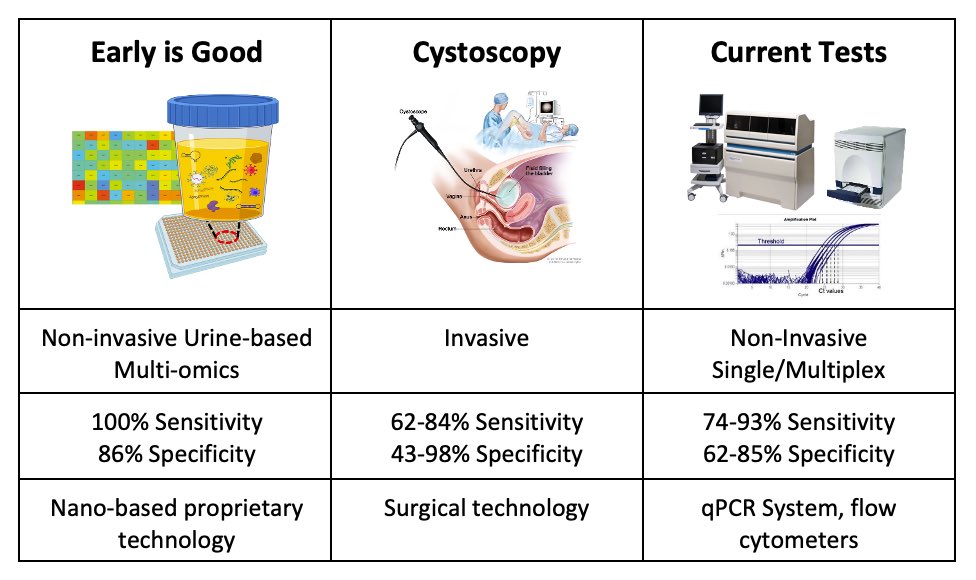
We directed this technology initially at bladder cancer. There are more than 80k new cases in the US each year and almost 600k worldwide. The current standard of care requires a cystoscopy (invasive test) for diagnosis. And then the patient requires a cystoscopy every 3-6 months after they are treated or are in remission.
Our company’s test is urine based, has a high PPV and NPV and can be used to diagnose bladder cancer early as well as prevent unwanted cystoscopies (see image below).
While we start the work to scale this test broadly, we will now start our next R&D effort: to see if we can create the first predictive test for prostate cancer AND make this urine based - no more blood based PSA tests or DREs.
This will take many years but if such a test can be created, it can potentially add a lot of value to men’s health and longevity.
If you find this kind of work interesting and would like to contribute, please consider working with us.
You can find out more here: https://t.co/xb2oVazonm
Hypothesis: The importance of a new technology is proportional to the amount of science fiction it makes obsolete.
If so, and if technology is growing exponentially, then science fiction will have an exponentially shorter readable life.
Buffett, Active Investing and Index Funds...
In 2008, Warren Buffett issued a challenge to the hedge fund industry, and a million-dollar bet was made.
Buffett's position was that, including fees, costs and expenses, an S&P 500 index fund would outperform a hand-picked portfolio of hedge funds over 10 years. The bet pit two investing philosophies against each other: passive and active investing.
Buffett picked the S&P500 Index. The hedge funders picked their actively managed funds. At the end of ten years, they looked back and Buffett won.
A recent article in Bloomberg reinforces this point. Only one equity mutual fund, the $7.1B Baron Partners Fund, has outperformed the Invesco QQQ ETF (Nasdaq ETF) over the past 5, 10 and 15 years.
Said differently, passively investing in the Nasdaq ETF exposed you to the gains of the best companies of this era without you having to do any work or diligence. All the best companies were part of the ETF. When one of those company lagged, their composition in the index fell or dropped all together. And when a company did well, their composition in the index would increase or they were added if they weren't part of it beforehand.
Passive investing allowed the ETF manager to define simple rules and then do all the work for you. The companies it picked, because of its rigid rules, turned out to be far superior to those picked by active investors. So much so that only ONE fund (out of thousands) managed to beat the ETF.
The lesson is that for most people, they will find that this is the superior method for investing in the stock market. Allocate some money (say each month) to a very low cost ETF and then let the ETF manager, natural selection and compounding do the rest.
China’s economy seems to be in big trouble.
- sluggish consumer demand because of Covid lockdowns
- broken property market with massive over supply
- fewer exports in part because of active reshoring efforts
- large youth unemployment - 21%
- massive local gvt debt
- shrinking population
This is a parade of terribles that stimulus alone won’t fix.
As part of this, it gives a clearer way of explaining their foreign policy.
- China’s economic movements abroad are more reflexive of their desire to be viewed inevitably as the worlds largest economy and use their influence therein vs the reality as such. So they do a few deals in Yuan, sign economic treaties to move countries off of SWIFT being the two big recent examples but it’s all economic theater because meanwhile they are buying USD like nobody else!
- Be the peacekeeper or intermediary of various conflicts or the go-between to various states. Again, this is about creating an aura of importance abroad that will be diminished as economic difficulties compound internally and the CCP focuses within.
For the rest of us, I think the fears of China domination are more anxiety based vs fact based.
I would bet that the USD remains the anchor currency in the world and that people may soon get exhausted by de-dollarization fear porn.
Have a great weekend!!!
I’m very excited our @Nature paper is out! It is the first published evidence that loss of the Y #chromosome in #bladdercancer alters T cell function resulting in more aggressive growth and effecting patient outcomes. #precisionmedicine@CedarsSinaiMed
https://t.co/90UAD30bzc
What if lawyers weren’t allowed to own law firms or chefs weren’t allowed to own restaurants?
Sounds absurd, but it’s a reality for one profession: doctors.
Excellent article by
@SenatorLankford@DrBrian4Health
https://t.co/0ugoMqLStd