@satyanadella “There is no societal permission for an AI future that hollows out entire industries.” Nuff said. The problem is that this such a breakthrough innovation that our people in charge of our institutions are barely fathom what the future could be. Did it happen the same before?
… y una cultura que proporcione valores (objetivos) y referencias (significados y significantes) comunes… una organización humana, vaya. Tres, dos, uno….
Espera a que los technobros se den cuenta de que para que un sistema agéntico pueda asumir completamente un proceso es necesario especificar unas reglas de juego de poder explícitas e implícitas (responsabilidades definidas y emergentes, alineadas o en conflicto)…
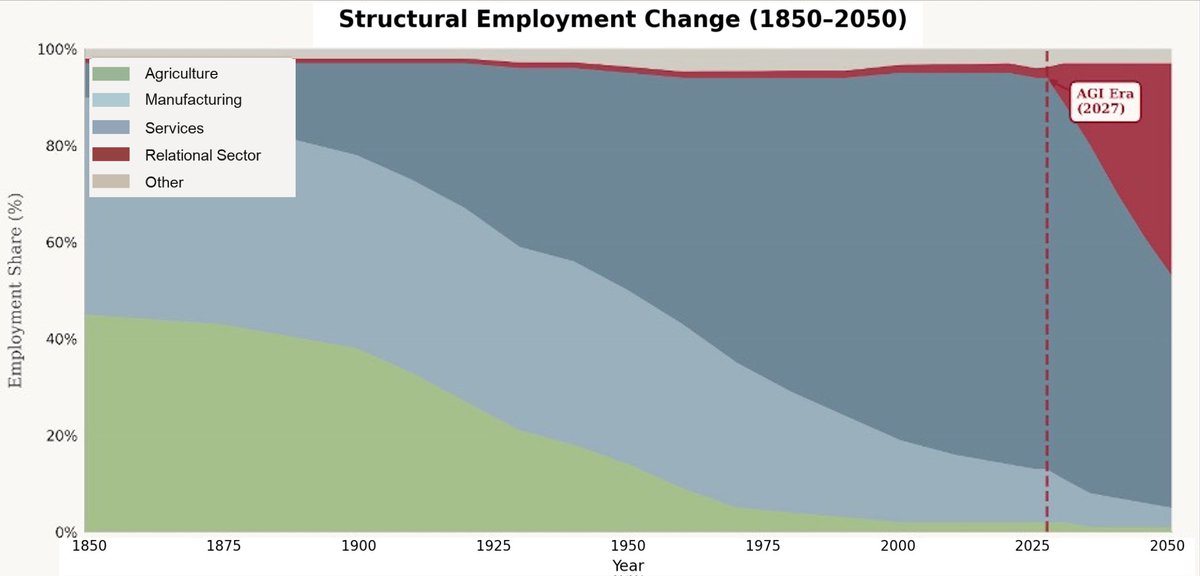
New essay on the economics of structural change and the post-commodity future of work.
1. Almost any question about the impact of advanced AI on the economy needs to start at the same place: what is still scarce? Answer that, and the analysis becomes pretty straightforward. This essay explores what becomes scarce if AI really can replicate most of what humans do in production, and what this mean for the future of jobs.
2. My conjecture, working through the economics: labor reallocates across sectors, and the sector it reallocates to has properties that keep labor a meaningful share of the economy. Ultimately this is about the structure of demand itself. For this, we have to go back to Girard, Augustine and Rousseau: once people's base needs are met, their preferences shift to comparative motives (e.g., status, exclusivity, social desirability). This motive is inherently non-satiated.
4. The key paper is Comin, Lashkari, and Mestieri (Econometrica 2021). As people get richer, they don't buy proportionally more of everything. They shift spending toward sectors with higher income elasticity. They estimate income effects account for 75%+ of observed structural change.
5. The ironic consequence: the sector that gets automated becomes a smaller share of the economy, not a larger one. Agriculture got massively more productive and its share of employment collapsed. Manufacturing too. The "stagnant" sectors absorb the spending and the jobs.
6. So the question is: which sectors have high income elasticity in a post-AGI world? I argue it's what I call the relational sector. Categories where the human isn't just an input into production, it is part of the value.
7. Why does the relational sector have high income elasticity? Because human desire has a mimetic, relational dimension. We don't just want things for their intrinsic properties. We want what others want, and we want it more when others can't have it. Girard, Rousseau, Augustine, and Hobbes all saw this.
8. In work with Kristóf Madarász, we showed this experimentally: WTP roughly doubles when a random subset of others is excluded from the good. And in new work with Graelin Mandel, AI involvement kills the premium. Human-made art gains 44% from exclusivity; AI-made art only 21%.
9. This all comes together for the core argument. The sector that absorbs spending as AI makes commodity production cheap is one where human provenance is part of the value, and demand for it grows faster than income. Exactly the profile that keeps labor meaningful.
10. To be clear about the claim: I'm NOT saying aggregate labor share must rise. It may fall. The claim is about sectoral composition, i.e., where expenditure and employment go once commodities get cheap, and the fact that the sector that will absorb reallocated labor maps to a substantial component of human preferences and desire.
11. If you're interested in the formal model, a linked companion technical note works out all the economics.
Read the essay here: https://t.co/NcjVgn2o8g
Claude Code is not AGI, but it is the single biggest advance in AI since the LLM.
But the thing is, Claude Code is NOT a pure LLM. And it’s not pure deep learning. Not even close.
And that changes everything.
The source code leak proves it. Tucked away at its center is a 3,167 line kernel called print.ts.
print.ts is a pattern matching. And pattern matching is supposed to be the *strength* of LLMs.
But Anthropic figured out that if you really need to get your patterns right, you can’t trust a pure LLM. They are too probabilistic. And too erratic.
Instead, the way Anthropic built that kernel is straight out of classical symbolic AI. For example, it is in large part a big IF-THEN conditional, with 486 branch points and 12 levels of nesting — all inside a deterministic, symbolic loop that the real godfathers of AI, people like John McCarthy and Marvin Minsky and Herb Simon, would have instantly recognized.*
Putting things differently, Anthropic, when push came to shove, went exactly where I long said the field needed to go (and where @geoffreyhinton said we didn’t need to go): to Neurosymbolic AI.
That’s right, the biggest advance since the LLM was neurosymbolic. AlphaFold, AlphaEvolve, AlphaProof, and AlphaGeometry are all neurosymbolic, too; so is Code Interpreter; when you are calling code, you are asking symbolic AI do an important part of the work.
Claude Code isn’t better because of scaling.
It’s better because Anthropic accepted the importance of using classical AI techniques alongside neural networks — precisely marriage I have long advocated.
It’s *massive* vindication for me (go see my 2019 debate with Bengio for context, or to my 2001 book, The Algebraic Mind), but it still ain’t perfect, or even close.
What we really need to do to get trustworthy AI rather than the current unpredictable “jagged” mess, is to go in the knowledge-, reasoning-, and world-model driven direction I laid out in 2020, in an article called the Next Decade in AI, in which neurosymbolic AI is just the *starting point* in a longer journey.*
Read that article if you want to know what else we need to do next.
The first part has already come to pass. In time, other three will, too.
Meanwhile, the implications for the allocation of capital are pretty massive: smartly adding in bits of symbolic AI can do a lot more than scaling alone, and even Anthropic as now discovered (though they won’t say) scaling is no longer the essence of innovation.
The paradigm has changed.
—
*Claude Code is plainly neurosymbolic but the code part is a mess; as Ernie Davis and I argued in Rebooting AI in 2019, we also need major advances in software engineering. But that’s a story for another day.
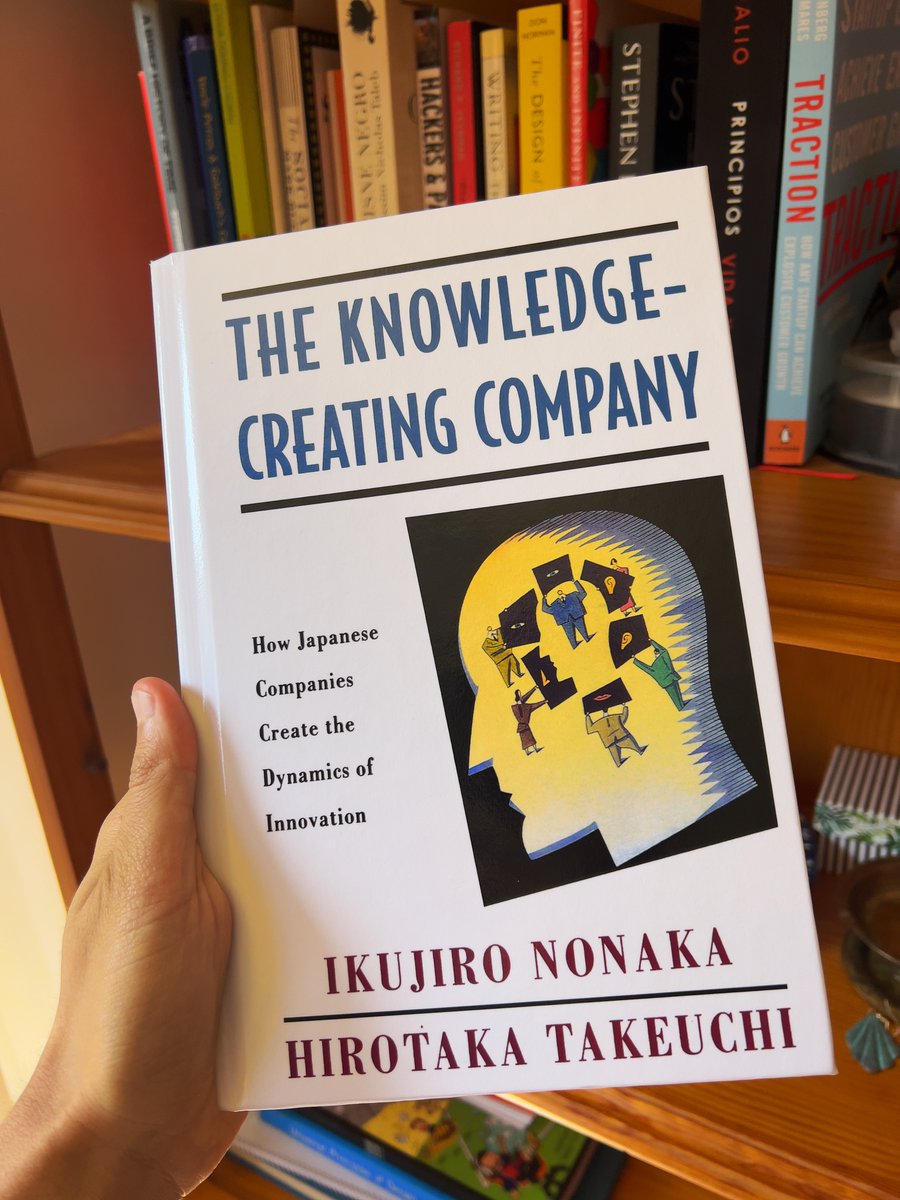
The best argument against remote work I've come across. A company is a machine for creating knowledge.
If the knowledge created from the daily experiences of its employees (talking to customers, researching what competitors do, programming an internal library, etc.) remains tacit (resides only in the minds of employees who often will forget and will leave the company) and is not transmitted, combined, and internalized, the company ends up dying unless it has artificial entry barriers (oligopolies, public companies...)
How does Spotify build products?
A little secret is the DIBB framework to arrive at strategic bets.
Audiobooks, Podcasts and many other products started with this little way of thinking.
Let us learn about DIBB framework in < 2 mins:
RIP CPU-based AI supercomputers?
NVIDIA just announced DGX GH200, an AI supercomputer that combines whooping 256 Grace CPUs & Hopper GPUs in the same package with 144 Terabytes of shared memory!
Here's the breakdown
What if we set GPT-4 free in Minecraft? ⛏️
I’m excited to announce Voyager, the first lifelong learning agent that plays Minecraft purely in-context. Voyager continuously improves itself by writing, refining, committing, and retrieving *code* from a skill library.
GPT-4 unlocks a new paradigm: “training” is code execution rather than gradient descent. “Trained model” is a codebase of skills that Voyager iteratively composes, rather than matrices of floats. We are pushing no-gradient architecture to its limit.
Voyager rapidly becomes a seasoned explorer. In Minecraft, it obtains 3.3× more unique items, travels 2.3× longer distances, and unlocks key tech tree milestones up to 15.3× faster than prior methods.
We open-source everything. Let generalist agents emerge in Minecraft! Welcome you all to try today: https://t.co/1d3YocozsI
Paper: https://t.co/JcWEasgtyI
Code: https://t.co/KsvVf7rcl0
Deep dive with me: 🧵
Muy contento de poder anunciar nuestro acuerdo con Microsoft para desarrollar conjuntamente servicios de #IA generativa sobre Azure OpenAI para nuestros clientes, y hacerlo además compartiendo la solución que hemos implementado de la mano de Almirall
https://t.co/R6XHS8xp66
1/The call for a 6 month moratorium on making AI progress beyond GPT-4 is a terrible idea.
I'm seeing many new applications in education, healthcare, food, ... that'll help many people. Improving GPT-4 will help. Lets balance the huge value AI is creating vs. realistic risks.
1/ La mayoría de las empresas confunden eficiencia operativa con estrategia empresarial. Este🧵será otro intento por vincular las finanzas corporativas con la estrategia a través del benchmarking, el efecto reina roja en los negocios, CAPEX y Production Possibility Frontier ↓: