Amazing writer, doting cat mom, busy social butterfly, and chronic hard worker. Writes as Zelici DragonSquire. Viewer discretion advised due to adult themes.
I love how supportive my fiance is. Even when we could really use the money he encourages me not to participate in plagiarism software. UpWork is currently full of requests for ghost writers and AI content creators. #StopChatGPT#amwriting
Built for running and jumping, the Impala is able to make jumps that are more than 10 m long and 3 m high. It can reach peaks of speed of 90 km/h.
No surprise that they seem to literally fly when chased by a cheetah
[📹 Samantha Pittendrigh]
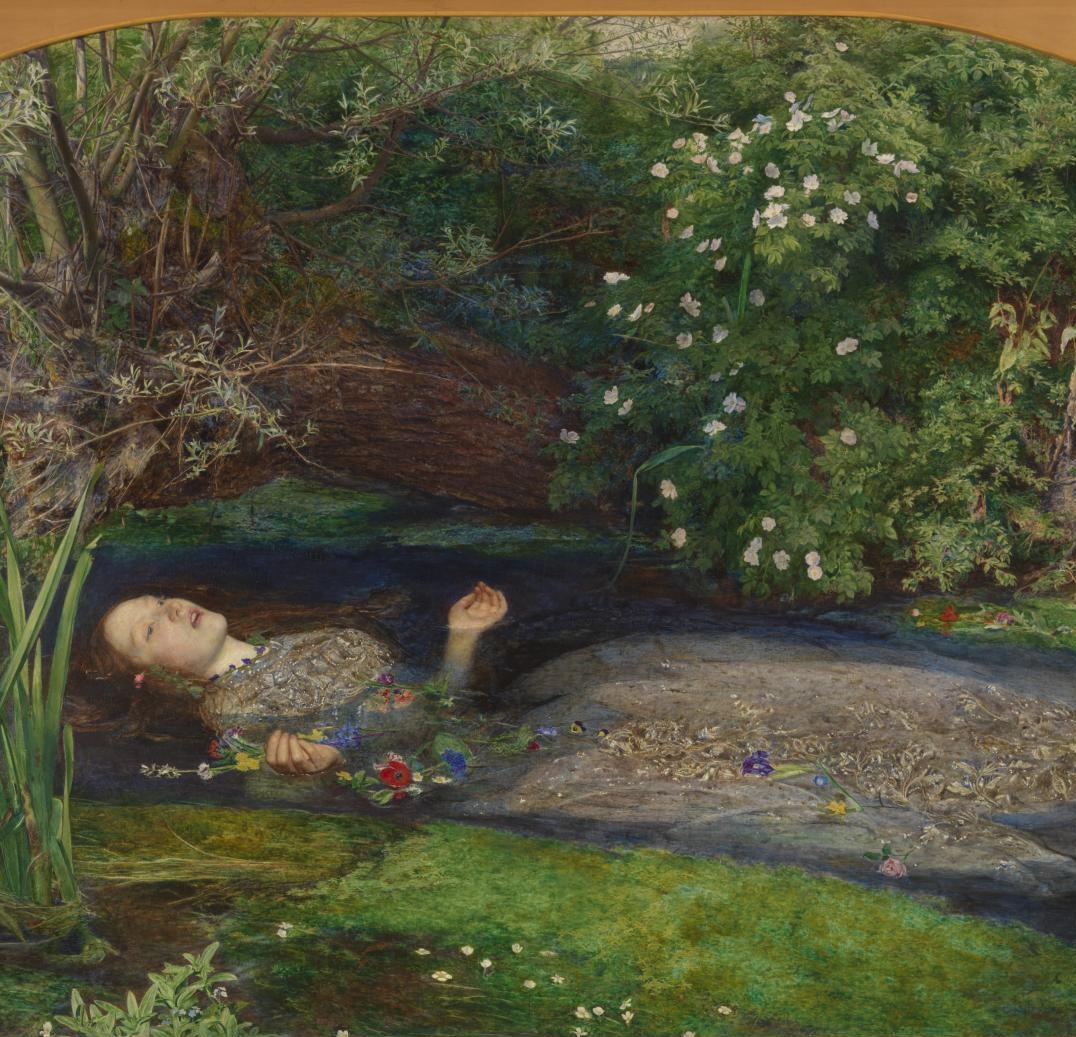
You've probably seen this painting before — it's Ophelia by John Everett Millais, from 1852.
But what you probably don't know is that people once thought this kind of art was dangerous.
In fact, Ophelia is one of the most radical and controversial paintings of all time...
Speaking of libraries, isn't this stunning?! This is the public library in Kansas City, Missouri. I have a picture standing in front of it (somewhere.) It's inspiring and so unique. #writerslife#WritingCommunity#ReadersCommunity#library
Archaeologists in Syria just found an astonishing Roman mosaic that has remained intact after 1600 years. Uncovered in ancient city of Rastan, mosaic measures a whopping 65ft long and 20ft wide.
Amid many dramatic scenes from Trojan War, mosaic includes depictions of sea god Neptune and his 40 mistresses as well as Hercules slaying the Amazon queen Hippolyta as part of his fabled Twelve Labors.
#archaeohistories
Let me introduce you to Virgil Lamar Ware. He was an eighth-grader, an A student who loved to play football.
Virgil had a bright future. He dreamed of becoming a lawyer.
All those hopes and dreams ended on September 15, 1963. The day he was gunned down in the aftermath of the Birmingham church bombing.
Virgil and his brother were returning home, totally unaware that the bombing had occurred.
They encountered Larry Joe Sims and Michael Lee Farley, two sixteen-year-olds coming from a segregationist rally.
When the white teens saw the Ware brothers, Farley told Sims to shoot, to “scare them.” Sims shot Virgil twice, once in the cheek and once in the chest.
The 13-year-old died on the Docena-Sandusky Road on the outskirts of Birmingham.
Young Virgil was buried on the side of the road up until 2004 when he was moved to a plot with a marker thanks to donations.
DeSantis and the likes want to hide this history. History is history.
DeSantis cites “white discomfort” I experience discomfort knowing that DeSantis and the likes don’t want Black history taught.
Black children were casualties of racism. It’s a fact. Children deserve to know and learn from it. #FreshResists #BlackHistoryWithLana
I know I’m posting into the void & no one will say anything, but this is the only place I have.
Max, my constant companion for the last 18 years, passed away this morning.
I am beyond heartbroken.
This is my Max from two days ago.
My heart is being ripped out of my chest .
23 July 1930 | A French Jewish girl, Mireille Rebecca Marcovici, was born in Nice.
In May 1944 she was deported to #Auschwitz. She was murdered in a gas chamber after the selection.
Sir Arthur Conan Doyle, best known as the brilliant creator of the world-famous detective Sherlock Holmes, possessed a keen intellect and an unyielding sense of justice that extended beyond the pages of his novels. In a remarkable turn of events in the early 1900s, Doyle found himself taking on the role of a real-life detective to right the wrongs of the justice system and secure the freedom of two innocent men.
It all began when Doyle, an avid reader of crime reports and court cases, stumbled upon two separate cases that piqued his curiosity. Both cases involved men who had been convicted and sentenced for crimes they vehemently claimed they did not commit. Struck by the inconsistencies in the evidence and testimonies, Doyle became convinced of the men's innocence and felt compelled to take action.
The first case involved George Edalji, a solicitor of Indian descent who had been convicted of mutilating animals in the Staffordshire region. Despite a lack of substantial evidence connecting Edalji to the crimes, he was found guilty and sentenced to seven years of hard labor. Doyle carefully examined the details of the case and came to believe that Edalji was indeed innocent.
The second case involved Oscar Slater, a German immigrant who had been accused of murdering an elderly woman in Glasgow. Slater's conviction was based on circumstantial evidence, and he was given the death penalty. Doyle's interest in this case intensified when he discovered numerous flaws in the investigation and the trial process.
Fuelled by his unwavering belief in justice and inspired by the detective skills of his fictional creation Sherlock Holmes, Doyle embarked on a personal mission to exonerate both men. He invested countless hours investigating the cases, gathering evidence, and interviewing witnesses and experts.
With his literary fame, Doyle had the advantage of garnering media attention, which he used to bring public awareness to the injustices faced by Edalji and Slater. His articles and public speeches raised eyebrows and generated discussions about the inadequacies of the legal system.
In 1907, after years of determined efforts, Sir Arthur Conan Doyle succeeded in proving the innocence of both George Edalji and Oscar Slater. Edalji's sentence was commuted, and he was finally released from prison. Similarly, Slater's death sentence was overturned, and he was granted clemency. Though not without their struggles, both men were ultimately vindicated.
The public outcry and media spotlight on these cases prompted significant reforms in the British legal system. As a result of Doyle's unwavering commitment to justice and the exposure of the flaws in the process, the UK established an official Court of Criminal Appeal in 1907. This institution allowed for further scrutiny and the potential for rectifying miscarriages of justice.
Sir Arthur Conan Doyle's extraordinary efforts in real-life detective work not only secured justice for two innocent men but also catalyzed the reformation of the legal system. His determination to see justice served, akin to the character of Sherlock Holmes, continues to inspire generations of readers, writers, and activists to seek truth and fairness in an often complex and imperfect world. Beyond the pages of fiction, Doyle's legacy as a crime solver in real life remains an indelible testament to the power of one individual's relentless pursuit of justice.
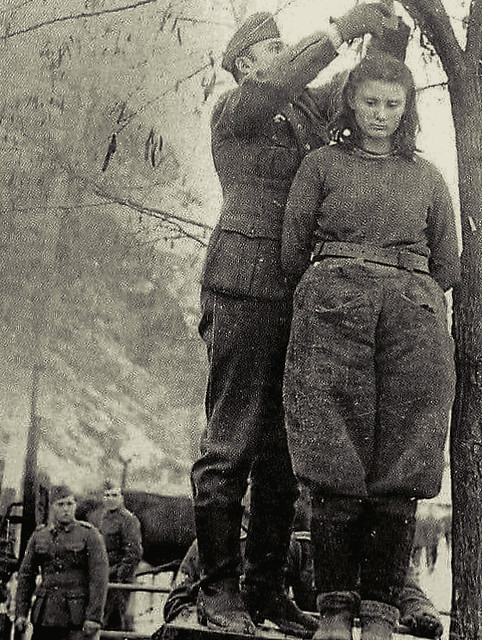
This is a similar story of unbelievable courage:
Seventeen year old Serb partisan Lepa Radic being executed by a German soldier after she refused to give up the names of her compatriots in exchange for her freedom. She was hung on the 11th of February, 1943 in Bosanska Krupa.
With the noose around her neck, she cried out: "Long live the Communist Party, and partisans! Fight, people, for your freedom! Do not surrender to the evildoers!
This is a picture of Albina Mali-Hodevar, a resistance fighter who fought for the liberation of Yugoslavia during World War II.
Albina Mali-Hocevar wanted to fight during World War II. When the young Slovenian teenager heard that her fellow partisans had assigned her to be a nurse during the conflict, tears of frustration filled her eyes. But by the war's end, Mali-Hocevar would see plenty of action. Famous today for the scars across her face, which fragmented her gaze, Mali-Hodevar spent the conflict fighting for the liberation of Yugoslavia.
After Germany invaded Yugoslavia in 1941, Mali-Hocevar joined up with the People's Liberation Movement of Yugoslavia at the age of 16, and as the war unfolded, she grew ever closer to the action. Though initially designated as a nurse, Mali-Hocevar soon went on to fight in multiple battles. She was badly wounded twice at 17 and once at 18. Mali-Hocevar ended up losing an eye, and scars crisscrossed her face.
Through it all, however, Mali-Hodevar took her duties as a nurse seriously. "The nurse Albina always paid more attention to the wounded than to herself," said one account of Mali-Hocevar's brave service. "She knew neither fear nor exhaustion while there were wounded [partisans] to be taken care of."
She was later recognized for her bravery when Yugoslavia awarded her the Yugoslavian Order of the Partisan Star, 3rd class.
Albina passed away on January 24, 2001.