Professor Hendrik Bessembinder of Arizona State has spent years studying long-term stock returns, and his latest work has a hard lesson for anyone holding a large position in a single stock. Out of nearly 30,000 US stocks over the last 100 years, just 46 companies created half of all the wealth the market made that exceeded a 1-month Treasury bill.
We turned the research into a short video, the first in a series we're calling The Evidence.
The aggregate market has been an extraordinary wealth machine, with around $91 trillion created over the century. The median stock lost money over its lifetime, and nearly 60% of companies ended up worth less to shareholders than a 1-month Treasury bill.
Across those 100 years, the wealth came from a very small group of companies. The top 3.7% of companies accounted for all of the net gains. The other 96.3%, taken together, simply matched what you'd have earned in 1-month T-bills. Only 27.6% of stocks beat the broad market at all.
That small group has gotten even smaller, and the names keep changing. The number of companies behind half the market's wealth fell from 89 to 46 over the past decade. Nineteen of the last decade's thirty biggest winners weren't on the list before, with Nvidia, Tesla, and Eli Lilly among them.
The takeaway for many isn’t that you should try to pick the winners. It's that identifying the full set of winners in advance is nearly impossible, and the market's returns come from owning the whole haystack rather than trying to find the right needles. Worth sitting with if a single stock has become a large part of your own net worth.
Read our blog post and disclosures here: https://t.co/USvMswf68D
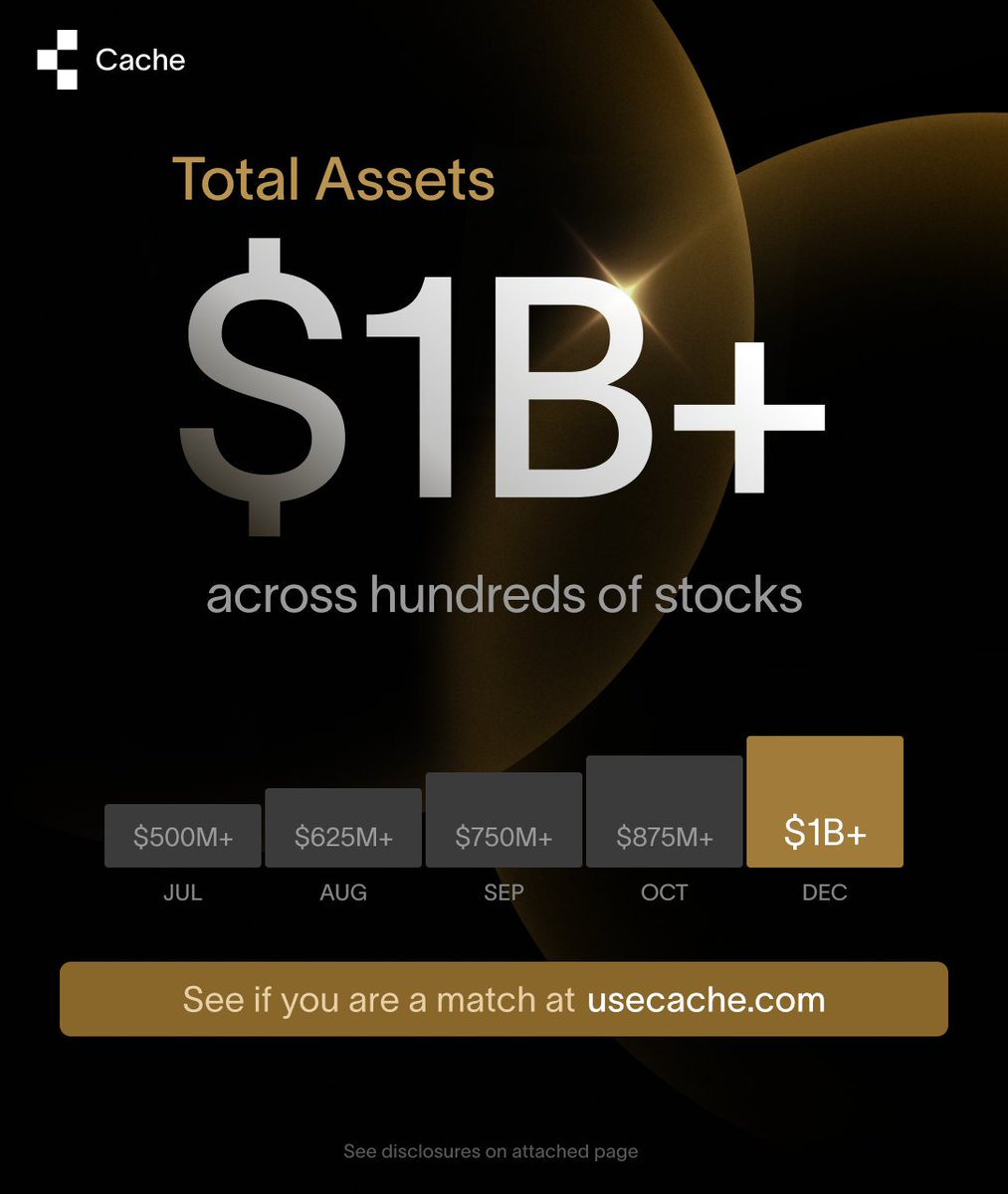
Cache crossed $1.5B in assets this week.
What matters most is what the number now signals. Concentrated stock is not a niche problem today. It is a defining wealth question in corporate America, and most investors end up there without a clear plan.
We're noticing a shift, however.
We’re having more of these conversations than ever. And increasingly, the rest of the industry is too. Many firms are now speaking directly to concentrated stock. That wasn’t the case a few years ago.
We’re proud to have helped bring a category into focus.
It has also driven our growth. From $0 to $1.5B in 25 months.
We’ve added more in the last four months than we did in our entire first year.
At the center of this is our Exchange Fund platform, where Cache offers the modern standard.
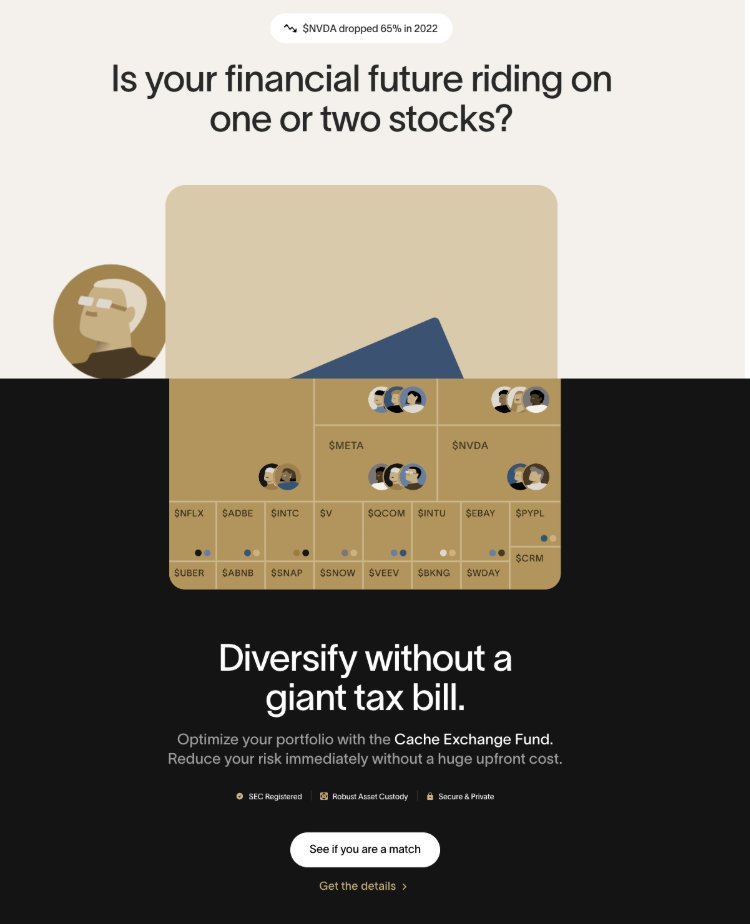
We now offer three flagship funds, giving investors a way to diversify a single stock into a broad portfolio without triggering immediate taxes.
From there, we’ve expanded the toolkit.
We launched Cache Long/Short two months ago. The response has exceeded our expectations. It reflects a broader shift toward focusing on after-tax outcomes.
We’ve also built tools to bring clarity to these high-stakes decisions.
The Concentrated Stock Calculator helps investors compare their options side by side.
The Capital Gains Calculator models real tax impact across federal, state, and local levels.
Cache exists for a simple reason: when a single stock becomes a meaningful part of your life, you should have better options.
If you’re sitting on a concentrated position, especially in a market like this, it’s worth stepping back and understanding your exposure. You don’t need to act all at once. But you should know your options. Start at https://t.co/9CpA4qGdX1.
To every client and advisor who trusted us early, thank you.
And to the team building this every day, thank you.
We’re still early.
P.S. We’re hiring across engineering, marketing, advisor sales, and portfolio management. Small team, big impact.
--
Disclosures:
Cache Advisors, LLC (Cache) is an investment adviser registered with the SEC, which advises the Cache Exchange Funds and the Cache Long Short Program. Cache Exchange Funds are alternative investments available only to accredited investors or qualified purchasers. For more information on eligibility criteria and the difference between accredited investors and qualified purchasers, please visit our website.
Investors should carefully review offering materials before investing. Cache does not provide investment recommendations or consider individual financial objectives to Exchange Fund Investors; they are responsible for determining whether an investment is suitable for their needs.Cache’s Flagship Funds, open to Qualified Purchasers only.
Assets within the Cache Long Short Program are sub-advised by an unaffiliated investment advisor and are custodied at Charles Schwab & Co., Inc., a member of SIPC, which is unaffiliated with Cache. Any securities mentioned are for illustrative purposes and not a recommendation.
Assets refer to the gross assets under management across all Exchange Funds, assets pending contribution to an Exchange Fund, and assets across Cache Long/Short and Collar Advance. Assets pending contribution and assets under Collar Advance are not managed by Cache. All data is as of 04/29/26 and will not be updated. For additional information and important disclosures, please visit our website.
Cool financial product:
If you have a lot of appreciation in a single stock (like $NVDA) and want to diversify, @usecache lets you swap into an exchange fund with other people in the same boat.
1) You swap $1M of $NVDA (bought for $25k) for a slice of a fund that tracks the S&P 500
2) It’s a "tax-free" swap under IRS Section 721, no capital gains tax on Day 1, that would take 37% of your gains in CA.
3) Your full $1M stays invested and compounding, now diversified across 100s of companies. They charge ~0.6%/yr
4) After 7 years, you can withdraw a diversified basket of stocks and sell when you want.
These funds have been around for a long time but they were access-limited with high mins, Cache is making it easy.
This seems super useful if you're overexposed to a big winner and want to protect your gains without writing a massive check to the IRS.
I am in this position thx to Nvidia - Cache seems great, I just learned of it yesterday (from a tweet!). Are there other options I should consider?
“It can’t be done. Too many have tried and failed.”
“Dead on arrival. I haven’t used one in decades.”
“You’re starting a what?”
“Are there even a hundred people who have a ‘concentrated portfolio’?”
This is what I heard from the largest wealth managers and RIAs in the country when I first floated the idea of building a modern exchange fund.
In 2022, I realized that many Americans were becoming more concentrated, driven by the growing trend of stock-based compensation and a historic bull-market run. Yet tax-efficient investing was limited to a small set of clients.
I saw this as a massive opportunity.
For decades, exchange funds had been a duopoly. And like most markets without competition, progress had slowed. It felt like a product from the 80s that hadn’t even met the internet. Minimums, fees, and the barriers were high.
We believed that it didn’t have to be true.
So we set out to build what many said couldn't be done: a modern exchange fund that was transparent, accessible, and efficient.
Just twenty months after launch, the market has spoken.
Cache recently crossed $1B in assets, likely one of the fastest to reach this milestone among digital investment platforms.
But this milestone isn’t about speed. It’s about a shift in who gets access to tax-efficient investing. The walls have been broken. This category no longer feels like a closed room with a velvet rope.
In 2025 alone, we grew approximately 4×. Our flagship exchange funds delivered performance in line with our goals. For example, UNIX achieved a ~0.99 correlation through our Index Sync approach.
We're grateful to the clients who trusted us early—and to the incredibly talented team that brought this vision to life.
Here’s to 2026, and here’s to building what the experts said cannot be done!
#wealthmanagement #personalfinance #financialplanning #concentratedstock
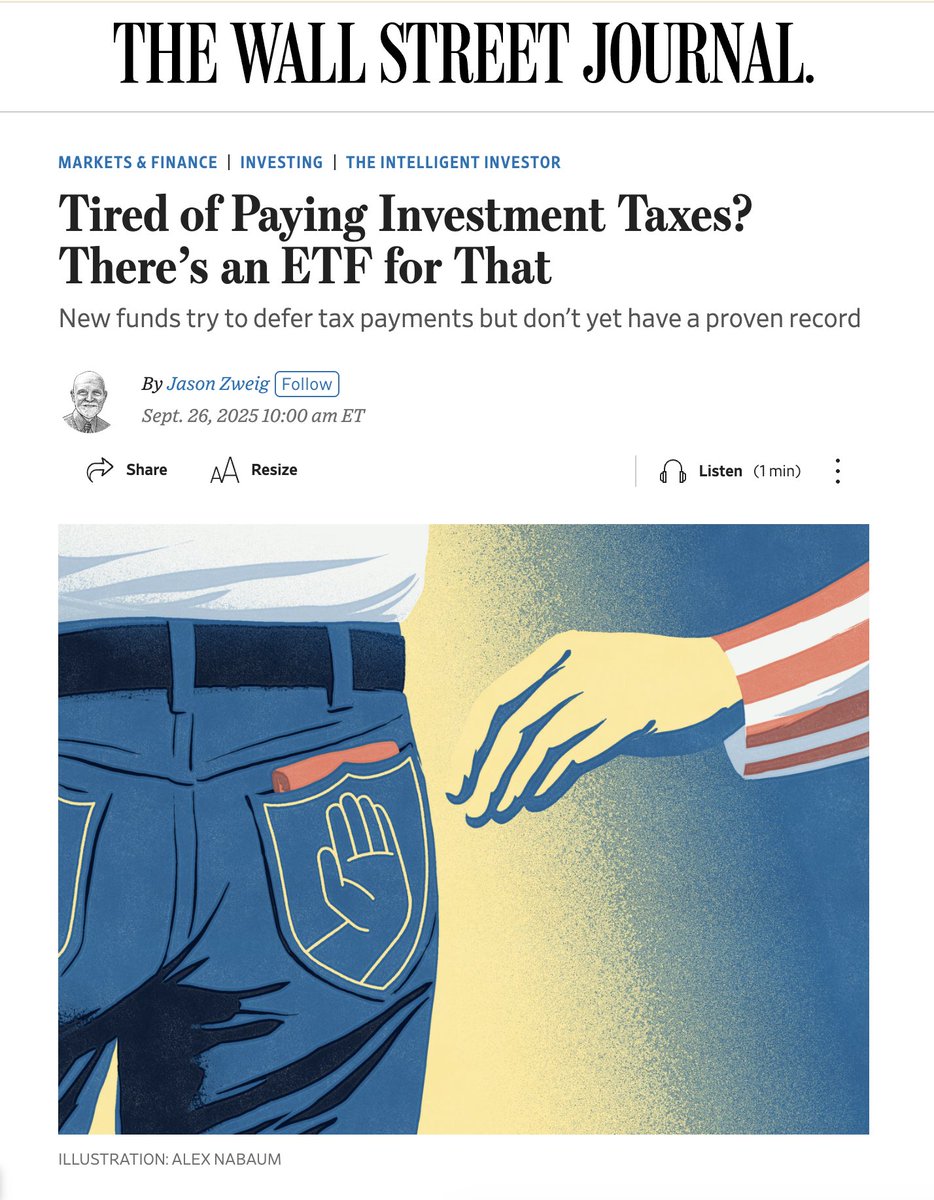
Honored to see Cache (@usecache) featured in @WSJ's Intelligent Investor by @jasonzweigwsj.
He highlights Cache’s role in the revival and modernization of exchange funds. Takeaway: “An ultraconcentrated position in a single stock becomes a low-cost, broadly diversified holding.”
For anyone sitting on a large single-stock position, this is essential reading.
https://t.co/kDpMgvnthG
wow.. this new AI is shaking Hollywood
LTX Studio just dropped a 13b parameters open sourced video model and.. it's now 30x faster, run on normal laptop for free
check out this film trailer I created in an hour and..
new features we never see before:
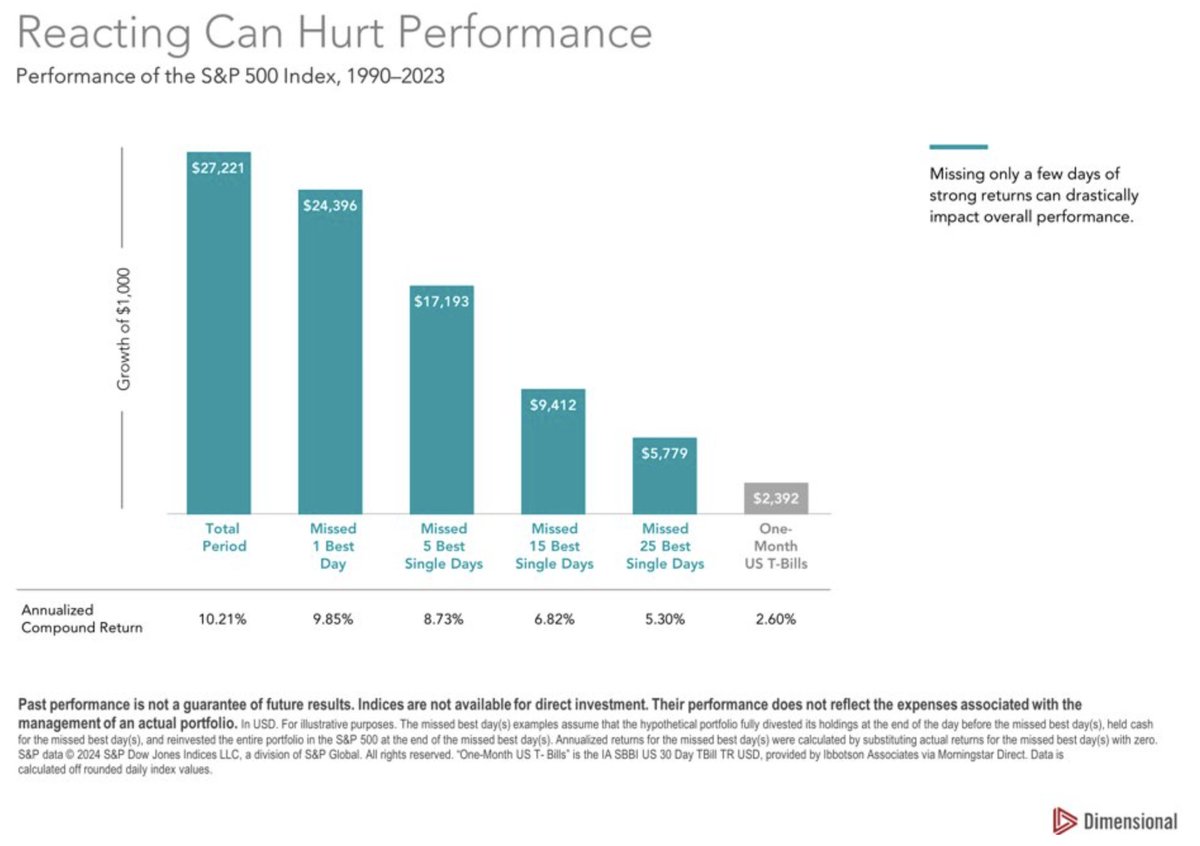
Today was the Nasdaq's 2nd / S&P's 9th biggest daily gain in history.
We've said it many times at @titanvest: missing only a few of the best days can crush your long-term compounded returns.
Chubbies was acquired for 9 figures and went through a 10 figure IPO - your classic overnight success that took a decade. As a brand builder, the stat that completely changed my approach to brand building was the 95/5 rule.
btw, I basically did the exact opposite of what the rule says for embarrassingly too long, but hey, my loss is your gain, so here's:
1) Three things I learned about the 95/5 rule,
2) Three ways you can update your thinking on the topic, and
3) Three things you can do about this right now.
let's do it.
** Three things I learned about the 95/5 rule **
1. Only 5% of the people who see your content on a daily basis (AKA your potential buyers) are in-market to buy right now. That means 95% of the buyers you reach are out-of-market and won’t buy for months or even years.
2. And, nope, no matter how awesome your direct response offer is, you cannot persuade the buyer to go in-market because they already have what you’re selling and won’t need a newer version any time soon. We don’t move buyers in-market – buyers move themselves in-market based on their needs.
3. All the direct-response conversion-focused dollars we spend are only relevant to the 5% of folks. This was especially humbling when realizing that ~95% of our spend allocation went to direct response (see reference above re: doing the exact opposite).
** Three ways you can update your thinking on the topic **
1. Our goal is to increase the probability that the brand comes to mind when the buyer goes in-market, NOT to persuade the buyer to go in market. You can’t push buyers down a funnel, but you can, to quote Professor Jenni Romaniuk, “catch buyers as they fall”.
2. "People largely use their memories when buying, rather than searching. Simply put, the brand that gets remembered is the brand that gets bought." - John Dawes of the Ehrenberg-Bass Institute
3. Since marketing works by influencing future buyers, think about developing creative that gets noticed and gets remembered -- gives you permission to be bold, put on a show and have a little fun.
** Three things you can do about it right now **
1. Since we've all been so focused on optimizing the hell out of how we convert the 5%, we need to reacquaint ourselves with the 95%. Walk a day in the shoes of the 95% to develop the empathy needed to effectively speak to that person.
2. Put together a plan to gradually shift your marketing investments to match the reality of the 95/5 rule. It could take all of 2024. No need to rush.
3. Take a day with your team. Remove all meetings. From a blank slate, think about what it means to do things that get remembered, that get noticed. What does it mean for your brand to be bold, to put on a show, and to have a little bit of fun?
enjoy
What is business?
• Warren Buffett: It’s value.
• Elon Musk: It’s disruption.
• Jeff Bezos: It’s customer obsession.
• Richard Branson: It’s adventure.
• Charlie Munger: It’s rationality.
• Bill Gates: It’s innovation.
• Steve Jobs: It’s the story.
• Mark Zuckerberg: It’s connection.
• Ray Dalio: It’s principles.
• Howard Schultz: It’s community.
• Larry Page: It’s solving big problems.
• Jack Ma: It’s resilience.
• Bernard Arnault: It’s craftsmanship.
• Sara Blakely: It’s solving pain points.
• Peter Thiel: It’s contrarian thinking.
What is business?