Today, we are incredibly excited to present LiteMol-1, our very first foundation model from LiteFold.
Structure-based models like BoltzGen, O-Design, and RFdiffusion have become the de facto standard for designing biomolecules. However, they are expensive to run at scale. In many campaigns, we have to generate tens of thousands of designs and rigorously filter them down to a handful of top candidates.
More importantly, most molecule design systems are primarily optimized around binding. But what about everything else that makes a molecule a useful therapeutic: ADME, toxicity, drug-likeness, membrane permeability, synthesizability, selectivity, and more?
That’s where we introduce LiteMol-1, our first Multi-Molecule Foundation Diffusion Language Model, pre-trained from scratch. With a single set of weights, LiteMol-1 can conditionally generate small molecules, peptides, cyclic peptides, depsipeptides, peptides with ncAAs, macrocycles, and PROTACs.
You can generate molecules unconditionally or condition generation on a protein target sequence. You can in-paint molecules, preserve parts of an existing scaffold, generate non-canonical peptides, cyclize designs, and continuously edit and regenerate them.
We also introduce a Monte Carlo Tree Search framework for multi-objective molecular design. Instead of trying to make one molecule perfect at everything, the search keeps a set of promising molecules, each with different trade-offs across properties. This matters because molecular design is fundamentally not a single-objective optimization problem.
Finally, and probably the part we are most excited about: this is a model for Agents. LLMs are not particularly efficient interfaces for repeatedly reasoning over thousands of large PDB/CIF files inside an AutoResearch loop. Sequence space is different. SMILES and molecular sequences are compact, editable, and much easier for an agent to inspect, compare, modify, and reason over.
So we treat LiteMol-1 as an infinite molecular canvas.
The model generates possibilities. The agent takes inspiration from them, evaluates them, edits them, optimizes them, and generates again. The AutoResearch loop continues until it finds candidates that satisfy the given design objectives; while bringing in expensive structure prediction, docking, or simulation only when they are actually needed.
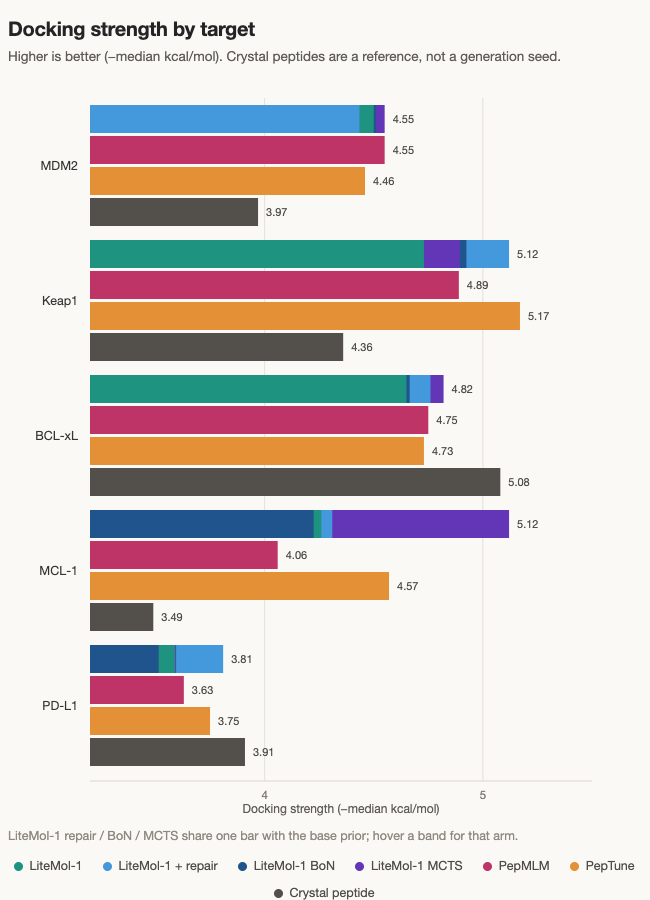
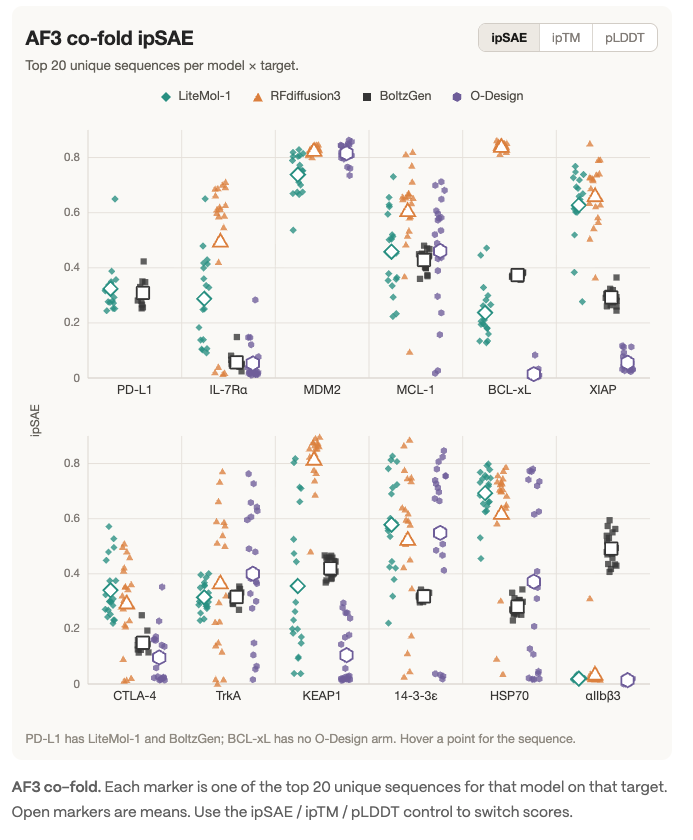
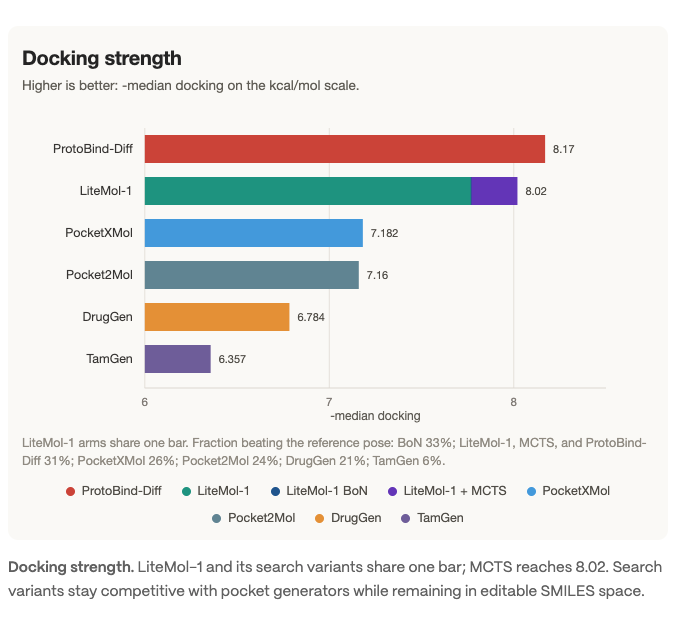
Our evaluations across peptide and small-molecule generation show that LiteMol-1 is competitive with, and in several settings on-par with or better than, frontier structure-based and sequence-based models, while operating at a fraction of the generation cost and time.
And this is only the first step. Check out our technical research blog post in the comments to learn more about LiteMol-1.
Just think, UPSC students are soo driven and hungry, they put so much hardwork. But the acceptance levels are soo low. Now imagine, if the same students put their efforts in making their own businesses, and putting the same effort, big or small, VC backed or bootstrapped. I have a feeling, there would be drastic reduction of poverty due to unemployment.
Actually you know what, the only thing, which is genuinely cooked here is being overly dependent towards teachers or seniors. People romanticize teachers soo much man. I get it, our history has those root. I see, this everywhere, in JEE, in getting jobs everywhere. Why is that? You will get your mentors in your journey, if you keep getting better by yourself anyways. You do not need to find them, they will find you.
Week 1 of @theresidency@enter_delta is nearly over.
Modern drug discovery needs a team of infrastructure, AI/software engineers, computational biologists, medicinal chemists, and biologics experts. What if one platform combined them all, letting scientists focus on solving complex, novel problems? That's what we're building at LiteFold.
Check out LiteFold, link in the comments—it's free.
Introducing LiteFold DeNovo.
Generate hundreds of chemically viable ligands against any protein pocket, evaluate them in real time, and refine with our built in molecular editor.
The problem: hit generation in drug discovery is slow, fragmented, and outsourced. With LiteFold DeNovo, it becomes interactive and instant.
You can also fragment grow base generated molecules, iterate, and soon run molecular dynamics to test stability. Docking and large scale screening are on the way.
When we said we’re building the AI first lab for drug discovery, we meant it. Super excited to what's coming next. Codename: Rosalind
Try LiteFold DeNovo today. It’s free. Links in the comments.
The first AI-powered structure prediction editor, powered by Boltz-2 with bulk structure prediction, is now available on the LiteFold Platform. Links in comments.
Exciting updates coming soon! 🚀
🚨BREAKING NEWS🚨
An anonymous person has come forward and shared important details about Dr. Moumita Debnath’s case. He claims that his father, who has connections with some of the morgue staff at RG Kar Medical College and Hospital, revealed that this case is part of a massive scam involving hundreds of crores, implicating executives, senior doctors, and a few government officials. He also alleges that Dr. Moumita Debnath discovered insider information about this scam, which includes the smuggling of medicines from the hospital. Additionally, he claims that the Health Minister of Bengal has a significant role in this crime and the corruption within West Bengal's healthcare system.
Will justice be served?
#JusticeForMoumita #JusticeForDoctor
I just got accepted to an $800 survey
I wrote a full guide on how you can do the same and start making $2-3k/m online
Just like, retweet + comment 'surveys' and I'll DM you the guide
(must be following me or I can't DM you)