I spent the last week building an AI chatbot SaaS from scratch.
🤖 Crawl any website
🧠 Generate embeddings
🔍 Semantic search with Qdrant
💬 RAG-powered answers
⚡ Deploy with one script tag
Stack:
Next.js • Node.js • Playwright • BullMQ • Redis • Qdrant • NVIDIA LLM
This has been one of my biggest AI engineering projects yet.
🧵 Here's how it works...
I spent the last week building an AI chatbot SaaS from scratch.
🤖 Crawl any website
🧠 Generate embeddings
🔍 Semantic search with Qdrant
💬 RAG-powered answers
⚡ Deploy with one script tag
Stack:
Next.js • Node.js • Playwright • BullMQ • Redis • Qdrant • NVIDIA LLM
This has been one of my biggest AI engineering projects yet.
🧵 Here's how it works...
Hey , @rapidoapp_ , I am frequently encountering an issue where drivers call prior to arrival demanding fare amounts significantly higher than the app's estimate. When I decline, they refuse to pick me up and insist that I cancel the trip.
One driver almost asked for a double fare.
Hey @hoichoitv
Noticed a small UX issue while using the platform.
When a request fails, the UI only shows “Request failed with status code 400”, which isn’t very helpful for users. The backend likely already returns a meaningful error message, but it isn’t being displayed.
Showing the actual message from the API (instead of the generic Axios error) would make debugging and the overall user experience much better.
Just a small suggestion. 😊
Hey @thsottiaux, could we get the ability to switch models after a plan has finished in Plan Mode? Sometimes the planning model is different from the one I'd like to use for execution, so being able to change it before continuing would be really useful inside codex.
Day2 of learning new things and posting about it
So Today let's learn about RAG in few words
What's RAG?
LLMs answer from memory.
RAG says, "Wait... let me check the docs first." 📚🤖
Retrieve the right information ➜ Generate the answer and stop the hallucination
Basically, AI with receipts. 😄
#AI #RAG #LLMs #AIEngineering
I am trying to start my journey towards learning AI/ML since a long time now but each time I start I just lost my motivation so I decided to post small ideas or parts of my learning through visuals and some examples each day I learn something new . So this is Day1 of me posting about a small idea
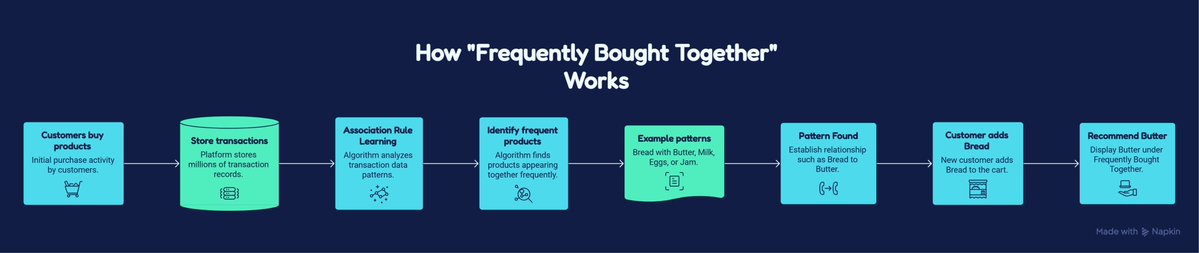
How "Frequently Bought Together" Actually Works
Imagine you open your mobile to order a bread from Blinkit and buy a loaf of Bread.
Immediately, Blinkit suggests Butter with a sign Frequently Bought Together
How did it know?
Step 1: Unsupervised Learning
There are no labels or correct answers.
The system simply looks at millions of past shopping carts to discover hidden patterns.
Step 2: Association Rule Learning
It asks one simple question:
"What products are usually bought together?"
Example:
Customer 1 → Bread + Butter
Customer 2 → Bread + Butter + Milk
Customer 3 → Bread + Eggs
Customer 4 → Bread + Butter + Jam
Step 3: Apriori Algorithm
Apriori scans all transactions.
It counts how often different products appear together.
It discovers:
Bread + Butter appears very frequently.
So it creates the rule:
Bread → Butter
Step 4: FP-Growth Algorithm
Apriori works well, but scanning millions of transactions repeatedly becomes slow.
FP-Growth stores the data in a compact tree structure.
Instead of checking everything again and again, it finds the same patterns much faster.
Final Result
When a new customer adds Bread to the cart...
The recommendation system already knows:
People who buy Bread often buy Butter.
Frequently Bought Together
Ans:🧈 Butter
This diagram is made using https://t.co/Jp4e5omPMB