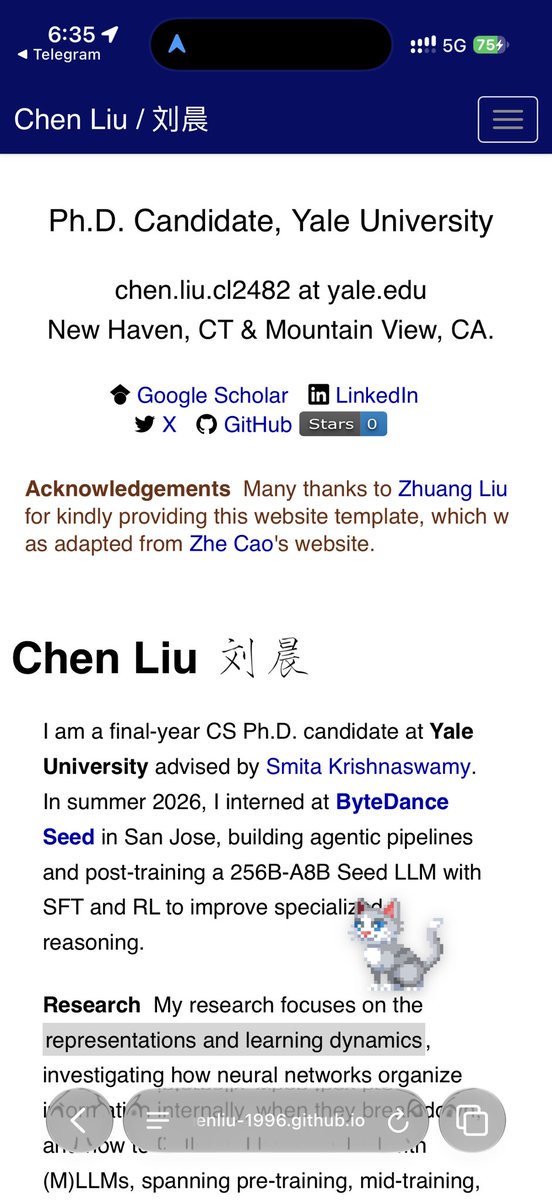
باحث دكتوراه في علوم الحاسوب بجامعة ييل اسمه ليو تشين، جمع الأكواد التي استخدمها لإنشاء الرسوم البيانية في أبحاثه المنشورة بمؤتمرات ومجلات علمية مثل Nature Machine Intelligence وNeurIPS، ووضعها في مستودع واحد على GitHub.
بعدها حوّل المشروع إلى AI Skill، بحيث تقدر تستخدمه مع وكلاء الذكاء الاصطناعي لإنشاء رسوم بيانية احترافية للأبحاث والأوراق العلمية، مثل المخططات العمودية والرادارية، بدل ما تضطر تكتب الأكواد وتضبط التنسيق بنفسك.
المشروع تجاوز 10 آلاف نجمة على GitHub، وأعتقد أنه مفيد جدًا للباحثين والطلاب اللي يحتاجون رسومًا بيانية بجودة مناسبة للنشر الأكاديمي.
https://t.co/qQykHDrYlj
I regret to inform you that regardless of how broken academia is, you are still responsible for what you become during your PhD.
Your advisor can guide you. Your university can give you a degree. Neither can make you an independent thinker.
Stop chasing paper counts. Stop waiting for the perfect research direction. Stop confusing publications with scientific progress.
Stay curious. Question everything. Take ownership of your research.
The goal was never to become a paper-producing machine. It was to become a scientist.
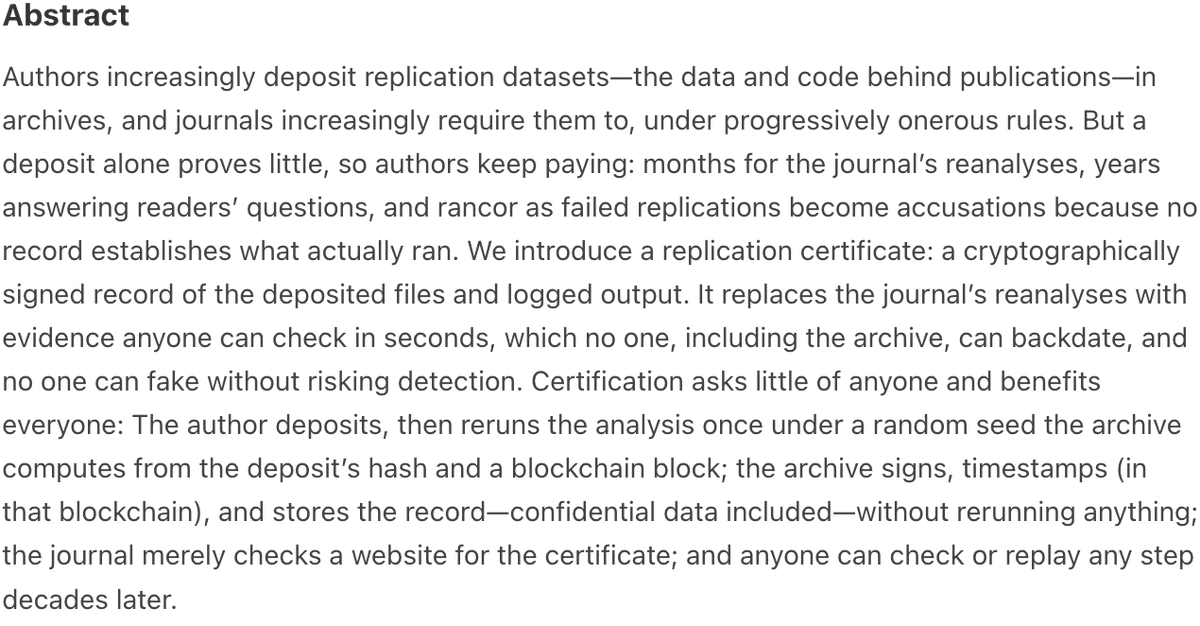
New paper: "Replication Certification at Publication: Checkable by Anyone, Anywhere, in Seconds, Forever" https://t.co/fRvNeEO2EV. with @xuyiqing & @YangYang_Leo. Comments welcome!
New paper: "AI Article Reviews Dominate Human Peer Reviews at Their Best: Evidence and Policy Choices" See: https://t.co/cLXCDy1Egs. with Steven Worthington. Comments welcome!
@abhishekn Couldn’t that also be a signal about the candidate too, if he has such an advisor, what would you infer about his training and quality of work, if it was him or mostly AI.
What is TMLR doing under a 300% increase in submissions?
- Suspensions of >150 authors
- Publicly naming major violations
- Submission quotas distinguishing slop patterns
- Desk rejections 6% → 53%; focus on clarity
- AI reviews evaluating soundness
https://t.co/TCFt0TB9RU
BREAKING NEWS
The Royal Swedish Academy of Sciences has decided to award the 2026 Sveriges Riksbank Prize in Economic Sciences in Memory of Alfred Nobel to Robert E. Hall and Michael Woodford “for microeconomic foundations of macroeconomic stabilisation.”
#NobelPrize
One reason it's harder for AI to beat Econ than to beat Math is that most published papers in Math are correct, whereas most published papers in Econ are wrong.
What's more, if you only read papers, you get the wrong idea about what is wrong.
From the written record, you would conclude that the biggest problems with a generation of diff-in-diff studies have to do with standard errors or negative weights, when in fact the biggest problem is that most DiD studies are poorly conceived and don't satisfy the necessary assumptions for diff-in-diff to work.
Understanding of this is mainly in researchers' heads.
So very good models will stay stupid things like "if you want a causal estimate, you'll need an IV for structural change, maybe you could use distance to coast."
So, for ADH this is actually pretty easy to explain
Controlling for the baseline sum of shares * time effects ("recentering") is essentially demeaning the industry shocks within period. This ensures that only the within-period variation in industry shocks is used for identification
If you don't include those controls, it means you're ok with using average shock variation over time for identification
More here: https://t.co/11DahknQKb
As recently as 2025, Autor and Hansen restated their results in the NYT. If they were aware of this, it's bad behavior. And if they weren't aware of this, it would be quite negligent.
https://t.co/NjjuIkknww
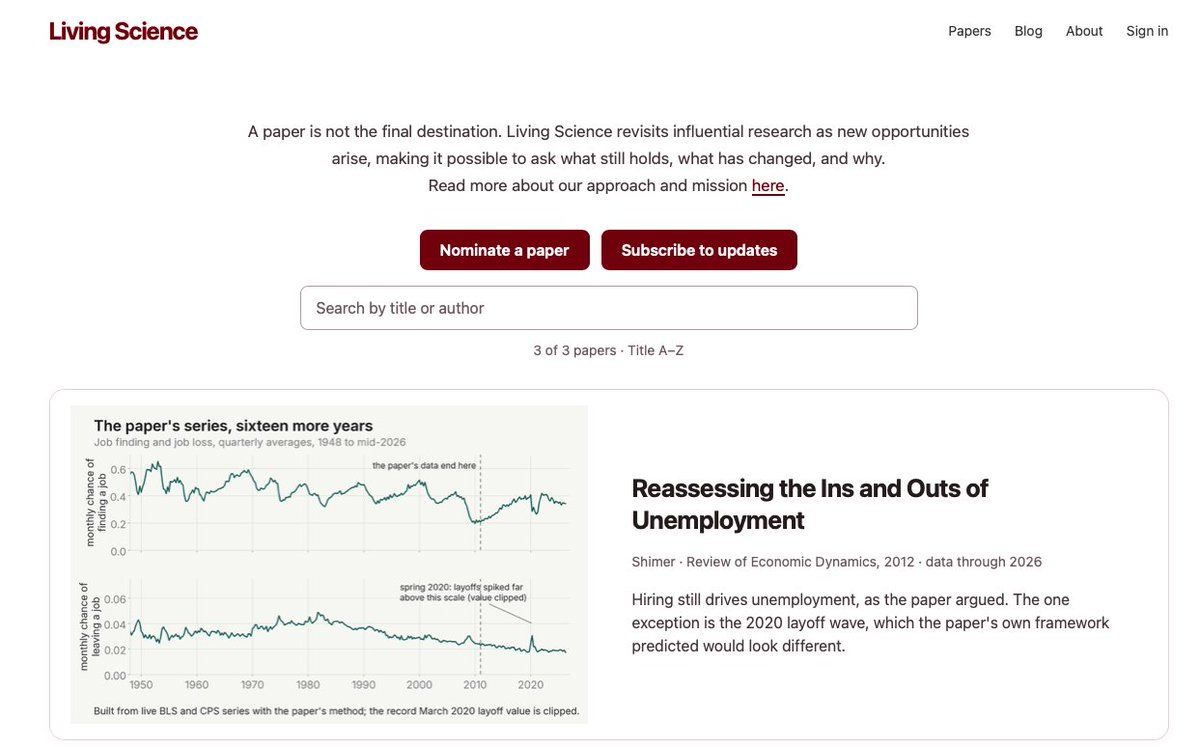
Very interesting project: Living Science uses an AI agent to reproduce key findings from seminal papers in economics, document what holds up and extend the analysis with newer data. It's like a follow-up paper with robustness checks and extensions. New paper every week.
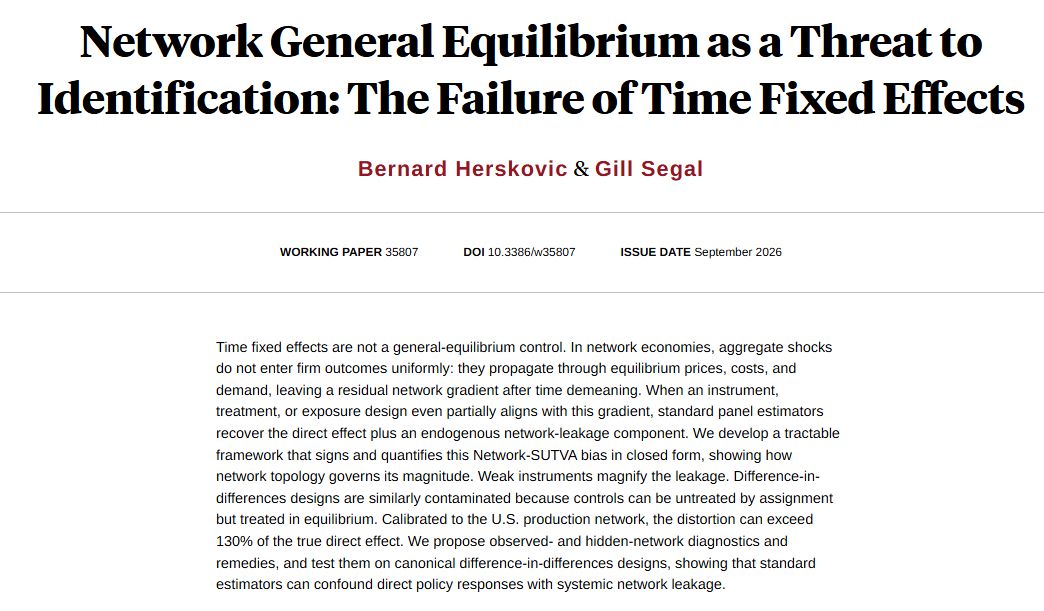
Time fixed effects don't absorb aggregate shocks in production networks: shocks spread unevenly through prices, costs, and demand, so IV and diff-in-diff estimates can mix direct effects with network "leakage." Calibrated to the US economy, this bias can exceed 130 percent of the true effect, from Bernard Herskovic and Gill Segal https://t.co/xwtsE8jeI9
Cornell just produced a massive new report on higher education noting that companies have a “jarring” skepticism of higher ed thanks to a new generation of degree holders who lack key skills like handling uncertainty, compromising, and absorbing feedback.
Faculty also report that incoming students, despite four years of undergraduate education, are “underdeveloped” in these relational or interpersonal skills.
This is a serious crises in higher education and the report calls for a greater need for conflict-resolution training. We need to do a better job training our students to deal with these issues.
These are traditionally the skills students developed in higher education. I loved college because it challenged me, sparked debate, and required me to grapple with complexity. This should be an essential part of college--inside and outside the classroom.
https://t.co/qvTg2hB7HO
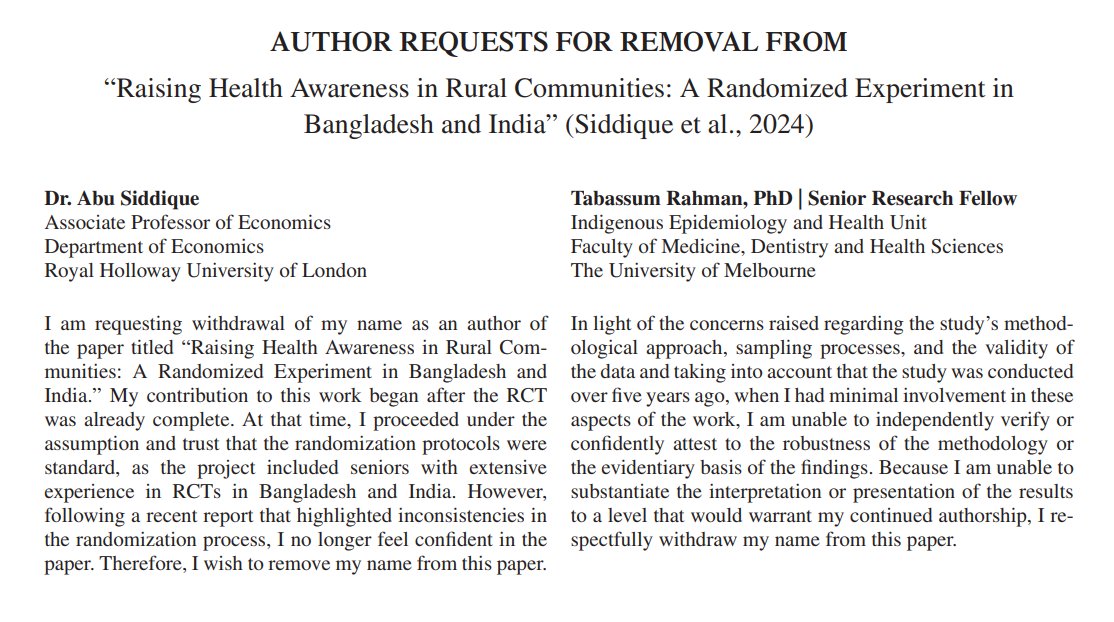
This might be a first in economics: Authors officially request to be removed from a paper published in REStat. The paper itself has not been retracted - and the other authors remain on the paper. https://t.co/gQ2GxmHpJb
Happy to share slides for six lectures on "causal panel analysis" based on my recent short course at Waseda.
https://t.co/byutHLxU7V
Written for applied researchers.