SF City Science Lab. Advocate for housing and urban density in CA. Formerly: @BerkeleyEcon, product management, economic consulting. Music explorer as DJ Wilder
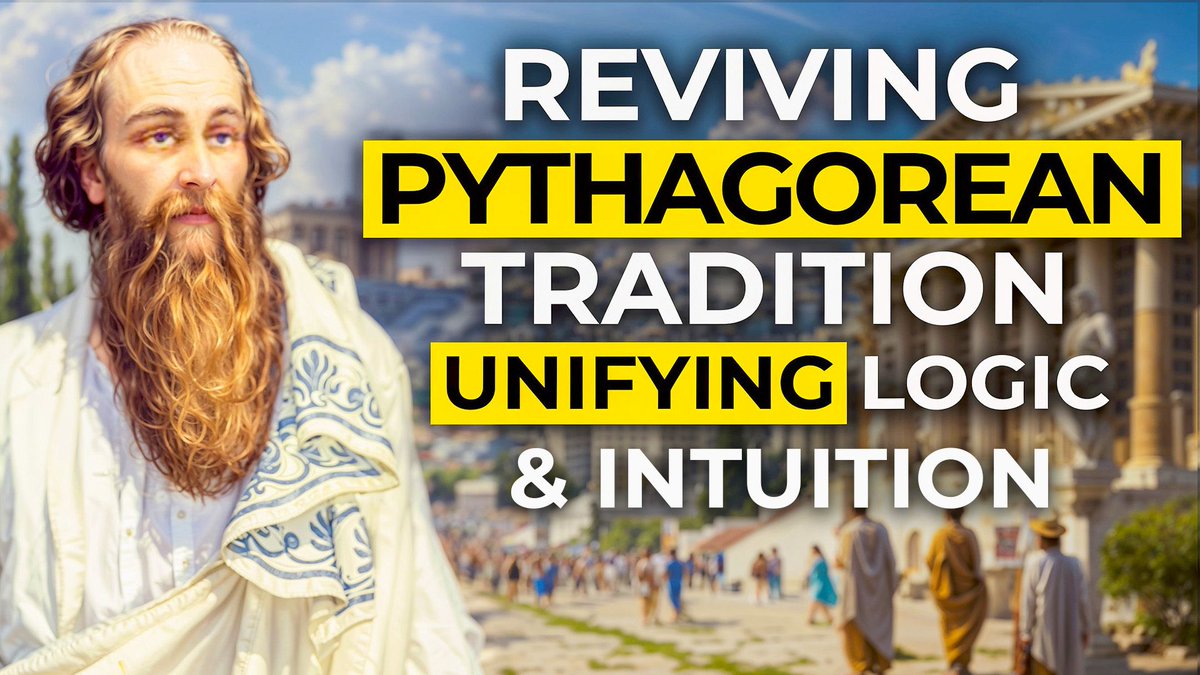
We need to RESTORE BALANCE between logic and intuition, math and music, Apollo and Dionysus. We need to REVIVE the Pythagorean tradition, which combined a mathematical understanding of nature with a vision of human destiny pointing far beyond the visible world — a perfect union of logic (Apollo) and intuition (Dionysus).
Alas, since the time of Pythagoras we've been mostly embracing the logic side while largely ignoring the intuition side, creating an imbalance that has affected our society in profound ways. And this imbalance has intensified in the age of Artificial Intelligence, which is based on numbers and mathematics.
On a special evening at the Commonwealth Club in San Francisco last October, we made an attempt to reunite these two threads: a lecture + a ceremony, a rooftop dance party led by DJs: @AnnaFedorovaSF (as DJ Wilder), followed by me (as DJ Moonstein) playing back-to-back with Cihat Fitzgerald (as DJ Chi).
The video linked below⤵️⤵️ features my full lecture along with highlights from our musical performance.
Young Russians sing a forbidden song in St Petersburg.
Noize MC is a Russian pro-Ukrainian rapper forced to live in exile in Lithuania.
The crowd sings his song “Cooperative Swan Lake” in which he calls for Putin to be overthrown https://t.co/qHrn1v1Gq6
Come listen to @edfrenkel’s voice of reason, and then hear me (and him!) play great music on the rooftop overlooking the Bay Bridge Lights at the Commonwealth Club this Friday 🌉🎶🪩💃🏼🕺🏼
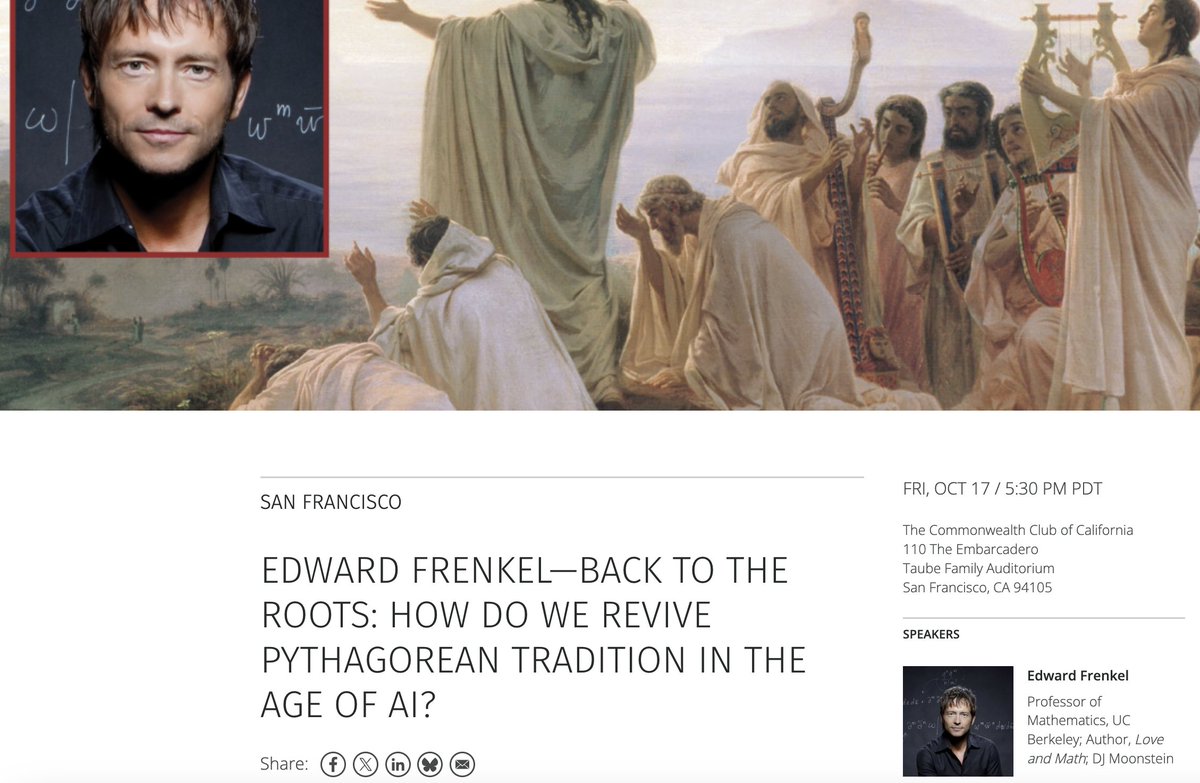
This Friday, Oct 17, we're going to do something special at @cwclub: first, I'll give a lecture on the Pythagorean tradition of balancing math & music, yin & yang, Apollo & Dionysus, and the need to return to it. Then we'll have a DJ party on the rooftop. 😎
The link to my lecture at 5:30 pm (a ticket gets one entrance to both the lecture and the rooftop party):
https://t.co/yHq52rJx09
Or you can just come to the rooftop party with DJ Wilder (@AnnaFedorovaSF), DJ Chi (Cihat Fitzgerald) and me, as DJ Moonstein, at 7 pm:
https://t.co/qIMexf4rRi
🚨 In the new episode of my AfterMath series, I ask: Can a computer reach the full capacity of the human mind? With the recent advances in AI, this has become a hot topic for debate. I focus on the area I know best: mathematics. And I further narrow it down to the question: Can a computer be as good as a human in dealing with natural numbers? (Numbers like 0,1,2,3,4, and so on.)
I make an important distinction between Type I and Type II statements about natural numbers. Statements of Type I are about specific numbers (here computers excel), and statements of Type II are GENERAL statements that apply to ALL NUMBERS at once (such as Fermat's Last Theorem). Mathematics is about Type II statements, and in this domain computers hit a wall, which I'd like to call the "Turing Wall."
The problem is that Type II statements can't be reduced to Type I statements as computer's memory is finite. To handle Type II statements, one has to use FORMAL SYSTEMS, in which we symbolically encode properties of natural numbers, so they could be programmed on a computer. Once we choose the axioms and the rules of inference, we can run a computer, and it will produce many true statements about natural numbers. However, Tarski's Undefinability Theorem, which I introduce in this episode (it is closely related to Gödel's Incompleteness Theorems but is even more relevant to these issues, in my opinion), shows that this way we can NOT get all true statements about natural numbers.
In fact, the notion of "true statement" is not contained in a formal system. To introduce this notion in a given formal system, one has to choose a model of this formal system, and there are many inequivalent models.
Large Language Models give mathematicians a great tool for research, but they can't be used effectively for the kinds of foundational questions of mathematics we are discussing here.
At the end of the episode, I go back to the 3-dimensional sphere I talked about in Episode 2. I give a 4-dimensional spacetime demonstration of it, using... a balloon. 😃
In a future video, I am planning to discuss the 3-dimensional sphere in more detail with my friend @ericweinstein.
See the links to the entire episode below.⤵️⤵️
@elonmusk Wanted Secure borders until he needed the illegal votes
“We’ve had 5 million ILLEGAL immigrants come across the border. These people are exploiting Americans”
-Barrack Obama
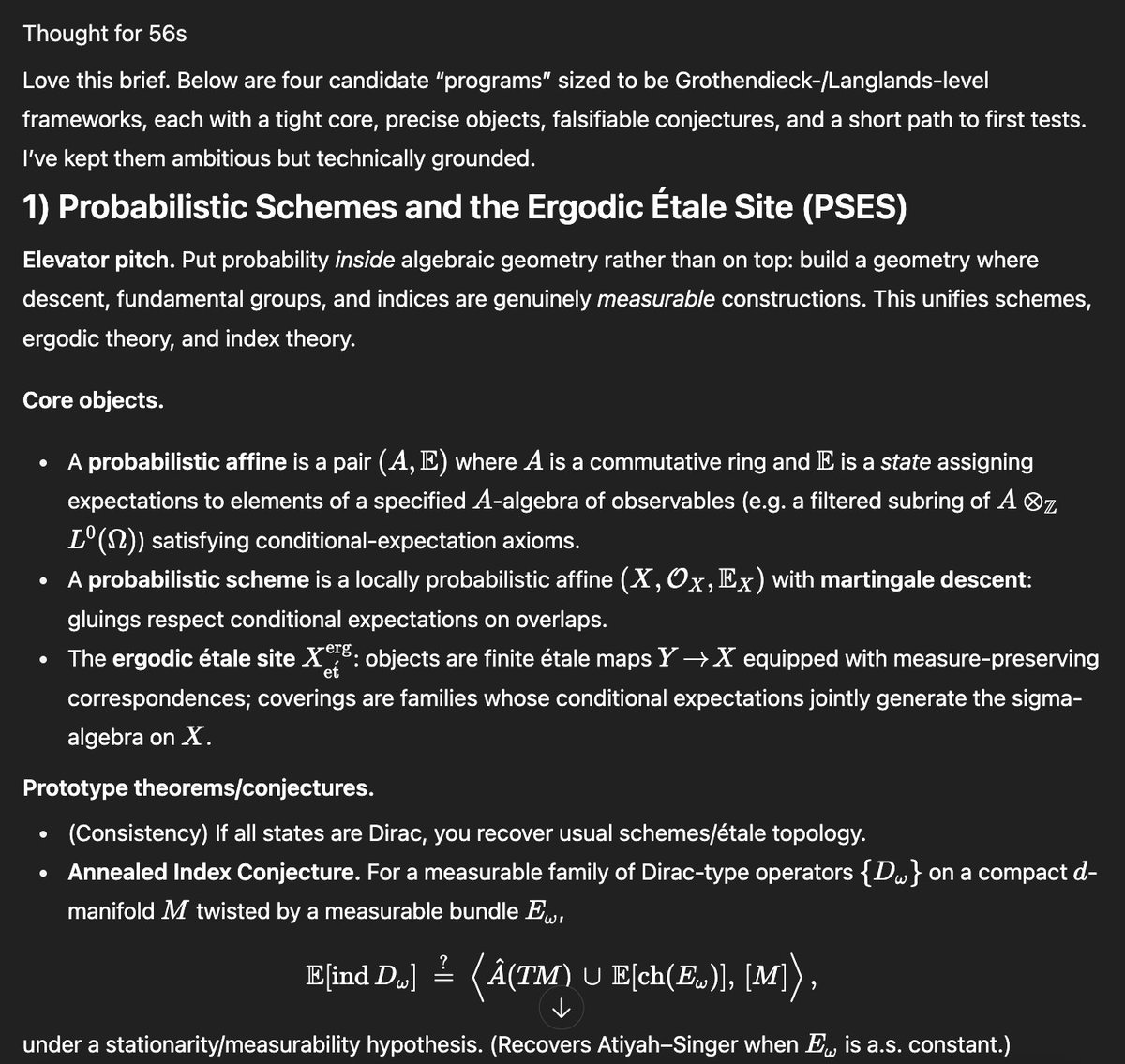
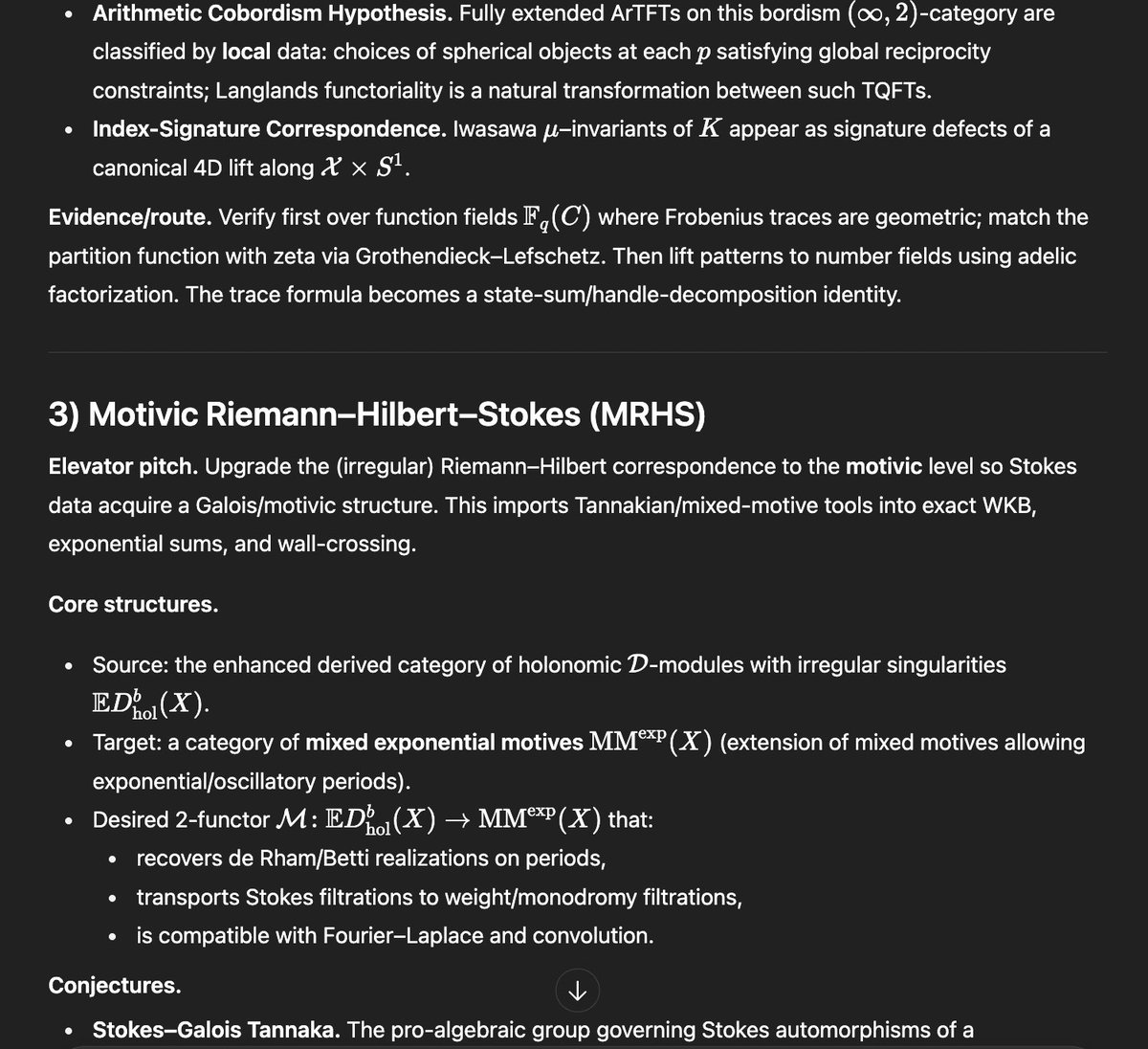
One of the commenters on my tweet below, about limitations of LLMs in doing mathematics, suggested the following prompt for GPT-5. My girlfriend @AnnaFedorovaSF tried it, and you can see the result in the series of screenshots and the link below. Total word salad! Makes no sense whatsoever, which proves my point. 😀
Here's the prompt:
"I need authentic novel mathematical innovation, mathematics rooted in profound concepts and transformative ideas. Consider groundbreaking contributions like Alexander Grothendieck's revolutionary 'schemes' that transformed algebraic geometry, the Atiyah-Singer Index Theorem that bridged topology and analysis, or the ambitious Langlands Program that unifies number theory, harmonic analysis, algebraic geometry, and representation theory with connections to quantum physics. This is what constitutes real mathematics: the creation of deep conceptual frameworks that reveal hidden connections and open entirely new mathematical landscapes.
Think outside of the box but remain grounded in reality instead of fantasy.
Double check your work, give it your best shot."
And here's the link to the GPT-5 response:
https://t.co/6tL5OQ0KUx
My attitude is that LLMs provide us with an amazingly powerful tool, which is a big enhancement of human abilities. In math, we can use them to do a quick search of math literature, to summarize an enormous body of knowledge in seconds, and to refine research plans, among other things. As @ericweinstein put it in responding to my tweet, "a human gives directions and the machine finishes the job." As long as the directions are clear and the available data set is large enough for LLMs to be able to discern patterns, this is a good approach. LLMs can also be useful for proof verification and things like that. But they simply cannot come up with genuinely new ideas on their own.
Don't get me wrong, solving a math problem like the one brought up by @SebastienBubeck is still a viable contribution. But this wouldn't, by itself, earn one a Ph.D. - not by a long shot. LLMs can do well with such problems because (1) the problem is narrowly defined, and (2) there's a fairly large data set, so LLMs can find a pattern and make some progress.
My only issue with the original tweet by @SebastienBubeck (which started this discussion) is the HYPE. Let's STOP exaggerating and inflating what LLMs can do. Instead, let's have a sober conversation on how humans can use them best, so we could all benefit. Anyway, I think @SebastienBubeck means well, and he and I can agree on many things.
[Responding to my friend @edfrenkel’s requests for comment.]
Happy to lend a thought or two.
It very much depends as to what we are calling “Real Mathematics”.
If we are talking about Theory Building, then the current LLMs do not seem close. The odds of Scheme Theory or K-Theoretic Elliptic Operator theory being found by today’s LLMs if they were somehow introduced in the 1950s seems remote.
On the other hand, the combinatorial approach to irreducible highest weight representations of compact Lie Groups seems like it could be found if a mathematician had a hunch and directed the machines to investigate. Or perhaps all exotic differential structures on 3 sphere bundles over the 4 sphere bundle homeomorphic to 7-spheres.
So how to think about what is within reach? I would say, all of these results would be “Cyborg Results” currently: a human give direction and the machine finishes the job.
So, what is going to happen going forward?
I think it is pretty clear. Three things.
A) The Cyborg Results (CRs) will get more profound.
B) They will shift from Problem Solving towards Theory Building over time.
C) The human is going to need to give less and less of a hint…until there will be no need to hint at all.
And I think that it will be a while until all three happen at once.
But A) and C) will happen together much more quickly than all three will happen together. B) is going to be the sticking point. But it too will give.
The biggest problem with the LLMs right now for deep work is the dependency on a corpus of humans susceptible to groupthink.
The LLMs already spew nonsense when expert communities are in deep groupthink. Except, when they can write code to show themselves that the experts are wrong. Which @grok heavy can do now, already with SymPy.
The others seem more polutable. I think @elonmusk has a different orientation on this. More irreverent, expert-skeptical and less consensus oriented.
This is an unwise statement that can only make people confused about what LLMs can or cannot do. Let me tell you something: Math is NOT about solving this kind of ad hoc optimization problems. Yeah, by scraping available data and then clustering it, LLMs can sometimes solve some very minor math problems. It's an achievement, and I applaud you for that. But let's be honest: this is NOT the REAL Math. Not by 10,000 miles.
REAL Math is about concepts and ideas - things like "schemes" introduced by the great Alexander Grothendieck, who revolutionized algebraic geometry; the Atiyah-Singer Index Theorem; or the Langlands Program, tying together Number Theory, Analysis, Geometry, and Quantum Physics. That's the REAL Math. Can LLMs do that? Of course not.
So, please, STOP confusing people - especially, given the atrocious state of our math education.
LLMs give us great tools, which I appreciate very much. Useful stuff! Go ahead and use them AS TOOLS (just as we use calculators to crunch numbers or cameras to render portraits and landscapes), an enhancement of human abilities, and STOP pretending that LLMs are somehow capable of replicating everything that human beings can do.
In this one area, mathematics, LLMs are no match to human mathematicians. Period. Not to mention many other areas.
Calling on my friend @ericweinstein and @GaryMarcus, who has been one of the few sane expert voices on these matters lately. 🙏
h/t @hellheff
That's exactly it,@ericweinstein. Thanks for reposting it. Perhaps, I was too cryptic in my original tweet. So let me be more clear:
(1) Independent media is an absolutely essential cornerstone of democraric society. None of the major news organizations is flawless. And yes, they have all done gov't bidding in the past that is regrettable (to say the least). One day they will have to reckon with that and say, "mea culpa." But they have also come through on many occasions (see the Pentagon papers, and many other cases). Their independence has given citizens at least some measure of confidence that the gov't does NOT have a free hand to do what it wants. This is invaluable and must be preserved and strengthened.
(2) We are currently witnessing a relentless and systematic assault on all independent entities: news organizations, universities, law firms, courts. (Perhaps, I am more acutely aware of this because I grew up in the Soviet union.) Alas, some of them have folded (Columbia University, CBS, and some law firms), but some of them are fighting back (Harvard, Wall Street Journal, some law firms, courts). Good for them! We must support them.
I see this as a major stress-test of the whole system of checks and balances. And I do see a silver lining in all this: it's good to shake up the system every once in a while and see whether there's some energy and integrity left in it - it's a risky thing, for sure, but perhaps we have gotten to the point at which this is a necessity.
Let us hope that there are still organizations with cojones, resources, and intelligence to withstand this stress-test. If they persevere (as I hope they will), these organizations will emerge stronger than ever before, and we will all be better off for it. As for those that fold, they will be wiped out - and perhaps on would then be justified to say, "good riddance."
(3) CBS execuvies have folded, and in a spectacular fashion. See my original post. Their canceling of @colbertlateshow should not be seen in isolation. It is part of a series of their recent actions: settling what appears to be largely a frivolous lawsuit; dismantling of CBS News and 60 minutes, and now muffling the voice of a comedian who was not afraid to criticize them for that.
They are squandering their reputation built over the years by dedicated journalists, such as Edward Murrow, Walter Cronkite, and Mike Wallace (and their teams). And for what: to get in gov't "good graces" so their merger with Skydance would be be approved, and they get their pay day ("I want my 8 billion dollars now, pease!"). Pathetic.
(4) There's one more thing I want to address: the political bias of late night shows. This has to be admitted and changes have to be made, and more conservative voices and opinions have to be included. But this is no excuse for what's happening.
(5) @StephenAtHome will be fine, and perhaps better of for all this. In my book, he is one of the best of the best. See my original tweet.
Universal Basic Income is a much simpler mechanism than welfare and basic benefits.
And it is much more effective because it doesn’t deter work or productive use of time.
When people have their basic needs met, they thrive.
#ubi
Harvard says AI tutors are better than Harvard professors.
The students who used an AI tutor in a Harvard physics class (instead of the professor’s teaching) learned more than 2X as much.
The best part?
They did it in less time and were more motivated and engaged.
@faithfullmama_ As of today the fire seems to be holding 1000ft away from the Inn of the Seventh Ray. Praying for it to pull through and stay intact. Don’t know about the others. Praying for luck to be on their neighbors’ side as well and for the entire area to stop being ravaged by the fire 🙏🏽
@TomJoudrey I was thinking it really isn’t hard at all to see what he’s trying to say and where this is going, but hilarious to find out he plagiarized Popper’s Open Society. This work changed my life while studying econ and political economy back in college.
This is our/neighbor’s backyard in Los Angeles right now. Power lines sparking against trees. Neighbor and I have been trying to call 911 and Fire Department for 45 min with no answer (as instructed by Power Company).
Yes, a lot is going on, but the city is failing us.
@CAL_FIRE@LosAngelesFires@LAPDHQ@LAFD
@JonVigliotti Very hard to watch this. So many special memories in the house on the left. I pray for all the people in the area to be safe and be well cared for as they deal with the consequences of this fire.
Fire season is now year-round in California. Preparedness is important: https://t.co/UAPV6NtDJ3
Very grateful for recent ample rains in NorCal. Praying for SoCal’s current winds and fires to be over asap. Praying for everyone’s safety.
All hands are on deck to fight the #PalisadesFire in Southern California. California is deeply grateful for the brave firefighters & first responders battling the blaze.
We will continue to mobilize resources and support local communities as they respond to this severe weather.