I’m in love with this sentence:
“The degree to which a person can grow is directly proportional to the amount of truth they can accept about themselves without running away.”
I’ll say it again and again, we are entering an era that will reward systems thinkers.
Systems thinking is the ability to understand how the parts of a broader system connect and influence one another over time. It means recognizing feedback loops, anticipating consequences, and understanding how a decision in one area can create trade-offs in another.
The boundaries of our professions have always been narrower than the consequences of our work. As AI begins to blur these boundaries, and as our world becomes increasingly interconnected in non-linear ways, systems thinking will become essential.
I don’t think this signals the end of expertise, as some people proclaim. But the ability to zoom out and make connections across a broader system will be crucial.
Read my latest Substack on systems thinking (link in comments)
All employees come in 5 levels, choose wisely:
Level 1 - tells you there's a problem
Level 2 - tells you there's a problem and what caused it
Level 3 - tells you there's a problem, what caused it, and options to fix it
Level 4 - tells you there's a problem, what caused it, options to fix it, and which one they'd pick
Level 5 - tells you there was a problem, what caused it, how they fixed it, and future proof’d it
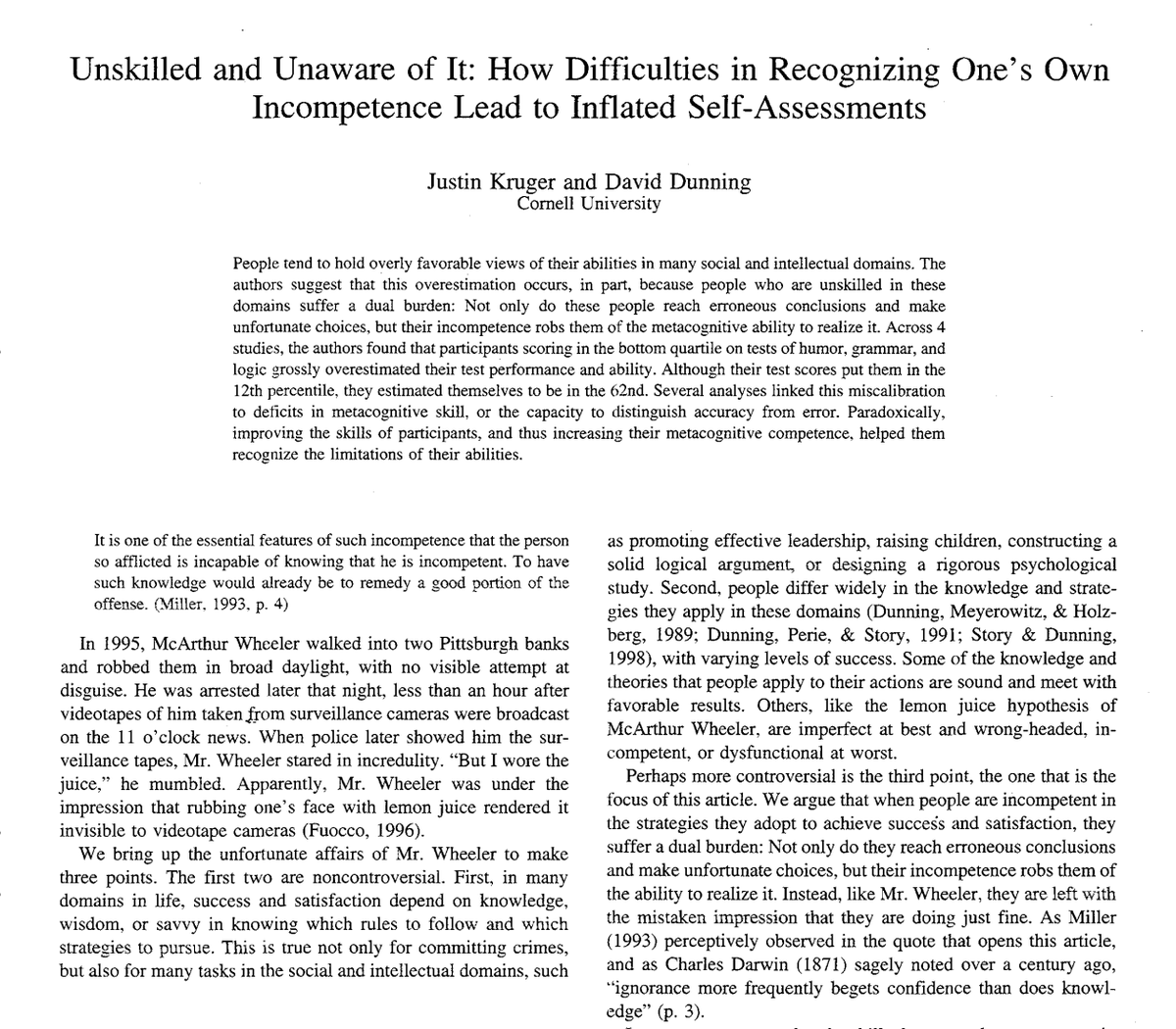
This paper answers why confident idiots run the world.
Cornell University published a psychological paper that explains every terrible boss, every loud influencer, and every broken corporate hierarchy.
It’s called “Unskilled and Unaware of It.”
they tested participants across logic, grammar, and humor to measure the gap between actual performance and self-perception.
And the results are wild.
participants scoring in the bottom 12th percentile consistently believed they were operating in the 62nd percentile.
they were not lying. they were literally incapable of recognizing their own incompetence.
the paper revealed a brutal paradox:
the exact skills required to master a domain are the exact same skills required to accurately evaluate your own competence in that domain.
if you lack the skill, you inherently lack the cognitive capacity to realize you are failing.
this creates a dangerous systemic loop.
the incompetent are blessed with absolute, blinding certainty. their brain protects them from their own ignorance, allowing them to speak first, demand authority, and never second-guess their decisions.
meanwhile, the actual experts suffer the exact inverse.
top performers in the study consistently underestimated their rank. because a task was easy for them, they falsely assumed it was easy for everyone else.
they hesitate. they obsess over nuance. they assume they have nothing unique to add.
we are biologically wired to confuse confidence with competence.
the loudest person in the room gets promoted, gets funded, and gets the microphone, not because they know what they are doing, but because they are physically incapable of seeing what they don't.
the only defense mechanism is building systems that stop rewarding absolute certainty and start demanding proof of work.
@MarkCCrowley Largely concur, but shouldn't meetings mostly be the work? Shared understanding & planning, analysis, decision making, transparency. In the knowledge economy and complex enterprises, not much work can be done solo. Seems like demonizing meetings causes them to be less effective.
So much of growing up is finally realizing that structure is not the opposite of freedom. It’s the thing that keeps freedom from turning into aimlessness.
Every system decays toward mediocrity unless someone keeps the standards high. Your life is not exempt from this rule. Sometimes you have to imagine yourself as your own parent. That’s basically what growing up is.
There are a couple of universal patterns that show up across fields that you should apply to pretty much anything:
- Use a written process because memory isn't reliable (see aviation checklists, surgery, mise en place, SOPs...)
- Stop early when something is wrong (Andon cord, feature flags, turnaround time, error budgets...)
- Leave a buffer (Margin of safety, safety stock, taper, defense in depth...)
- Fix the system rather than blame people (Blameless post-mortems, poka-yoke, Swiss cheese model...)
- Get feedback fast (OODA, kaizen, canary releases, after-action reviews...)
- Hand over with a fixed format (SBAR, BLUF, commander's intent...)
- Ramp up gradually (10% rule, canary releases, position sizing....)
Underrated life advice: Become difficult to rush. The world will pressure you to rush into everything. Rushed decisions. Rushed relationships. Rushed conversations. Rushed timelines. There's power in rejecting that trend. Pause. Slow down. Create space to think clearly.
The single best thing you can do to improve a company: shorten the distance between a problem being noticed and a decision being made about it. Everything you hate about bad companies is a symptom of that distance being long.
How many leaders would you guess actually create #PsychologicalSafety for their teams?
After a decade of books, articles & podcasts on the subject, you'd guess most of us have this figured out by now.
McKinsey puts the real number at about 1 in 4.
We're not nearly as good at this as we think we are.
#Leadership #LeadFromTheHeart #HR #SHRM #WellBeing
The loser has more in common with the winner than with the person sitting on the sidelines.
The winner and the loser each had the courage to try. Both risked embarrassment. Both were willing to face uncertainty. Both were stubborn enough to continue.
Success is endurance in disguise. It belongs to the person who can absorb the losses without absorbing the identity of "loser." It's the courage to start — and to stick with it — that is the real separator. Results tend to find the person who stays in the game.
The sidelines are safe, but sterile. Nothing grows there.
Something I noticed about resilient people: They don't have fewer problems. They have faster reset times. Bad news hits at 9am. By 10am, they're back to their priorities. They feel it, process it, and move. The speed of the reset matters more than the size of the setback.