Hands up anyone who thinks a British-Polish hybrid model of "I was born to run this thing" confidence + "time to roll up our sleeves and work 24/7" ambition is actually what fixes Europe.
You know who else has both of these qualities in abundance? Americans. The American work ethic + ambition + managerial confidence is pretty much the mid-point between Polish and British professional culture, minus the downsides of each (insecurity/waiting for permission vs. complacency/over-reliance on ossified systems).
It's replicable in Europe if we lock the UK and Poland in a room together and tell them they're not leaving until they've figured out a way to solve the Great European Stall that is 50% weighted to the best qualities of each.
Not necessarily volatile, just generational - PiS has been a monolith since 2004, new generation, new Politics. A challenger/successor to Tusk will probably emerge soon too (likely Sikorski) - if it's him, then both successor movements will lean towards the centre-right, with defence/growth/sovereignty in focus, which is roughly where most Poles tend to sit anyway, so it's more a gentle corrective to natural processes of entropy
Abolished by the Whigs in 1851 following a campaign by doctors/scientists which coined the term "daylight robbery" + ordinary constituents flooding parliament with letters.
Tax reached peak absurdity when the govt built a giant glass palace for the Great Exhibition while taxing ordinary people.
Russell caved bc his govt collapsed, but since nobody else could actually FORM a govt, he had to stay + needed a win.
BONUS was the Chancellor (Wood) was running a £2.5M surplus following radical spending cuts needed to fix a £3m deficit from the late 1840s (+Industrial Revolution + Free Trade + Peel's 1842 income tax more efficient anyway)
Poles over 40 are still hugely cautious about investing in anything intangible bc institutional memory of communism/mistrust of systems/perception that systems cannot be influenced strategically persists in those who have had the time to accumulate the most capital (ONLY exception I can see is the tech ecosystem = operates on exponential growth/ full of young people who understand exponential/network impact, usually because they worked or studied abroad)
It's been apparent for years Poland needs a chain of Overseas Institutes + international comms/events strategy but until about 5 years ago the only people with the financial resources to invest in building one had grown up in the unshapeable system + felt safest parking capital in land / small businesses / government bonds.
Poland has become one of Europe’s standout growth stories, with an economy that crossed $1 trillion and a new generation of entrepreneurs returning home. But some economists see challenges. Watch Wall Street Week tonight at 6 p.m. ET https://t.co/cd918goEiB
Świetna szansa na budowanie + eksportowanie własnych struktur i paradygmatów. Aby to zrobić dobrze, powinniśmy: 1) dokładnie przestudiować jak zrobił to poprzedni "Zachodni" establishment (strukturalnie), 2) dogłębnie zrozumieć własną tożsamość i cele, 3) rozpisać i realizować konsekwentny plan na pogłębienie polskich wpływów
@MsMelChen@business There is a new language of diplomacy and Poland's President Nawrocki caught on first - most European leaders are still speaking the old language (institutional/civil service), and are backed by those structures - the new language is monarchical/court-style
Palmerston can talk like the Romans because his education = studying the classics + learning to do what the Romans did with updated technology. There are people who do that today. They mostly run tech companies.
Fantastic news! Worth noting that history/classical teaching is about pattern-spotting. The same problems recur through history, just with new technology. Focusing teaching primarily on marginal or under-represented cases actually hinders the building of the unconscious pattern-spotting engine which is needed when reacting quickly to emergency situations (such as battlefield command). It's much more effective when built in as a corrective to teaching the canon, as opposed to being the focus itself.
Without the canon, the pattern spotting engine can't be formed, and leaders are liable to assume that the outlier example is in fact the most likely to occur, which most of the time is not an accurate conclusion to draw. 80% canon, 20% corrective/outlier seems to be a more effective ratio to train on. (Yes, it is a lot like training algorithms.)
Resetting Britain’s relations with the EU should not mean being beholden to France and Germany: rather, Anna Richards lays out a plan to build a Europe of the peripheries.
https://t.co/aQU1AAJO5E
Labour's NHS digitisation project is looking increasingly like centralisation-by-stealth - my analysis for the Constitution Society https://t.co/IyJitGxdj1
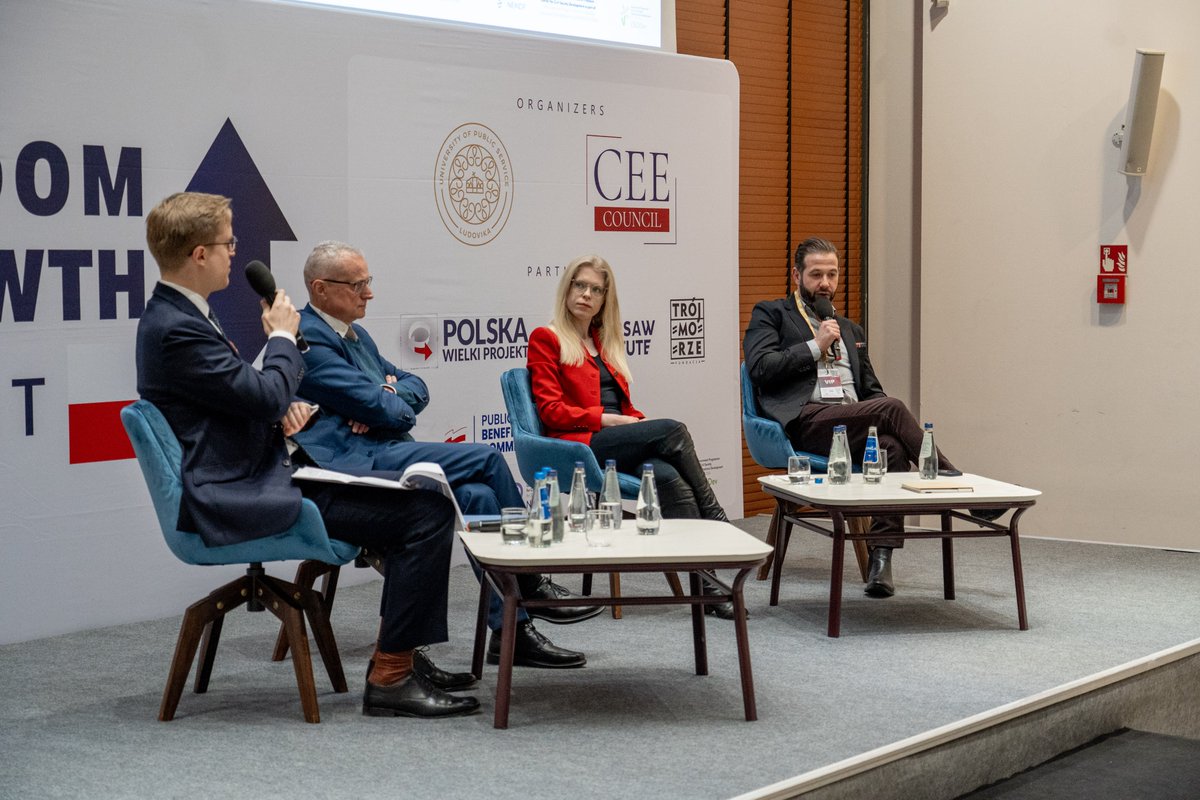
If you still haven’t seen the debates from the Freedom and Growth Summit 2025, here is the one regarding importance of transatlantic alliance.
https://t.co/ZDUrCSSquH
@georgephilipb@mmagierowski@AaronKorewa@AnnaRichards_PL
The British debate around Digital ID is not about data privacy - it's about the legacy of 19th-century UK voter reform, whose incremental nature once saved the UK from revolution, but is now strangling innovation.
This week on the blog, @AnnaRichards_PL delves into an unconsidered outcome of leaving the ECHR. Read it now at: https://t.co/rkAt8M21N1. #ECHR#Privacy
@Arrogance_0024 Think about this for a second: Russia respects China, the all-time master of quiet and non-reactive long-term strategy building. So you think the best way to get them to respect Poland is to be... the opposite of that?
Keep calm and carry on. It is not in Poland's interests to go to war now. Our economy just hit $1 trillion, we got approved for a 43 billion Eur defence loan, and NATO allies have our backs. We need discipline, patience & faith: in our allies, but more importantly, in ourselves