🐋 THE WHALES ARE BACK, and this is not a drill! We REPEAT, THE WHALES ARE BACK! 🌊🐋
📍 Every year, from May to November, Southern Right and Humpback whales make their way along South Africa’s coastline. 🌍
🎥 by IG sharynhodges
Scientists have developed VIZZ, a new prescription eye drop that can temporarily restore clear near vision, offering an alternative to reading glasses for many people.
VIZZ is designed specifically for presbyopia, the common age-related condition that makes it difficult to focus on nearby objects (such as phones, books, or menus). The once-daily drops work by gently constricting the pupil, which enhances depth of focus and improves near vision.
The U.S. FDA approved VIZZ in August 2025. Its effects typically last up to 10 hours, making it a convenient option for daily use. This breakthrough could benefit more than 120 million Americans with presbyopia, along with millions more worldwide.
While VIZZ is not a permanent cure, it represents a significant advancement in non-invasive vision correction. Users can read, use their phones, or work on computers more comfortably without constantly reaching for glasses.
As with any medication, it should be used under the guidance of an eye care professional to ensure safety and best results.
Imagine walking along a road in Costa Rica and encountering dozens of enormous lenses pointing at the forest... until you zoom in and discover this imposing winged guardian. 😂
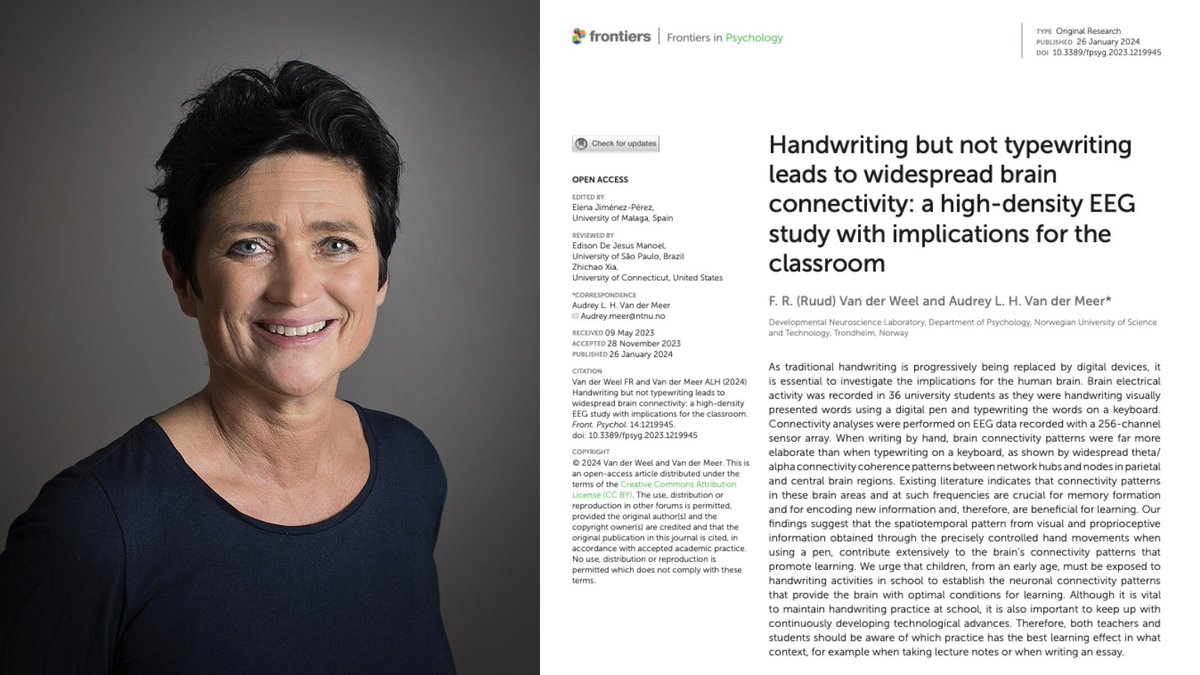
A Norwegian neuroscientist spent 20 years proving that the act of writing by hand changes the human brain in ways typing physically cannot, and almost nobody outside her field has read the paper.
Her name is Audrey van der Meer.
She runs a brain research lab in Trondheim, and the paper that closed the argument was published in 2024 in a journal called Frontiers in Psychology. The finding is brutal enough that it should have changed every classroom on Earth.
The experiment was simple. She recruited 36 university students and put each one in a cap with 256 sensors pressed against their scalp to record brain activity. Words flashed on a screen one at a time.
Sometimes the students wrote the word by hand on a touchscreen using a digital pen, and sometimes they typed the same word on a keyboard. Every neural response was recorded for the full five seconds the word stayed on screen.
Then her team looked at the part of the data most researchers had ignored for years, which is how different parts of the brain were communicating with each other during the task.
When the students wrote by hand, the brain lit up everywhere at once.
The regions responsible for memory, sensory integration, and the encoding of new information were all firing together in a coordinated pattern that spread across the entire cortex. The whole network was awake and connected.
When the same students typed the same word, that pattern collapsed almost completely.
Most of the brain went quiet, and the connections between regions that had been alive seconds earlier were nowhere to be found on the EEG.
Same word, same brain, same person, and two completely different neurological events.
The reason turned out to be something nobody had really paid attention to before her work. Writing by hand is not one motion but a sequence of thousands of tiny micro-movements coordinated with your eyes in real time, where each letter is a different shape that requires the brain to solve a slightly different spatial problem.
Your fingers, wrist, vision, and the parts of your brain that track position in space are all working together to produce one letter, then the next, then the next.
Typing throws all of that away. Every key on a keyboard requires the exact same finger motion regardless of which letter you are pressing, which means the brain has almost nothing to integrate and almost no problem to solve.
Van der Meer said it plainly in her interviews.
Pressing the same key with the same finger over and over does not stimulate the brain in any meaningful way, and she pointed out something that should scare every parent who handed their kid an iPad.
Children who learn to read and write on tablets often cannot tell letters like b and d apart, because they have never physically felt with their bodies what it takes to actually produce those letters on a page.
A decade before her, two researchers at Princeton ran the same fight using a completely different method and ended up at the same answer. Pam Mueller and Daniel Oppenheimer tested 327 students across three experiments, where half took notes on laptops with the internet disabled and half took notes by hand, before testing everyone on what they actually understood from the lectures they had watched.
The handwriting group won by a wide margin on every question that required real understanding rather than surface recall.
The reason was hiding in the transcripts of what the two groups had actually written down.
The laptop students typed almost word for word, capturing more total content but processing almost none of it as they went, while the handwriting students physically could not write fast enough to transcribe a lecture in real time, which forced them to listen carefully, decide what actually mattered, and put it in their own words on the page.
That single act of choosing what to keep was the learning itself, and the keyboard had quietly skipped the choosing and skipped the learning along with it.
Two studies. Two countries. Same answer.
Handwriting makes the brain work. Typing lets it coast.
Every note you have ever typed instead of written went into your brain through a thinner pipe. Every meeting, every book highlight, every idea you captured on your phone instead of on paper was processed at half depth.
You did not forget those things because your memory is bad. You forgot them because typing never woke the part of the brain that would have made them stick.
The fix is the thing your grandmother already knew.
Pick up a pen. Write the thing down. The slower road is the faster one.
Every year(ish), since 2009, we’ve been gathering and visualising billions mentioned in news headlines and reports. These gargantuan numbers often make little sense unless put in context and comparison with other billions. Here’s the latest 2026 edition.
interactive version
https://t.co/xBeJqajPJR
In a groundbreaking discovery, scientists have revealed that the heart contains its own “brain” made up of over 40,000 neurons. This incredible finding shows that the heart plays a much more significant role in our emotions, memory, and decision-making than previously thought. The neurons in the heart communicate directly with the brain, creating a powerful connection that influences not just physical function, but also mental and emotional states.
The heart’s neuronal network is capable of processing information and sending signals to the brain, impacting how we experience emotions and make decisions. This discovery challenges traditional views of brain function and opens up new possibilities for understanding how our emotions and memories are interconnected with our heart’s responses.
For years, we've known that emotions can affect the heart, but now, we know the heart also has the ability to shape our emotional and cognitive responses. This breakthrough is expected to lead to a deeper understanding of how the heart and brain interact, potentially paving the way for new treatments in emotional and mental health care.
«I believe that scientific knowledge has fractal properties, that no matter how much we learn, whatever is left, however small it may seem, is just as infinitely complex as the whole was to start with»
— Isaac Asimov (I Asimov, 1995)
The incredible DNA Repair System
DNA - and Life - cannot exist without it.
It requires 6-7 sub-systems working together + a massive complex network of 130–200+ unique proteins.
Simpler versions don't work.
Only Intelligence designs systems like this.