BROWDER: The fact that Putin is acknowledging problems, even talking about fuel crisis and all this kind of stuff, is unprecedented. In all time Putin has been in power, I’ve never seen him show this kind of weakness. It's significant and shows he's backed himself into a corner.
On a hot July day, a single mature tree in your yard pumps somewhere around 100 gallons of water up from its roots and out through its leaves as water vapor. A mature elm with 150,000 leaves can clear that in a day.
As that water evaporates off the leaf surface, it carries heat away with it, the same basic physics that makes sweat work. The air around the canopy drops measurably.
The cooling effect of a single large tree transpiring 100 gallons of water is roughly equivalent to two household air conditioning units running all day. Except it runs on sunlight and groundwater, costs nothing, and has been doing it since before your house was built.
A yard with mature canopy runs 5 to 10 degrees cooler than a paved or treeless yard next door. That's not a feeling. It's a physics difference you can measure with a thermometer. The urban heat island is real, and it gets worse one removed tree at a time.
The best time to plant a tree was twenty years ago. The second best time is this weekend, before another hot ass July like this one comes around.
Swiss farmers planted flowers between their crops and watched pest damage drop by over half. The UK is now running the same trial across 15 farms. The reason this works is embarrassingly simple.
A Swiss study on winter wheat found that fields with wildflower strips had 40 to 53% fewer leaf beetle pests than fields without. Crop damage dropped 61%.
The mechanism is simple. Wildflowers feed hoverflies, lacewings, parasitic wasps, ladybugs, and ground beetles. Those insects eat the aphids, beetle larvae, and caterpillars that farmers would otherwise spray for. A few meters of wildflowers hosts an unpaid pest control crew that would jump at the chance to whoop some aphid ass.
In apple orchards where no insecticides had been used for five years, plots with wildflower alleyways had 9.2% damaged fruit. Control plots without flowers had 32.5%.
The UK is now running a five-year trial across 15 farms placing 6-meter flower strips through the middle of fields, not just at the edges, because the beneficial insects can't reach the center of a large field otherwise.
This works the same way in a backyard vegetable garden as it does on a commercial farm. Plant native flowering species near your tomatoes, beans, and squash. The pests still show up, but the predators show up too.
Study doi: 20151369
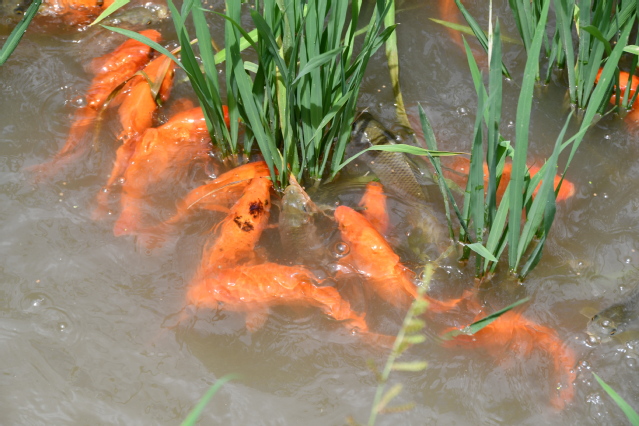
In one region of Indonesia, malaria rates dropped from 16.5% to nearly zero. The fix wasn't pharmaceutical. It was fish.
Farmers there raise fish directly in flooded rice paddies, a practice roughly 2,000 years old. The fish eat mosquito larvae before they mature, which is what crashed the malaria rate. They also eat insect pests and weeds in the rice itself, and their waste fertilizes the crop as they swim through it. The rice gives them shade and cover in return. One field, two harvests, and a public health outcome nobody was trying for.
The numbers hold up under modern scrutiny. Studies have found rice-fish systems use 68 percent less pesticide and 24 percent less fertilizer than conventional rice farming, with equal or higher rice yields. Same land, fewer chemical inputs, plus a second source of protein and income from fish that were already doing the pest control.
The Green Revolution pushed rice farming toward chemical monoculture, and practices like this nearly disappeared in the process. It's coming back because it never stopped working. A flooded field isn't a factory. It's an ecosystem, and apparently it can out-perform a malaria program too.
The rescue doggie Tsunami has officially found more than 350 people in Venezuela. He’s whipped. The exhaustion and
Tsunami’s effort are visible in his eyes. ❤️🇻🇪
A recent study has demonstrated that continuous exposure to rose essential oil through inhalation can lead to measurable increases in gray matter volume in the human brain.
In this randomized controlled intervention, 50 healthy women participated: 28 in the experimental group applied rose essential oil to their clothing daily for one month, while 22 in the control group used plain water. Before and after the period, researchers used magnetic resonance imaging (MRI) to assess changes in brain structure. The results indicated a significant increase in gray matter volume (GMV) across the whole brain, with a particularly notable effect in the posterior cingulate cortex (PCC)—a region involved in memory processing, self-referential thinking, and emotional regulation. No significant changes occurred in areas like the amygdala or orbitofrontal cortex.
The olfactory pathway likely explains this effect: aromatic compounds from the rose oil travel directly to the limbic system, providing sustained stimulation that may promote neuroplasticity and help counteract age-related brain atrophy. The authors suggest this could have implications for dementia prevention, as the PCC is among the regions affected early in conditions like Alzheimer's disease.
This appears to be the first evidence that prolonged scent inhalation can induce structural changes in the adult human brain.
[Kokubun, K., et al. (2024). Continuous inhalation of essential oil increases gray matter volume. Brain Research Bulletin, 208, 110896. DOI: 10.1016/j.brainresbull.2024.110896]








![Rainmaker1973's tweet photo. A recent study has demonstrated that continuous exposure to rose essential oil through inhalation can lead to measurable increases in gray matter volume in the human brain.
In this randomized controlled intervention, 50 healthy women participated: 28 in the experimental group applied rose essential oil to their clothing daily for one month, while 22 in the control group used plain water. Before and after the period, researchers used magnetic resonance imaging (MRI) to assess changes in brain structure. The results indicated a significant increase in gray matter volume (GMV) across the whole brain, with a particularly notable effect in the posterior cingulate cortex (PCC)—a region involved in memory processing, self-referential thinking, and emotional regulation. No significant changes occurred in areas like the amygdala or orbitofrontal cortex.
The olfactory pathway likely explains this effect: aromatic compounds from the rose oil travel directly to the limbic system, providing sustained stimulation that may promote neuroplasticity and help counteract age-related brain atrophy. The authors suggest this could have implications for dementia prevention, as the PCC is among the regions affected early in conditions like Alzheimer's disease.
This appears to be the first evidence that prolonged scent inhalation can induce structural changes in the adult human brain.
[Kokubun, K., et al. (2024). Continuous inhalation of essential oil increases gray matter volume. Brain Research Bulletin, 208, 110896. DOI: 10.1016/j.brainresbull.2024.110896]](https://pbs.twimg.com/media/HL-klRMWAAAQd9o.jpg)


