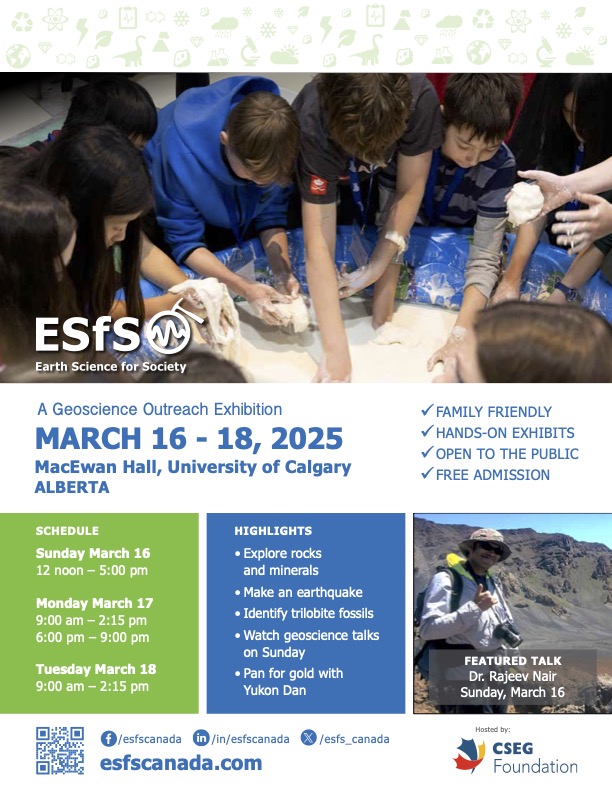
Volunteer for the 12th Earth Science for Society (ESfS) exhibition, an interactive geoscience outreach event!
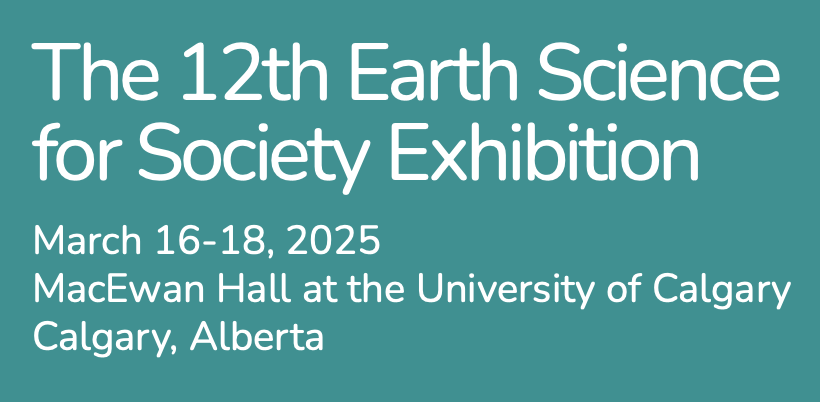
March 16-18 in MacEwan Hall @UCalgary
Join Yukon Dan, a popular exhibitor returning for #ESfS2025 and pan for gold!
https://t.co/MX7FDIRVJu
https://t.co/MEe9WTI0rj
It's our pleasure to announce that the updated earth science careers website is now LIVE!!
A proud collaboration with @can_geo_ed_network
Possible thanks to funding from Canadian Geological Foundation and Engineers & Geoscientists BC
Share widely!
https://t.co/sgtXAXYX9l
The 12th Earth Science for Society exhibition is March 16-18, 2025 @UCalgary
Sunday, Geo-Theatre Featured Talk:
Dr. Benjamin Tutolo is a Canadian leader in the field of geochemistry.
Topic: Exploring Martian Geology for Signs of the Potential for Life.
The 12th Earth Science for Society (ESfS) Geoscience Outreach Exhibition is March 16-18 @UCalgary
Explore rocks & minerals.
Make an earthquake!
Identify trilobite fossils.
Pan for gold with Yukon Dan.
#ESfS2025
open to the public, free.
family-friendly with hands-on exhibits.
Join researcher Tara Hayden on the Artemis II geology training in Labrador and see how Moon rocks could unlock the secrets of water on the lunar surface!
Astophotographer Nick Kuzmin captures the aurora over the CMT dome at the RAO. Our Milky Way Nights event was a great success, thanks to clear skies and beautiful aurora on Friday night.
#ESfS2025 exhibit registration is OPEN!
March 16-18 @UCalgary
Hosted by @csegonline Foundation
#YYC#Geoscience outreach
Beat the rush, visit our website for exhibitor/sponsor brochure and application form:
https://t.co/yDEhWrAGQp
The Perseids is one of the best meteor showers to observe, producing up to 60 meteors per hour at its peak. It peaks this year on the night of August 11 and the morning of August 12. Meteors will radiate from the constellation Perseus, but can appear anywhere in the sky.
Landslides in the Fraser Canyon and most recently on the Chilcotin River have occurred in vital salmon habitat 🌲 Hakai researchers are trying to understand the aftermath of these events. Learn more about the tricky work of mapping riverine landslides 🔗 https://t.co/7G6gSiGUqm
Here’s an elevation change map of the Chilcotin landslide using pre and post event lidar. Estimated volume about 6x10^6 m^3. Map and comparison by @HakaiInstitute, flown by KÎSIK, data GeoBC
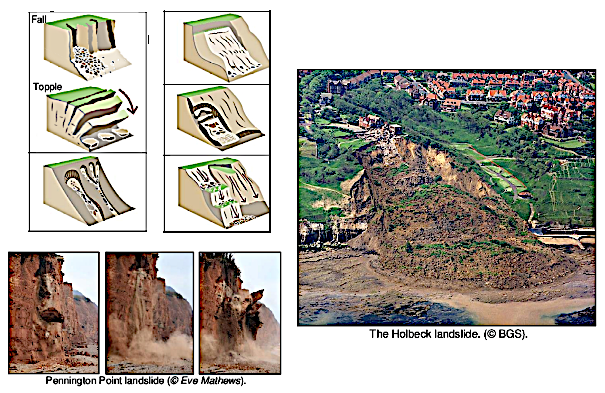
In view of the recent fatal landslide in Nepal, today, the ELI Team is publishing "Landslide danger – and climate change; case studies of how landslides work and the likely effects of climate change."
Free download: https://t.co/zwIOd8C2jm
1/🧵Check out this animation of one of yesterday’s offshore #earthquake that occurred over 400km west of #Victoria – ONC’s land+sea seismic network provided more than 1 min of notification of minor ground shaking to subscribers.
@uvic
As we gear up for #ESfS2025 we are looking for enthusiastic geoscientists who are passionate about sharing their knowledge with the youth and public who attend this popular Earth science event!
Dromaeosaurus albertensis, the new raptor in the UBC's Earth Sciences Building, is one of the rarest theropods from the American west 🦖
They are closely related to Velociraptor but significantly larger!
School's out but the fun with hands-on learning doesn't have to stop! 🚀
Check out our space activities and STEM resources all summer long: https://t.co/UokPuhSW9p
The Earth Science for Society committee believes that increased science literacy is essential for the students of today as they are the decision-makers of tomorrow and the future caretakers of the Earth.
Save-the-Date for #ESfS2025#YYC#Geoscience
https://t.co/03brR4QHdZ
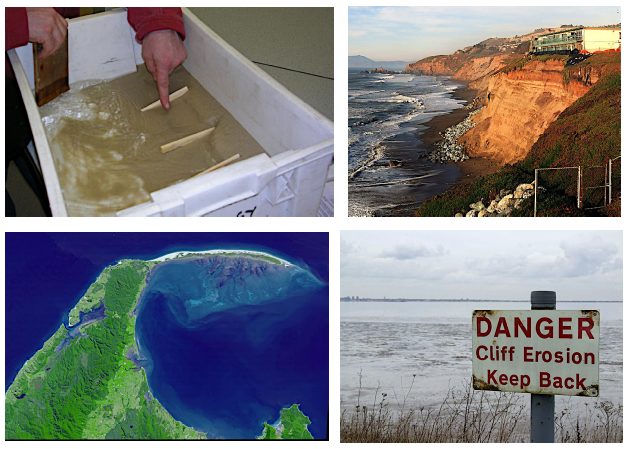
'Changing coastlines; investigating how wave erosion, transportation and deposition can change the shapes of coastlines'.
Free download: https://t.co/zwIOd8C2jm
#FossilFriday This bulge in the rock is a dinosaur footprint cast, created from sediment infilling the print and then turning to stone over millions of years. This exciting find was discovered by museum staff on a recent rafting trip along the Wapiti River.
Here at @NASA, we don’t take geology for granite.
Enjoy this rock-solid episode of Surprisingly STEM and learn how exploration geologist Angela Garcia is training @NASA_Astronauts to explore for the crater good of humanity.