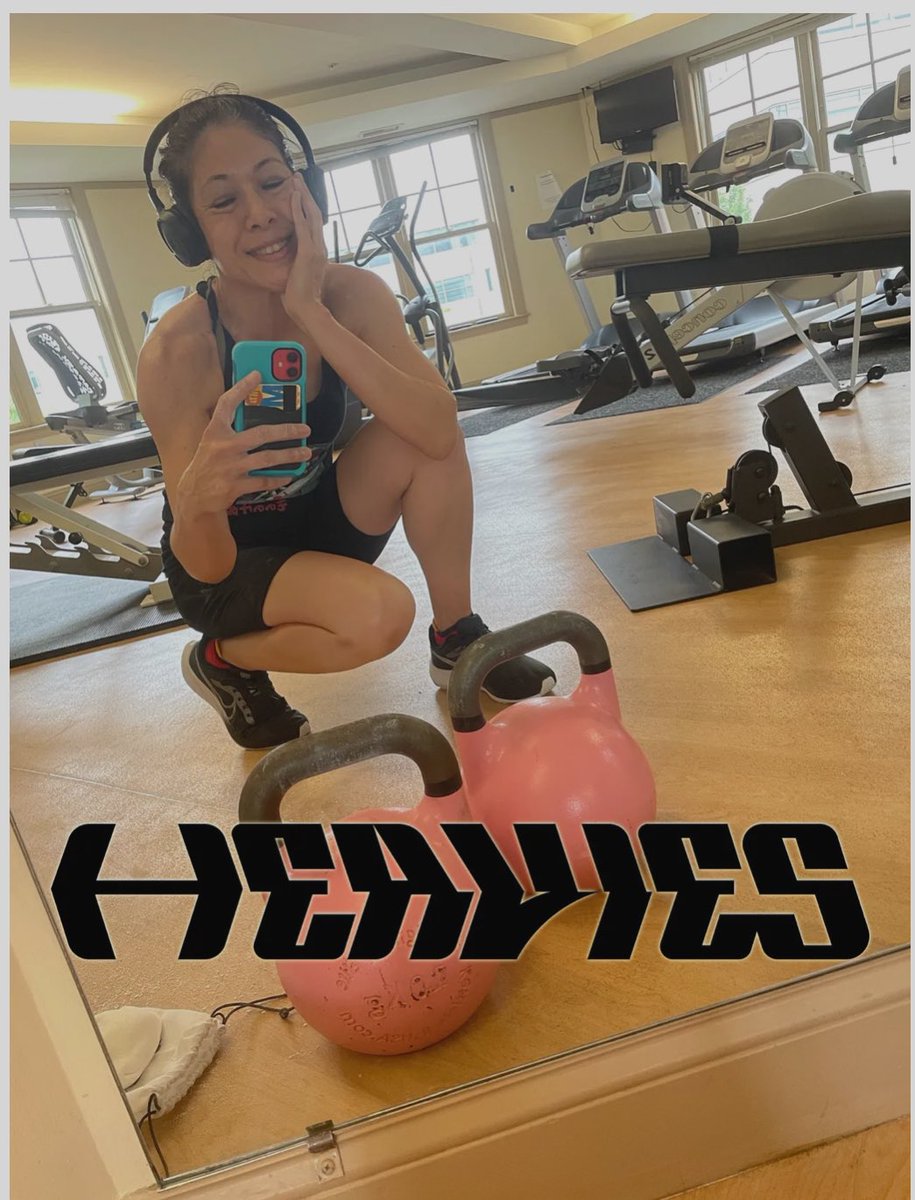
I rarely get to talk about the topics that I actually spend the most time thinking about - teaching, strength, aging, embodied knowledge. So grateful to superstar journalist @chrisgayomali for this interview - and subscribe to his Substack, Heavies! https://t.co/1ONIlJRY4z
@MyShtender@gamzeyaavor Ha! I originally wanted to include an image of the recipe with the essay so got a copy from his wife & realized this too—adds a fun twist; even in his bookish turn, ever the storyteller :)
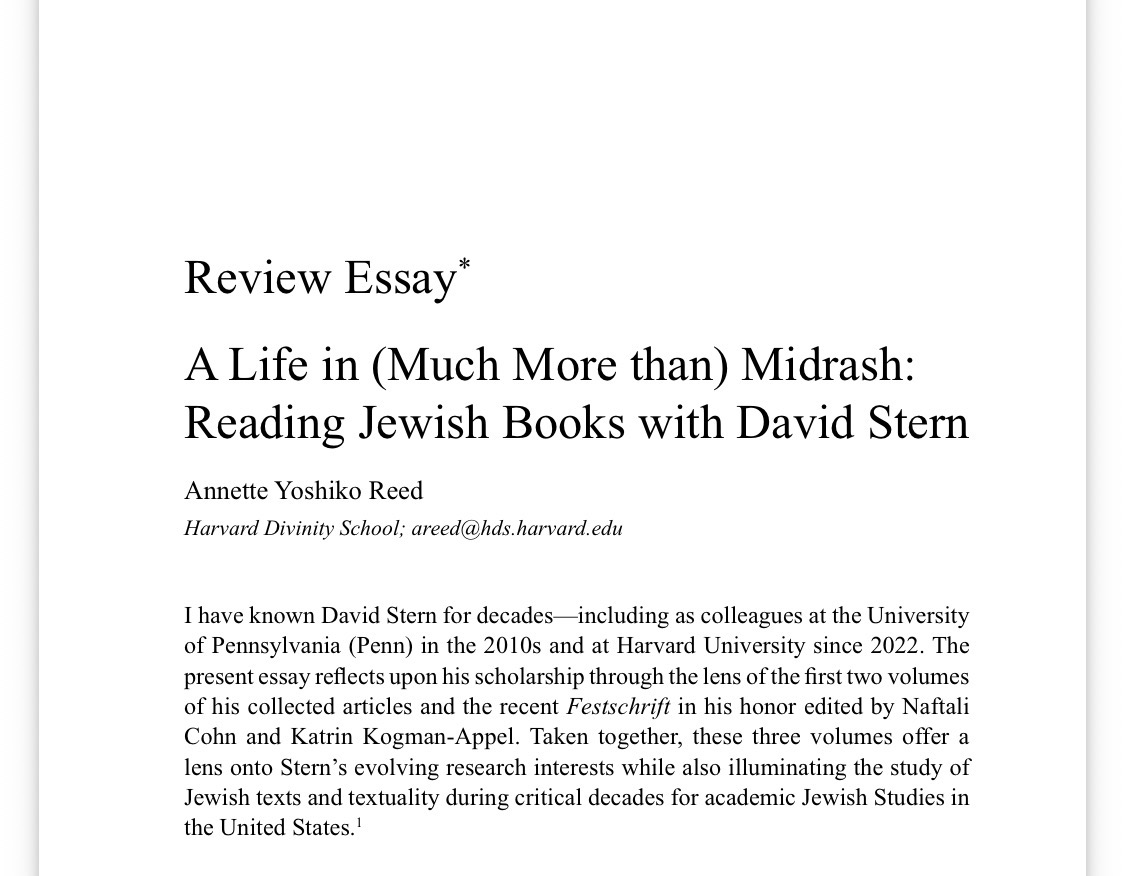
Just out in newest Harvard Theological Review—my essay reflecting on the scholarship of David Stern, my Jewish Studies colleague at Penn and now Harvard
Interestingly, the recipe as published is titled simply “David’s Cholent,” not “David’s Erotic Cholent,” in *By Special Request*, in Rochelle R. Isserow, ed. (Brookline, 1978), 183-185, where the adjective erotic appears only in the introductory essay, in which the author remarks that cholent without the requisite long, slow Sabbath cooking “ceases to be cholent, and becomes merely another erotic, ethnic dish”; it does not appear in the recipe’s title. The recipe itself, alongside many of his other writings, is available on his Academia page (https://t.co/g5udghjCvM). A fitting reminder, perhaps, that attention to the material text can sometimes complicate even the best stories about it, @AnnetteYReed (and cc: @yitzlandes).
@gamzeyaavor With many thanks for the push & conversation, I figured out a workaround--I submitted the penultimate copy of that HTR piece to our Harvard depository so I can legally circulate this version to anyone w/no paywall! See PDF link on the left of this page: https://t.co/eeO3ZVKAr9
Just out in newest Harvard Theological Review—my essay reflecting on the scholarship of David Stern, my Jewish Studies colleague at Penn and now Harvard
@gamzeyaavor That's amazing--and actually makes a lot of sense in retrospect. I re-read VALIS a lot but never got around to Exegesis (just ordered though; thanks!)
@gamzeyaavor As per PKD, the system makes it difficult to make choices that honor our human relationships--in this case, between teachers and students, writers and readers...
@gamzeyaavor You are totally right. I should have pushed to make it Open Access but didn’t think in the rush to squeeze into the spring issue—i.e. to coincide with David’s last semester teaching (☹️). But that does take away from disseminating a piece that honors him…
@gamzeyaavor As a university-based journal, this one supports many of our students who work in its editing and thus gain the experience too—so in this case, I’m hesitant. That said, point well taken, and I’ll think about it…
@samhaselby ICYMI Shaul Magid has drawn upon concepts from Afro-pessimism to analyze the thought of Meir Kahane, e.g. https://t.co/lDkMBQZb1X + in more detail https://t.co/CF8Sm7JTgi
Open Call for Fellows: @PRRIpoll seeks applicants to join a diverse cohort of 9 non-residential Public Fellows who are engaged in public scholarship at the intersection of #Religion, #Culture, & #Politics. Stipend included. Apply by June 19, 2026. https://t.co/TJWeO28Tf6
https://t.co/CKfBlaH73n
ON SALE NOW! What is the Talmud? The State of the Question: The Proceedings of a Conference at Harvard University
The CJS and the Julis-Rabinowitz Program on Jewish and Israeli Law are excited to announce this new publication.
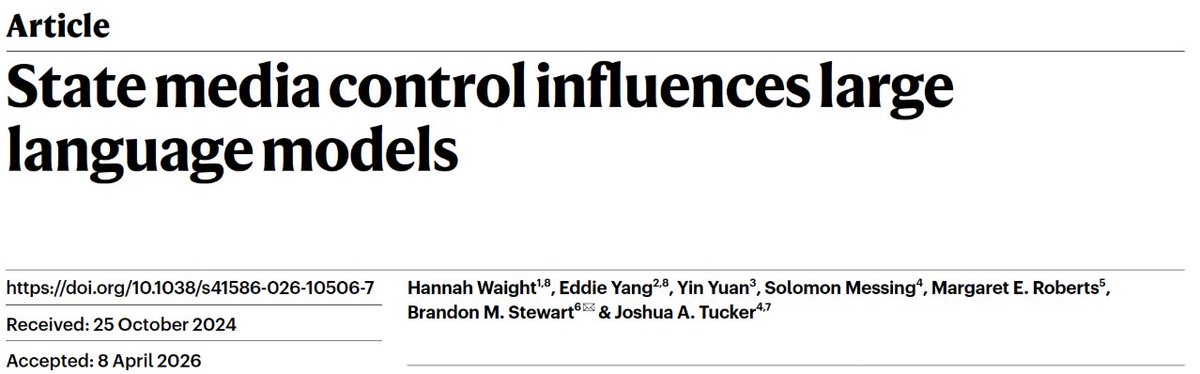
1/ New @Nature! We study how powerful institutions shape the information environment for LLMs. Commercial LLM training is opaque, so we trace a path from state-coordinated media -> training data -> model responses.
New paper in Nature. The more a government controls its domestic media, the more it dominates AI training data, the more pro-regime outputs we get from AI. By scraping the open web, LLMs are unwittingly laundering state-coordinated narratives into seemingly objective answers.
Department of Classics at the Faculty of Arts and Humanities, University of Salzburg Tenure Track Position “Jewish Studies”, deadline for applications: 27th May 2026
https://t.co/L0uVkSUi2s