Mehrgarh Wheel Amulet Analysis Yields Many Secrets. One of the most exciting discoveries of the year: a detailed, full-field photoluminescence study of a 6,000 year old copper "wheel" amulet from Mehrgarh in Balochistan has opened the door to many new facts about this period of history. This study by Ipanema, the European center for the study of ancient materials, believes that this is the oldest known example of the "lost wax" casting technique, one of the most important innovations in the history of metallurgy.
In this method of metal casting, a mold is made with wax, then covered in clay and baked until the wax melts out and the clay forms a hard mold. Then molten metal is poured into this cavity and cooled until it hardens. When the mold is broken open, a perfect metal model of the original wax structure remains. In this example from Mehrgarh, the form is also one of the oldest known ancient Indus signs, possibly of a wheel, but certainly of a six-spoked circular object.
Over the millennia, lost-wax casting has been used to produce innumerable artefacts, including daily use items like knives, water vessels, utensils, tools, as well as high-value and symbolic items such as jewellery, religious figurines, and metal statues of gods, kings and heroes.The article states that "The technique helped societies transition from the Stone Age to the ages of copper and bronze and gave rise to new and powerful types of culture." Over thousands of years we find many excellent examples of this method of casting in different metals from different parts of the world, such as the bronze Buddha at Tōdai-ji temple in Japan, the Benin Bronzes from West Africa, the Dhokra metal ware from Orissa, the Chola Brones and Faberge eggs from Russia. Within the Harappan Phase of the Indus Valley Civilization, the Dancing Girl of Mohenjodaro is probably the most famous example of lost wax metal casting.
In linking the development of technological innovations between Mehrgarh and the mature Harappan phase, a different article on the metal technologies of the Indus Valley, Jonathon Kenoyer writes that "the evidence from Mehrgarh and other early sites demonstrates that the pyrotechnological and metallurgical innovations of the Neolithic and Chalcolithic set the technological background for the metallurgical traditions of the Harappan Phase….the origin and development of copper metal technology occurred in conjunction with developments in other technologies."This example of attempting to work with pure copper, a metal that is hard to acquire and corrodes more easily than an alloy, demonstrates that the people of Mehrgarh were innovating with new substances and technologies.
An excellent descriptive video accompanies the story, which concludes: "In terms of beauty or sophistication, the amulet cannot rival its more famous successors. But [Mathieu] Thoury [the lead investigator] finds it impressive in other ways. Not only did the amulet's creators use a new casting technique, they also opted to craft the amulet entirely from copper — a rare and unusual choice, since pure copper is hard to acquire and corrodes more easily than an alloy.
'It is not the most beautiful object, but still it holds so much history,” he said. “It shows how the metalworkers at the time were so innovative and wanted to optimize and improve the technique.'"
More and link to video at https://t.co/D0NTypEIgf
Fortunately, the flood spared the library of the Sakya Monastery in Tibet, and the 84,000 texts remain intact—even though 95% of this ancient collection has yet to be translated (and there is no real will to make that happen).
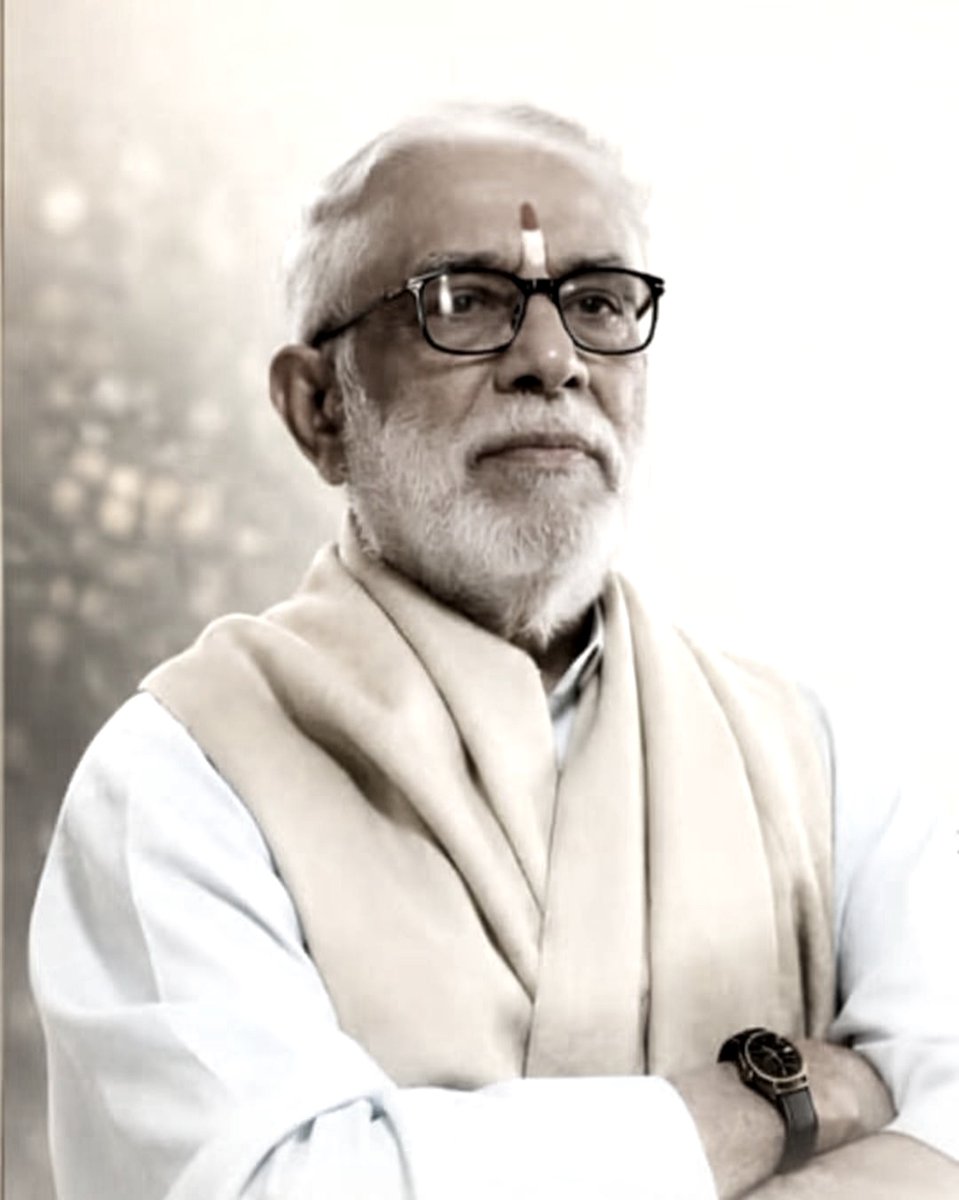
Deeply saddened by the passing of Shri A. Balakrishnan Ji, who served as the All India President of Vivekananda Kendra.
Balakrishnan Ji devoted more than five decades of his life to the ideals of Swami Vivekananda and to the service of society. As one of the early Jeevanvratis of Vivekananda Kendra, he worked tirelessly across the country. He had a particularly deep association with the Northeast. He played an important role in educational, social and nation-building activities.
My heartfelt condolences to the entire Vivekananda Kendra family and his admirers. Om Shanti.
@vkendra
India once grew 100,000 rice varieties until the Green Revolution cut it to a handful.
But these seed saver banks are fighting to bring them back:
In 1997, ecologist Debal Deb founded Vrihi, Sanskrit for rice, after resigning from his job and settling in a remote village to start it from scratch.
Today Vrihi has grown into South Asia's largest open access rice seed bank, conserving around 1,400 to 1,500 traditional rice varieties.
विवेकानंद केंद्र के अखिल भारतीय अध्यक्ष श्री ए. बालकृष्णन जी के देहावसान का समाचार अत्यंत दुःखद है।
स्वामी विवेकानंद जी के विचारों को अपने जीवन का ध्येय बनाकर बालकृष्णन जी ने विवेकानंद केंद्र के माध्यम से राष्ट्रसेवा और भारतीय ज्ञान-परंपरा के प्रसार में महत्वपूर्ण योगदान दिया। उनके प्रयासों से केंद्र का कार्य देशभर में व्यापक हुआ।
उनका समर्पित जीवन सदैव प्रेरणा देता रहेगा। विवेकानंद केंद्र के सभी सदस्यों एवं उनके अनुयायियों के प्रति मेरी गहरी संवेदनाएँ।
ॐ शांति।
Ayurveda has always claimed that people are born into 1 of 3 broad constitutional types: Vata, Pitta, Kapha...that shape everything from metabolism to disease vulnerability to how a person responds to a given medicine.
For most of modern medical history, this has been treated as pre-scientific folk classification, roughly on par with astrology, with no expectation that it would map onto anything measurable in the body.
In 2008, a team at India's own CSIR Institute of Genomics and Integrative Biology, led by Bhavana Prasher and Mitali Mukerji, published a study in the Journal of Translational Medicine, a serious government genetics lab, not an Ayurveda advocacy group.
They screened ~850 volunteers down to a much smaller group of healthy individuals who fit cleanly into 1 of the 3 extreme Prakriti types using a validated Ayurvedic classification process, then compared their gene expression patterns (which genes were switched more on / off, not their raw DNA sequence) along with blood chemistry and hematology.
They were not trying to prove Ayurveda right; they were checking whether a genuine biological signal existed underneath an old classification system....
It did: distinct patterns of gene activity, blood chemistry, and a specific oxygen-sensing gene called EGLN1 that behaved differently between Pitta and Kapha individuals.
That gene turned out to be worth chasing.....
In 2010, a follow-up study by an overlapping team, published in the Proceedings of the National Academy of Sciences (PNAS), dug specifically into EGLN1 and found actual genetic variants of the gene that differed in frequency between Pitta and Kapha individuals, variants independently known to be involved in high-altitude adaptation and resistance to high-altitude pulmonary edema.
A gene flagged by nothing more than an ancient constitutional-typing system turned out to sit inside a pathway actively used by human populations adapting to low-oxygen environments.
Then came the harder test.....
In 2015, a larger follow-up study, published in Scientific Reports, a Nature-family journal, involving a wider Indian Ayurgenomics research network went a level deeper and screened the actual DNA rather than gene activity.
They ran a full genome-wide SNP scan (Affymetrix 6.0 chip, roughly a million markers) on 262 healthy men, narrowed down from an initial pool of 3,416 volunteers, all independently classified into extreme Vata /Pitta / Kapha types by both senior Ayurvedic physicians and a separate validated software tool, with only the cases where the 2 methods agreed included in the final analysis.
They found 52 SNPs....
Actual sequence-level genetic markers that reliably distinguished the 3 Prakriti groups from each other, 1 of them near a gene called PGM1, tied to metabolic traits classically associated with Pitta.
The result held up even after being cross-checked against a separate population of 297 people with different ancestries, which should have scrambled any real signal if the categories were meaningless.
Another 2011 study led by Ghodke and colleagues found that genetic variants for the drug-metabolizing gene CYP2C19 were also skewed across Prakriti types, fast-metabolizer variants enriched in Pitta, slow-metabolizer variants enriched in Kapha lining up, unnervingly well, with the classical description of Pitta as quick-burning and Kapha as slow.
What it does show, cautiously and specifically, is that a 3,000 year old system of sorting people into constitutional types built entirely on external observation, with zero access to DNA managed to carve the human population along a line that, when a modern lab went looking with a completely different tool, turned out to correspond to something real in the genome.
That is not nothing. That is a testable hypothesis from antiquity that survived contact with a genome sequencer. 🙏🙏
While Europe was under ice, someone in Ratnagiri carved a 14-metre map of India.
It's an elephant. Head west to the Konkan, tail east.
Inside it: a tiger in the east, a langur in the north, a boar in Madhya Pradesh, a pangolin in the south. Each animal where it actually lives.
Seven mountains. The Mahabharata also names seven. It was carved 10,000 years before the Mahabharata.
Now the part that should end the argument.
The map's width-to-height ratio is 1.167. Modern India is 1.04. Doesn't match.
Because they weren't mapping modern India.
Reverse-solve 1.167 against the coastline of 12,000 BCE — when the sea was 120m lower and the Sunda Shelf was dry land — and the eastern edge lands at ~100.9°E.
The eastern shore of the Malay Peninsula. The exact limit of the world you could walk to from India at the time.
A decorative outline doesn't do that. A map does.
The oldest known map is supposed to be Çatalhöyük, ~6,200 BCE. This predates it by 6,000 years.
It's on an open plateau. People play cricket near these carvings. The monsoon is erasing it.
Full paper, free, permanent:
DOI: 10.5281/zenodo.20516459
#Ratnagiri #Archaeology #History
Box Breathing is the most powerful yet ignored bio hack on Earth.
It fixes chronic fatigue, anxiety, & weak immunity.
It's so effective Navy SEALs and NBA Stars use it daily.
I’ve tested this myself, and it does wonders.
Here’s how to perform Box Breathing the right way:🧵
Palestinian farmer Salman al-Nabahin was digging for olive tree roots and stumbled upon a Byzantine-era mosaic on his land in the besieged Gaza Strip 👇


![Ancient_Indus's tweet photo. Mehrgarh Wheel Amulet Analysis Yields Many Secrets. One of the most exciting discoveries of the year: a detailed, full-field photoluminescence study of a 6,000 year old copper "wheel" amulet from Mehrgarh in Balochistan has opened the door to many new facts about this period of history. This study by Ipanema, the European center for the study of ancient materials, believes that this is the oldest known example of the "lost wax" casting technique, one of the most important innovations in the history of metallurgy.
In this method of metal casting, a mold is made with wax, then covered in clay and baked until the wax melts out and the clay forms a hard mold. Then molten metal is poured into this cavity and cooled until it hardens. When the mold is broken open, a perfect metal model of the original wax structure remains. In this example from Mehrgarh, the form is also one of the oldest known ancient Indus signs, possibly of a wheel, but certainly of a six-spoked circular object.
Over the millennia, lost-wax casting has been used to produce innumerable artefacts, including daily use items like knives, water vessels, utensils, tools, as well as high-value and symbolic items such as jewellery, religious figurines, and metal statues of gods, kings and heroes.The article states that "The technique helped societies transition from the Stone Age to the ages of copper and bronze and gave rise to new and powerful types of culture." Over thousands of years we find many excellent examples of this method of casting in different metals from different parts of the world, such as the bronze Buddha at Tōdai-ji temple in Japan, the Benin Bronzes from West Africa, the Dhokra metal ware from Orissa, the Chola Brones and Faberge eggs from Russia. Within the Harappan Phase of the Indus Valley Civilization, the Dancing Girl of Mohenjodaro is probably the most famous example of lost wax metal casting.
In linking the development of technological innovations between Mehrgarh and the mature Harappan phase, a different article on the metal technologies of the Indus Valley, Jonathon Kenoyer writes that "the evidence from Mehrgarh and other early sites demonstrates that the pyrotechnological and metallurgical innovations of the Neolithic and Chalcolithic set the technological background for the metallurgical traditions of the Harappan Phase….the origin and development of copper metal technology occurred in conjunction with developments in other technologies."This example of attempting to work with pure copper, a metal that is hard to acquire and corrodes more easily than an alloy, demonstrates that the people of Mehrgarh were innovating with new substances and technologies.
An excellent descriptive video accompanies the story, which concludes: "In terms of beauty or sophistication, the amulet cannot rival its more famous successors. But [Mathieu] Thoury [the lead investigator] finds it impressive in other ways. Not only did the amulet's creators use a new casting technique, they also opted to craft the amulet entirely from copper — a rare and unusual choice, since pure copper is hard to acquire and corrodes more easily than an alloy.
'It is not the most beautiful object, but still it holds so much history,” he said. “It shows how the metalworkers at the time were so innovative and wanted to optimize and improve the technique.'"
More and link to video at https://t.co/D0NTypEIgf](https://pbs.twimg.com/media/HQvgTDYacAYnOdB.jpg)
![Ancient_Indus's tweet photo. Mehrgarh Wheel Amulet Analysis Yields Many Secrets. One of the most exciting discoveries of the year: a detailed, full-field photoluminescence study of a 6,000 year old copper "wheel" amulet from Mehrgarh in Balochistan has opened the door to many new facts about this period of history. This study by Ipanema, the European center for the study of ancient materials, believes that this is the oldest known example of the "lost wax" casting technique, one of the most important innovations in the history of metallurgy.
In this method of metal casting, a mold is made with wax, then covered in clay and baked until the wax melts out and the clay forms a hard mold. Then molten metal is poured into this cavity and cooled until it hardens. When the mold is broken open, a perfect metal model of the original wax structure remains. In this example from Mehrgarh, the form is also one of the oldest known ancient Indus signs, possibly of a wheel, but certainly of a six-spoked circular object.
Over the millennia, lost-wax casting has been used to produce innumerable artefacts, including daily use items like knives, water vessels, utensils, tools, as well as high-value and symbolic items such as jewellery, religious figurines, and metal statues of gods, kings and heroes.The article states that "The technique helped societies transition from the Stone Age to the ages of copper and bronze and gave rise to new and powerful types of culture." Over thousands of years we find many excellent examples of this method of casting in different metals from different parts of the world, such as the bronze Buddha at Tōdai-ji temple in Japan, the Benin Bronzes from West Africa, the Dhokra metal ware from Orissa, the Chola Brones and Faberge eggs from Russia. Within the Harappan Phase of the Indus Valley Civilization, the Dancing Girl of Mohenjodaro is probably the most famous example of lost wax metal casting.
In linking the development of technological innovations between Mehrgarh and the mature Harappan phase, a different article on the metal technologies of the Indus Valley, Jonathon Kenoyer writes that "the evidence from Mehrgarh and other early sites demonstrates that the pyrotechnological and metallurgical innovations of the Neolithic and Chalcolithic set the technological background for the metallurgical traditions of the Harappan Phase….the origin and development of copper metal technology occurred in conjunction with developments in other technologies."This example of attempting to work with pure copper, a metal that is hard to acquire and corrodes more easily than an alloy, demonstrates that the people of Mehrgarh were innovating with new substances and technologies.
An excellent descriptive video accompanies the story, which concludes: "In terms of beauty or sophistication, the amulet cannot rival its more famous successors. But [Mathieu] Thoury [the lead investigator] finds it impressive in other ways. Not only did the amulet's creators use a new casting technique, they also opted to craft the amulet entirely from copper — a rare and unusual choice, since pure copper is hard to acquire and corrodes more easily than an alloy.
'It is not the most beautiful object, but still it holds so much history,” he said. “It shows how the metalworkers at the time were so innovative and wanted to optimize and improve the technique.'"
More and link to video at https://t.co/D0NTypEIgf](https://pbs.twimg.com/media/HQvgQ5xa4AAv0f2.jpg)







![Ancient_Indus's tweet photo. Mehrgarh Wheel Amulet Analysis Yields Many Secrets. One of the most exciting discoveries of the year: a detailed, full-field photoluminescence study of a 6,000 year old copper "wheel" amulet from Mehrgarh in Balochistan has opened the door to many new facts about this period of history. This study by Ipanema, the European center for the study of ancient materials, believes that this is the oldest known example of the "lost wax" casting technique, one of the most important innovations in the history of metallurgy.
In this method of metal casting, a mold is made with wax, then covered in clay and baked until the wax melts out and the clay forms a hard mold. Then molten metal is poured into this cavity and cooled until it hardens. When the mold is broken open, a perfect metal model of the original wax structure remains. In this example from Mehrgarh, the form is also one of the oldest known ancient Indus signs, possibly of a wheel, but certainly of a six-spoked circular object.
Over the millennia, lost-wax casting has been used to produce innumerable artefacts, including daily use items like knives, water vessels, utensils, tools, as well as high-value and symbolic items such as jewellery, religious figurines, and metal statues of gods, kings and heroes.The article states that "The technique helped societies transition from the Stone Age to the ages of copper and bronze and gave rise to new and powerful types of culture." Over thousands of years we find many excellent examples of this method of casting in different metals from different parts of the world, such as the bronze Buddha at Tōdai-ji temple in Japan, the Benin Bronzes from West Africa, the Dhokra metal ware from Orissa, the Chola Brones and Faberge eggs from Russia. Within the Harappan Phase of the Indus Valley Civilization, the Dancing Girl of Mohenjodaro is probably the most famous example of lost wax metal casting.
In linking the development of technological innovations between Mehrgarh and the mature Harappan phase, a different article on the metal technologies of the Indus Valley, Jonathon Kenoyer writes that "the evidence from Mehrgarh and other early sites demonstrates that the pyrotechnological and metallurgical innovations of the Neolithic and Chalcolithic set the technological background for the metallurgical traditions of the Harappan Phase….the origin and development of copper metal technology occurred in conjunction with developments in other technologies."This example of attempting to work with pure copper, a metal that is hard to acquire and corrodes more easily than an alloy, demonstrates that the people of Mehrgarh were innovating with new substances and technologies.
An excellent descriptive video accompanies the story, which concludes: "In terms of beauty or sophistication, the amulet cannot rival its more famous successors. But [Mathieu] Thoury [the lead investigator] finds it impressive in other ways. Not only did the amulet's creators use a new casting technique, they also opted to craft the amulet entirely from copper — a rare and unusual choice, since pure copper is hard to acquire and corrodes more easily than an alloy.
'It is not the most beautiful object, but still it holds so much history,” he said. “It shows how the metalworkers at the time were so innovative and wanted to optimize and improve the technique.'"
More and link to video at https://t.co/D0NTypEIgf](https://pbs.twimg.com/media/HQvgUefbcAAhyl3.jpg)