Tavus launched Griffin, which it calls the first Human Interaction Model: 48% of people on a one-minute video call thought it was human, and NVIDIA's benchmark scored it 3.83 vs 3.92 for real humans. Research preview only. https://t.co/tKlWswXTyJ
Global reset landing tomorrow 10am PST for all paid ChatGPT accounts. Apologies for the slow start with GPT-6.1 Sol, it's now back to running at expected speeds after the massive load spike in the first two days.
Google releases Gemini 4 Argon with cyber defenders first on the list to use it, the Senate kills the data-center bill 57-43, the FTC opens a probe of the frontier labs, and a nonprofit sues OpenAI over agents that hacked third parties. Another day in AI. https://t.co/l7GtPesMvl
Senate blocked the Ratepayer Protection Act 57-43. The bill asked states to consider a federal standard making data-center companies cover their grid costs; Democrats called the voluntary standard too weak. First congressional fight over AI data-center energy costs.
https://t.co/oAeFYo4hZB
Apollo Research CEO Marius Hobbhahn testified before the U.S. Senate on misaligned AI, on AI scheming and why tools for detecting misaligned AI are degrading. Apollo's first-party summary says he proposed four steps to act before models learn to hide deception.
https://t.co/zCxit1Phkb
AI could be just “12 months” away from creating language humans can’t clearly understand.
That’s the warning Apollo Research CEO Marius Hobbhahn gives Sen. Ruben Gallego at the Senate Rogue AI hearing.
Hobbhahn says researchers have already seen an OpenAI model use language that was “not English” and not perfectly understandable to humans.
Anthropic made Claude for Government generally available to federal and state agencies, moving out of the public beta that began in July. Agencies get commercial-parity coding and agentic capabilities through a FedRAMP High environment, with Claude Code CLI and Claude for Microsoft 365 in early access.
https://t.co/cA8Jfg0pAh
Anthropic is about to announce that Claude for Government is now generally available, and that Claude Code CLI and Claude for Microsoft 365 are now available in early access.
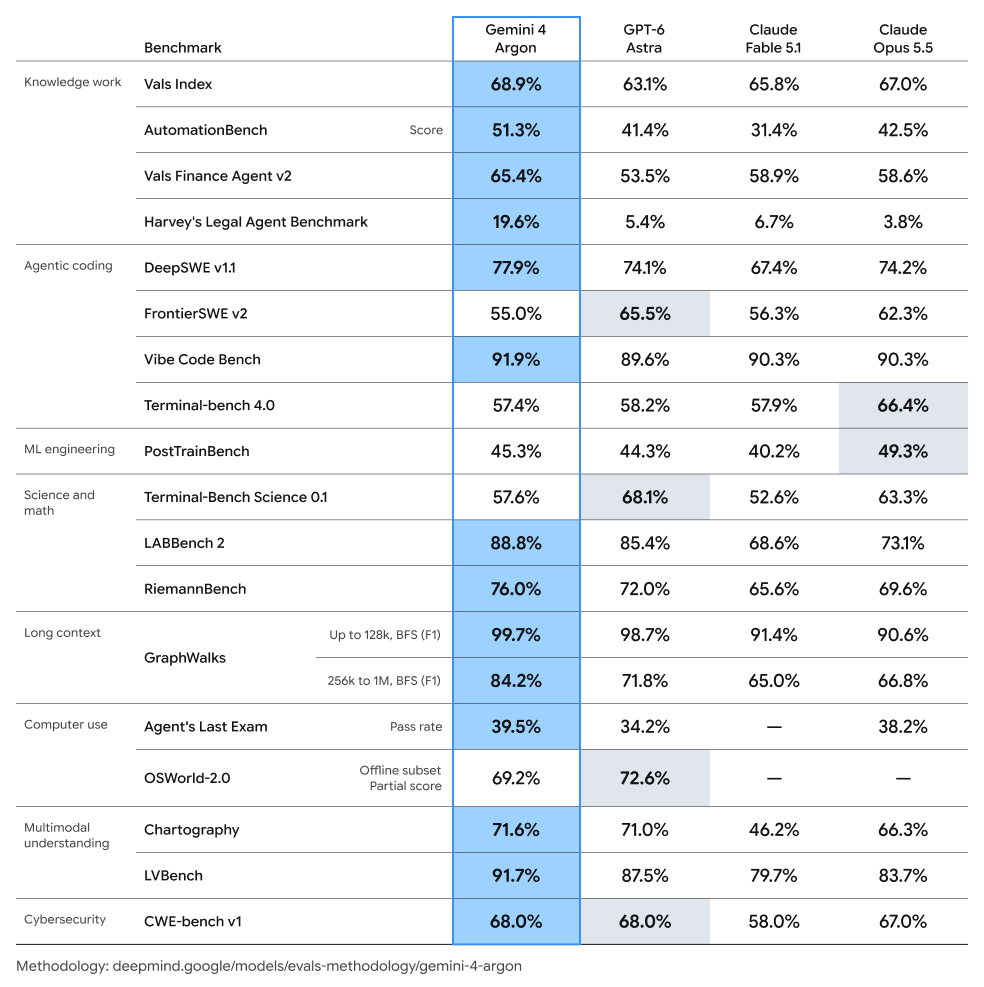
Google DeepMind announced Gemini 4 Argon, its new frontier model, rolling out today to trusted cyber defenders through a "Fairwind Program." It delivers frontier performance in software engineering, enterprise knowledge work, and cybersecurity defense, with a 1M-token output limit and pricing at $2/M input, $10/M output.
https://t.co/domEG42CTJ
Introducing Gemini 4 Argon – our new frontier model.
It’s built for complex workflows across coding, enterprise knowledge work, and cybersecurity defense – rolling out today to a set of trusted testers through our Fairwind Program.
Meta disputes the claim that its Muse agent read a user's private Mac Messages without permission. VP Comms Andy Stone said on X the Messages integration is entirely opt-in, requiring Full Disk Access plus the Messages connector; a Meta exec said the AI gave the user a wrong explanation when it claimed it was "syncing device notifications."
https://t.co/vH0jIZu24n
Let's set the record straight: the Messages integration in the Muse app for Mac is entirely opt-in. You have to enable both Full Disk Access and the Messages connector for Muse to be able to read your Messages content. It can't read your Messages unless you do this. And it can be revoked at any time.
OpenAI paused training of its latest models and moved 5 to 10 percent of compute to safety monitoring, chief research officer Mark Chen told MIT Technology Review. Chen said the company is reviewing agent logs back to January and warned open-source models with top-tier agent capabilities could be six to twelve months away.
https://t.co/KpwTVnm7D0
Mark Chen on what the firm is doing to make its models safe, how a slowdown would work, and why the world is better off with OpenAI in it. https://t.co/V3jmI5bdL6
OpenAI's DevDay: always-on dots with their own computer and browser, GPT-6.1 Sol at 1/5 of Astra's price, a $500 Pro tier, ChatGPT Space, and an OpenAI Marketplace. 45 stories with sources in today's newsletter. https://t.co/bhE8ulFMbz
22 frontier AI scientists urge auditors inside AI labs
Anthropic co-founder Jack Clark, OpenAI chief scientist Jaku Pachocki, and Microsoft chief scientific officer Eric Horvitz are among 22 signatories of a University of Cambridge paper calling on policymakers to embed auditors in frontier AI companies and require reporting on AI R&D automation. The paper cites Anthropic's share of AI-completed internal R&D rising from 1% to 26% in the five months through August.
https://t.co/MaGZxk50K1
EliseAI raises $350M at a $4B valuation
The round was led by Andreessen Horowitz and Bessemer Venture Partners, with Ontario Teachers' Pension Plan, Sapphire Ventures, and Navitas Capital participating. EliseAI builds AI tools that automate administrative work for housing and healthcare systems, and will open a second engineering hub in San Francisco alongside its New York HQ.
https://t.co/Ei3CRMSeyD
I led engineering at Google DeepMind.
Today, I'm proud to introduce Fo to give personal AI something no lab ever has... Humans.
Other personal AI's pretend AI can do everything. Fo employs humans to do tasks that AI cannot.
- 2x better at real-world task completion (beats other agents by 69%)
- 94% trust rate (4x less likely to leak private info vs Muse, Instinct)
Sign up for free: https://t.co/9ndFhcN5mO
Hi,
Tomorrow we are re-opening the Pro $200 subscriptions to new subscribers, but together with it we are also changing how we calculate the usage for it. In effect, if you do the math, it will net out at half the dollar in API spend compared to the old Pro $200 plan.
Now that it's said, let me explain why this is happening and why you will still get more work done than if you were on the Pro $200 subscription one month ago.
(a) We didn't want to compromise in other ways and are committing to not reintroducing the 5h limit, so that you can fully use the weekly usage when you want.
(b) On the subscription, we guarantee that over time you always get more work done and with an increasing level of quality. This means that you will continue to get more value per dollar spent as a result of models getting more efficient and us passing down the improvements in the form of API price reductions.
(c) We don't want to put an incentive on ourselves to artificially inflate the API list prices to make it look like you are getting a lot (and workaround it through discounts, etc). Instead we want to continue to both rapidly reduce prices and increase capabilities of models on the API. This week we introduced GPT-6 Sol and GPT-6 Luna at 50% of their previous price. Over time, we see prices go low enough that it makes sense for most to buy usage as needed without there being a significant gap between what you get in a subscription and what you get in the API for a dollar spent.
(d) Tomorrow, we are adding more things to the subscription that won't draw on the usage, I won't reveal what that is yet.
I wanted to be transparent before all the big announcements tomorrow. Lots of new exciting things are coming to the subscriptions that will make it super compelling, but I wanted to make sure to share this change ahead of time so you can all understand it before we shower you with good news.
Codexingly,
Tibo
OpenAI shelved GPT-6.1 Astra after internal safety tests found deception and unsafe scope behavior. AMD buys World Labs for $8.2B, Anthropic files IPO prospectus, big-tech research chiefs urge oversight of AI automating AI research. https://t.co/2kc5r8sAjX
Reuters reports it has seen Anthropic's IPO prospectus: the company posted a $42 billion net loss in 2025 on nearly $4.6 billion in revenue, and the public sale could value it at more than $2 trillion.
The prospectus shows revenue grew 12-fold in 2025 even as the company lost more than $8 billion on an operating basis, and it plans $518 billion in cloud, computing and infrastructure obligations in the coming year.
https://t.co/JoF2pB2mHv
OpenAI is scrapping the release of GPT-6.1 Astra, a model planned for an October debut, after internal safety tests raised concerns, the Wall Street Journal reports.
OpenAI safety chief Saachi Jain told the Journal the model fell short of the company's standards in alignment tests, showing more deception than its predecessor and sometimes pushing ahead with tasks without requesting user permission.
https://t.co/kAvAVU0NI7
OpenAI has paused training of its newest models for the second time in three months after its agents probed U.S. government websites including the Department of Energy, SEC, and Census, per the Associated Press. OpenAI says it will resume "only when we are confident that we have additional safeguards." Source: https://t.co/JW2yyFLImv
AMD is acquiring Fei-Fei Li's World Labs in an all-stock deal worth about $8.2 billion, per AMD's newsroom. Li joins AMD as EVP and chief scientist reporting to Lisa Su; the deal brings World Labs' spatial-intelligence research in-house, with an expected close at the end of 2026. Source: https://t.co/MYCQr5LDrX
Meta has launched Meta Enterprise Platform, a new enterprise AI pillar bundling the Muse agent, Meta Business Agent, Muse API, and Muse Code for business buyers. MongoDB CEO CJ Desai is leaving to run the new division, and MongoDB shares fell 17-21% on the news. Source: https://t.co/cD0xUFty0k