@j_foerst@bold_lab_ai If you want to push the frontiers of AI and make a real impact towards AI that empowers everyone, do apply! Happy to answer any questions
somewhere in a perfect and ideal alternate reality, everyone is overly obsessed with brainmaxxing instead of looksmaxxing. clavicular is now known as curricular
Effective Mathematics: instead of thinking about math directly, you go work in finance or something, make a bunch of money, and then spend that on tokens, asking the AI to solve some unsolved math problems
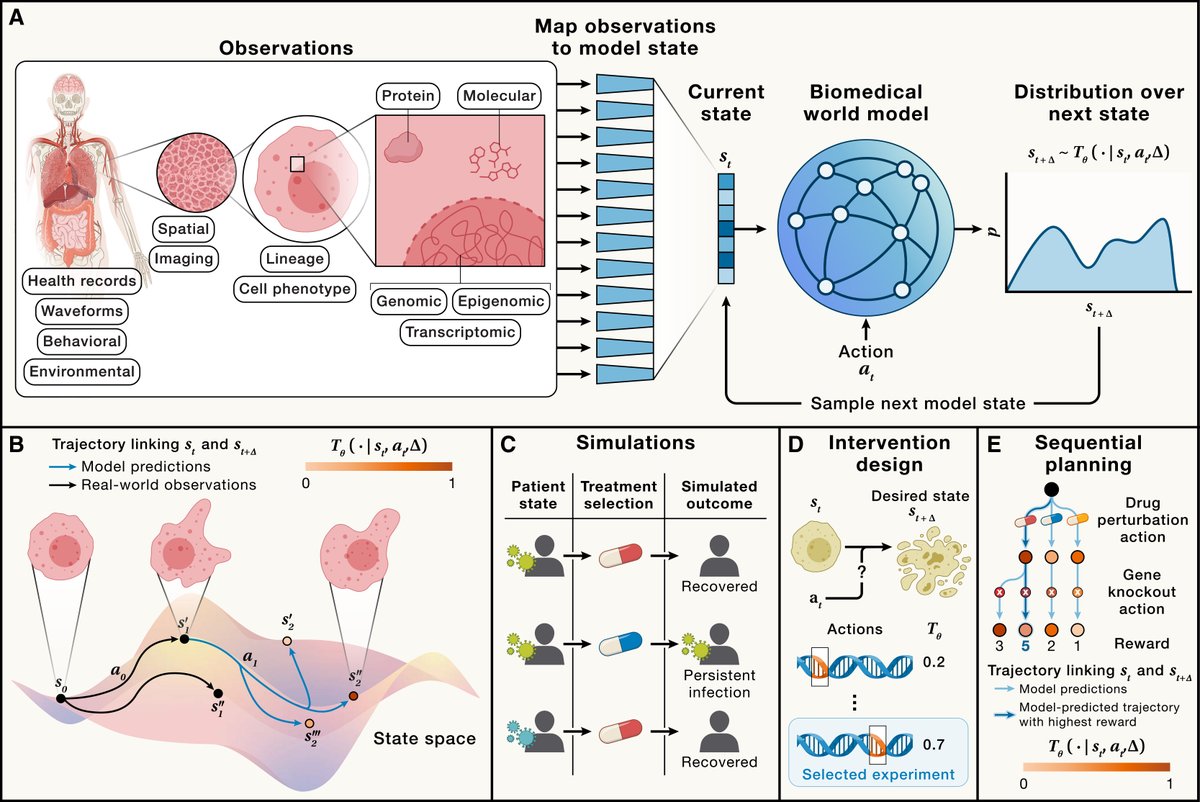
Simulating the consequences of an experiment before running it is a holy grail of AI for biology. How can we get there?
Our new paper, “World models for biomedicine,” which I led together with @njwfish, is out now in @CellCellPress’s special issue on AI in biology. We explore how biomedical world models could help scientists navigate the enormous space of possible biological interventions. In principle, they could:
🧪 Simulate how biological systems respond to interventions never previously tested
🎯 Search for interventions that drive cells, tissues, or patients toward desired states
🧭 Plan experimental campaigns over long time horizons
🤖 Power autonomous, closed-loop AI scientists
However, realizing this vision requires much more than calling a model a “world model.” What exactly defines a biomedical world model, and what capabilities distinguish it from related models? Where do today’s models already show promise, and where do they fall short? What new data and architectures are needed? What evaluations would demonstrate that a world model works?
We tackle these and other questions in this latest paper from @marinkazitnik's lab: https://t.co/musHiEcHMp
More below 🧵👇🏽 1/8